
Virtual Patching Myths: What It Actually Fixes and Breaks
Virtual patching intercepts traffic at the network edge to block exploits, but it does not remove the underlying code flaw or change the application logic.
Virtual patching is a network-level shield, not a code fix. It stops known attack patterns from reaching your servers, buying time for real remediation. It fails against new zero-day methods, internal threats, and complex business logic errors that look like normal traffic.
Misreading: Virtual patching fixes the vulnerability
Correct reading: Virtual patching never removes the flaw from your software. It places a filter between the internet and your application to drop malicious requests before they execute. The vulnerable code remains active and reachable by anyone who bypasses the filter. You must still apply the vendor’s official patch to eliminate the risk permanently.
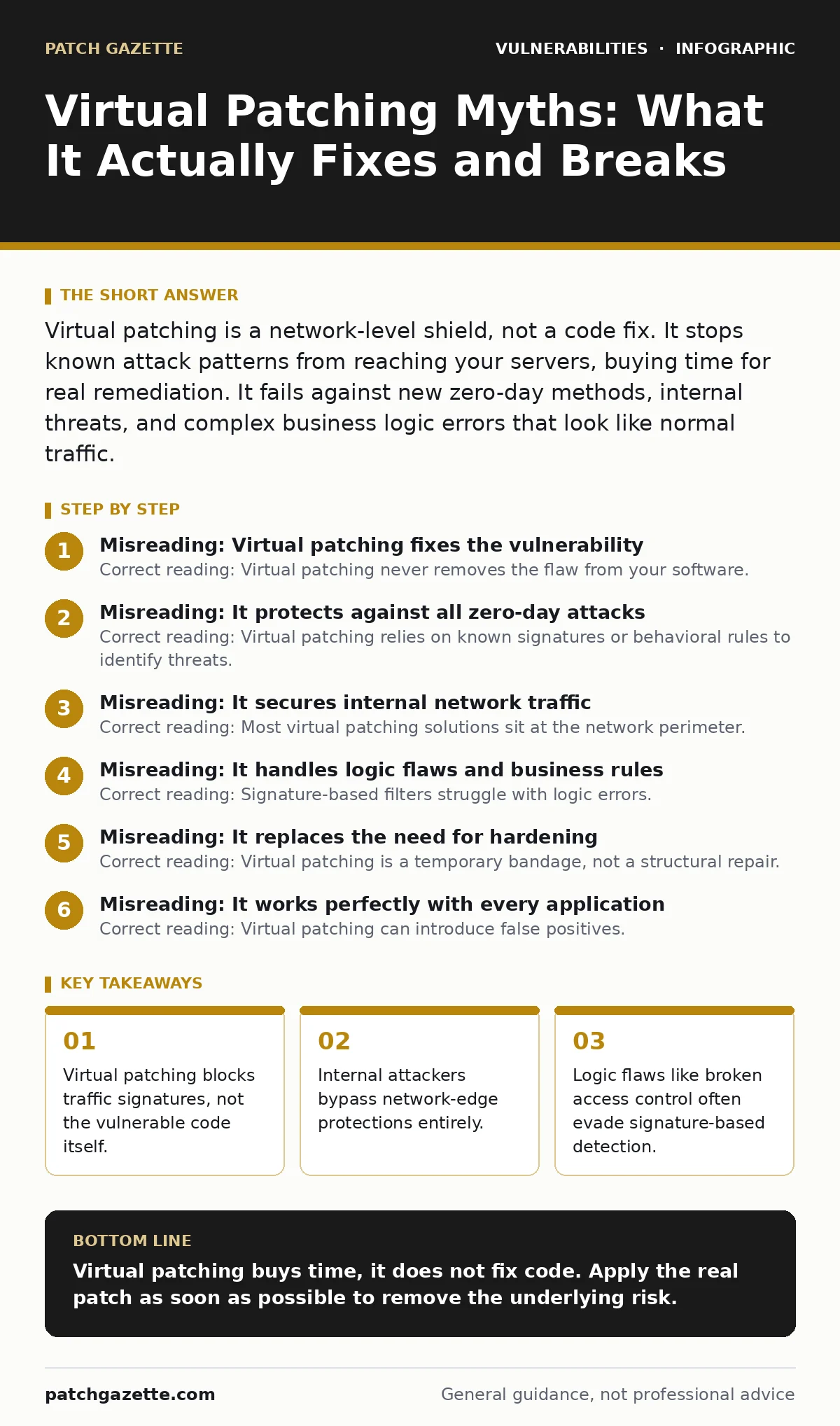
Misreading: It protects against all zero-day attacks
Correct reading: Virtual patching relies on known signatures or behavioral rules to identify threats. It cannot block an attack method it has never seen. If a researcher discovers a novel exploit that does not match existing patterns, the virtual patch will allow the traffic through. You need layered defenses, including output encoding and parameterized queries, to catch unknown threats.
Misreading: It secures internal network traffic
Correct reading: Most virtual patching solutions sit at the network perimeter. They inspect incoming requests from the internet. They do not monitor traffic moving between servers inside your data center. An attacker who compromises one internal server can move laterally to others without triggering perimeter rules. Internal segmentation and strict identity controls are required for east-west traffic.
Misreading: It handles logic flaws and business rules
Correct reading: Signature-based filters struggle with logic errors. They look for specific byte sequences or malformed inputs. They cannot easily distinguish between a legitimate user accessing a restricted page and an attacker exploiting broken access control. If your application allows a user to view another user’s data due to a coding error, the traffic looks normal. You need application-level code reviews to fix these issues.
Misreading: It replaces the need for hardening
Correct reading: Virtual patching is a temporary bandage, not a structural repair. Relying on it alone increases your security technical debt. You accumulate unpatched systems that work only because the filter is active. If the filter fails, goes offline, or is misconfigured, all those systems become instantly vulnerable. Hardening a self-hosted GitLab server or other infrastructure requires removing unnecessary services and restricting permissions at the OS level.
Misreading: It works perfectly with every application
Correct reading: Virtual patching can introduce false positives. If your application uses unusual data formats or complex API structures, the filter might block legitimate users. This causes downtime and frustrates customers. Tuning the rules requires deep knowledge of your application’s normal behavior. You must test updates carefully to ensure the filter does not break critical business functions.
Misreading: It eliminates dependency risks
Correct reading: Virtual patching focuses on network traffic. It does not inspect the libraries your application imports. If your code depends on a library that suffers from dependency confusion attacks, the malicious package installs directly on your server. The virtual patch sees only the installation traffic, which looks like normal package manager activity. You must verify package sources and use signed artifacts.
Misreading: It provides complete visibility into attacks
Correct reading: Virtual patching logs blocked requests. It does not show successful attacks that slip through. It also does not reveal the context of the attack. You see a blocked SQL injection attempt, but you do not know if the attacker tried other methods. You need application performance monitoring and intrusion detection systems to get a full picture of your security posture.
Misreading: It scales automatically with cloud services
Correct reading: Cloud environments change rapidly. New instances spin up and down. Virtual patching rules must update to cover these changes. If your cloud configuration drifts, the protection may not apply to new resources. You need automated configuration management to ensure every new service inherits the correct security policies. Manual updates will fail at scale.
Misreading: It is a substitute for security training
Correct reading: Virtual patching stops technical exploits. It does not stop social engineering. If an employee gives away credentials, the attacker gains legitimate access. The virtual patch allows this traffic because it looks like a real user logging in. You need ongoing security awareness training to teach staff how to recognize phishing and other social attacks.
Misreading: It works with encrypted traffic without inspection
Correct reading: Most virtual patching solutions need to decrypt traffic to inspect it. If you use end-to-end encryption that the patching system cannot decrypt, it cannot see the payload. It can only block based on metadata like IP addresses. This leaves the actual content unchecked. You must balance privacy with security by decrypting traffic at the edge for inspection.
Misreading: It handles all CWE weakness categories
Correct reading: Virtual patching is good at stopping injection flaws. It is less effective against other CWE weakness categories. For example, it cannot easily stop an application from leaking sensitive data in error messages. It cannot prevent a server from running with excessive privileges. You need a holistic approach that addresses coding standards and system configuration.
Misreading: It requires no maintenance
Correct reading: Virtual patching rules degrade over time. Attackers adapt their methods. Old rules may become irrelevant or cause performance issues. You must update rules regularly to reflect current threats. You must also review rules to remove obsolete ones. Neglecting maintenance leads to a bloated rule set that slows down your network and misses new attacks.
Misreading: It is only for web applications
Correct reading: Virtual patching can protect other protocols. It can inspect database queries, API calls, and file transfers. However, the rules for these protocols are different. You need specific signatures for each protocol you protect. Applying web-only rules to a database connection will not stop SQL injection attempts. You must tailor your protection to each service type.
Key takeaways
- Virtual patching blocks traffic signatures, not the vulnerable code itself.
- Internal attackers bypass network-edge protections entirely.
- Logic flaws like broken access control often evade signature-based detection.
- Over-reliance on virtual patches creates hidden security technical debt.
Virtual patching buys time, it does not fix code. Apply the real patch as soon as possible to remove the underlying risk.
Frequently asked questions
Does virtual patching work with API gateways?
Yes, virtual patching can integrate with API gateways to inspect and filter API requests before they reach your backend services.
Can virtual patching stop brute force attacks?
It can help by blocking rapid login attempts, but rate limiting at the application level is more effective for stopping credential stuffing.
Is virtual patching expensive to maintain?
It requires ongoing tuning and rule updates, which consumes security team time. The cost is in labor, not just software licenses.
Does virtual patching protect against insider threats?
No, virtual patching primarily protects against external network attacks. It does not stop malicious actions from authorized internal users.
How this guide was produced: written by the Patch Gazette editorial team with AI assistance, checked against the public references listed below, and reviewed when the facts change. See our editorial policy or report an error.