
Endpoint Protection Misconceptions: What Your Security Stack Actually Does
Endpoint protection agents do not prevent every attack; they detect anomalies and enforce local policy, leaving network-level threats and social engineering entirely outside their scope.
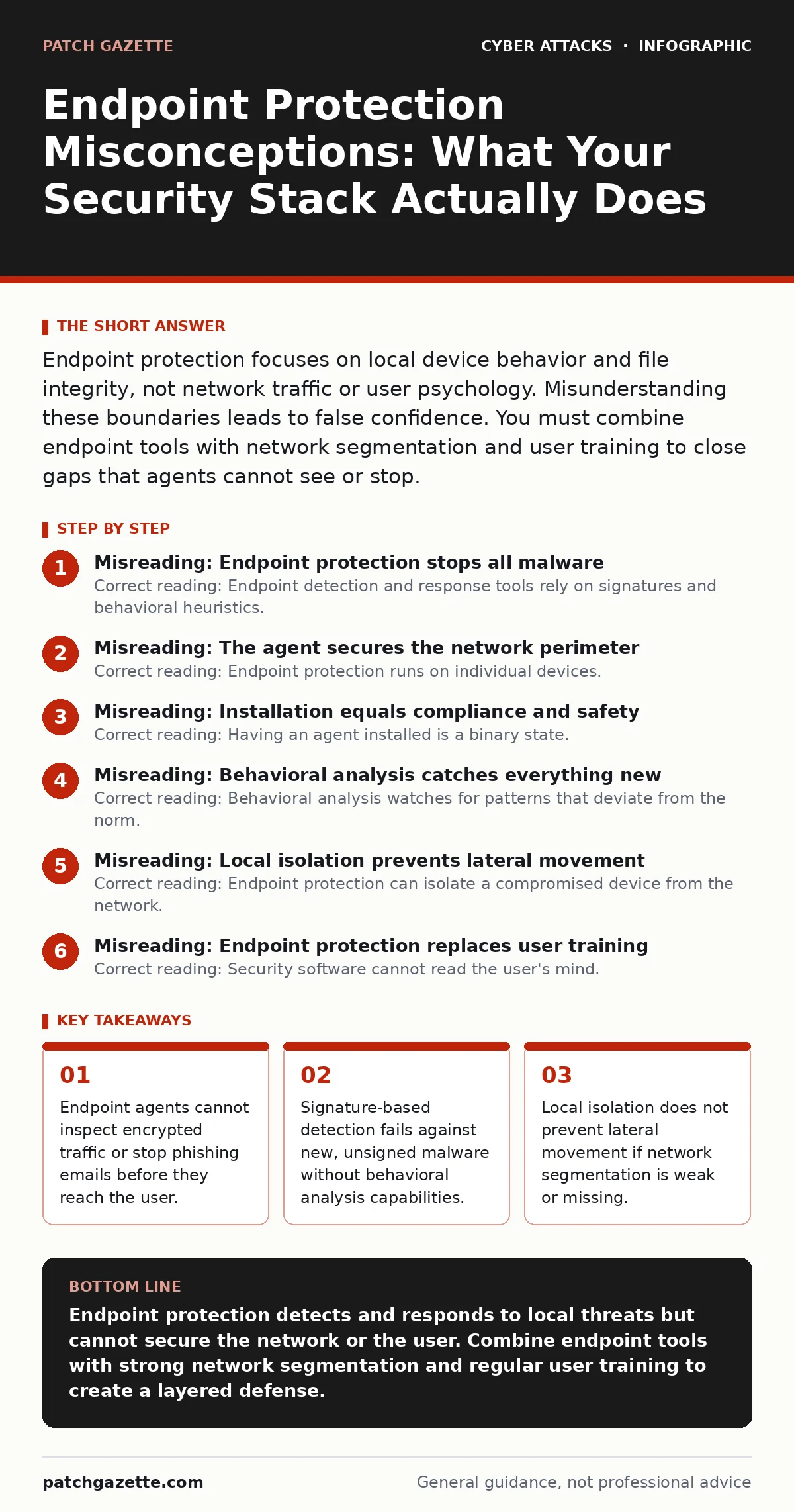
Endpoint protection focuses on local device behavior and file integrity, not network traffic or user psychology. Misunderstanding these boundaries leads to false confidence. You must combine endpoint tools with network segmentation and user training to close gaps that agents cannot see or stop.
Misreading: Endpoint protection stops all malware
Correct reading: Endpoint detection and response tools rely on signatures and behavioral heuristics. They identify known threats by matching file hashes against databases. They identify unknown threats by watching for suspicious system calls. This approach misses custom, unsigned code that behaves like legitimate software. A new virus with no prior record may execute fully before the agent flags it.
Imagine a developer compiles a custom script to automate a task. The script modifies registry keys and creates new processes. The endpoint agent sees standard system activity. It does not block the script because the behavior matches authorized administrative actions. The malware runs silently until it exfiltrates data.
Endpoint protection reduces the chance of infection. It does not guarantee prevention. You must assume some malicious code will execute. The goal shifts from blocking every byte to detecting the anomaly quickly and limiting its impact.
Misreading: The agent secures the network perimeter
Correct reading: Endpoint protection runs on individual devices. It has no visibility into the broader network infrastructure. It cannot stop Distributed Denial of Service attacks or DNS amplification attacks. It cannot prevent BGP hijacking that redirects traffic to malicious servers. These threats occur at the network layer, far above the operating system kernel where the agent lives.
Suppose an attacker spoofs a Domain Name System response. Users connect to a fake server thinking it is legitimate. The endpoint agent sees an HTTPS connection to a valid certificate. It trusts the transport layer security. The agent does not know the IP address is fraudulent. The breach happens before the endpoint sees the payload.
You need separate controls for network integrity. Endpoint tools protect the host. Network firewalls and intrusion prevention systems protect the path. Relying on endpoint agents for perimeter defense creates a blind spot. Attackers exploit this gap by bypassing local checks entirely.
Misreading: Installation equals compliance and safety
Correct reading: Having an agent installed is a binary state. Security is a continuous spectrum. Many organizations treat the installation checkbox as the final step. They ignore configuration audits. They ignore policy updates. An agent with default settings may allow known vulnerable applications to run. It may log events to a disk that fills up and stops recording.
Consider a server running an outdated database. The endpoint agent is installed and active. The database has a known vulnerability. The agent does not patch the database. It only monitors the process. An attacker exploits the database flaw. The agent records the connection but does not stop it. The system is compromised despite being "protected."
Regular configuration reviews are necessary. You must verify that the agent blocks the specific threats relevant to your environment. Check that logging is functional and data is being sent to your security information and event management system. Installation is the start of the job, not the end.
Misreading: Behavioral analysis catches everything new
Correct reading: Behavioral analysis watches for patterns that deviate from the norm. It looks for rapid file encryption or unusual network connections. This method generates false positives. Legitimate software often behaves strangely. Antivirus software, backup tools, and system updates trigger alerts. Analysts spend hours investigating benign activity.
Suppose a user runs a legitimate data compression tool. The tool reads many files and writes new archives. The endpoint agent sees high disk I/O and many file changes. It flags this as potential ransomware. The security team isolates the machine. Work stops. The threat was non-existent. The cost of the false positive exceeds the risk of the missed threat.
Tuning behavioral engines requires deep knowledge of your environment. You must define what "normal" looks like for every major application. Without this baseline, the tool becomes a nuisance. It alerts on everything, causing alert fatigue. Analysts miss real threats in the noise.
Misreading: Local isolation prevents lateral movement
Correct reading: Endpoint protection can isolate a compromised device from the network. This containment stops the malware from spreading via direct connections. It does not stop an attacker who has already moved to another device. If the network is flat, with no segmentation, the attacker uses legitimate credentials to jump to other systems. The isolated endpoint is just one lost node.
Imagine an attacker steals a service account password. They use this account to access a file server. The endpoint agent on the file server sees a valid login. It does not block the access. The attacker copies sensitive data. The initial infection point is isolated, but the data is already gone.
Network segmentation limits the blast radius. Conditional access policies ensure that only authorized users connect to sensitive resources. Endpoint isolation is a reactive measure. It works best when combined with strict network architecture. You cannot isolate your way out of a poorly designed network.
See also: Antivirus Software Mistakes That Leave Systems Exposed · Stop Keyloggers: Detection, Prevention, and What Actually Works
Misreading: Endpoint protection replaces user training
Correct reading: Security software cannot read the user's mind. It cannot distinguish between a legitimate request for credentials and a QR code phishing attempt. It cannot detect social engineering tactics that manipulate human psychology. The user remains the primary interface for many attacks. Technical controls fail when the user willingly hands over access.
Suppose an employee receives a message from the CEO. The message asks for urgent financial approval. The request looks legitimate. The employee clicks the link. The endpoint agent sees a web request to a known domain. It does not block the click. The user enters their credentials on a fake site. The account is compromised.
Training teaches users to verify requests through secondary channels. It builds skepticism. Endpoint protection handles the technical execution. It does not handle the human decision. You need both. Ignoring the human factor leaves a massive gap that no amount of software can fill.
Key takeaways
- Endpoint agents cannot inspect encrypted traffic or stop phishing emails before they reach the user.
- Signature-based detection fails against new, unsigned malware without behavioral analysis capabilities.
- Local isolation does not prevent lateral movement if network segmentation is weak or missing.
- Compliance checkboxes do not equal security; an agent can be installed but misconfigured or ignored.
Endpoint protection detects and responds to local threats but cannot secure the network or the user. Combine endpoint tools with strong network segmentation and regular user training to create a layered defense.
Frequently asked questions
Does endpoint protection stop ransomware?
It can detect and block known ransomware variants. It may also stop new ransomware if its behavior matches malicious patterns. It cannot stop ransomware if the user manually executes it and the behavior looks normal.
How do I know if my endpoint agent is working?
Check the agent status in your management console. Verify that logs are being sent to your monitoring system. Run a test signature to ensure detection works. Review recent alerts to see if they are being investigated.
Can endpoint protection protect against replay attacks?
No. Replay attacks involve re-sending valid data packets. Endpoint agents do not inspect network packet sequencing. You need network-level controls and encryption with nonces to prevent replay attacks.
Is endpoint protection enough for remote work?
No. Remote work increases exposure to untrusted networks. You need virtual private networks and multi-factor authentication alongside endpoint protection. Endpoint tools alone cannot secure the connection path or verify user identity.
How this guide was produced: written by the Patch Gazette editorial team with AI assistance, checked against the public references listed below, and reviewed when the facts change. See our editorial policy or report an error.