
CVSS Score Explained: How to Read Risk Metrics and Prioritize Fixes
The CVSS score explains base risk but hides environmental context, meaning a low score can still halt your business if it hits a critical internet-facing service.
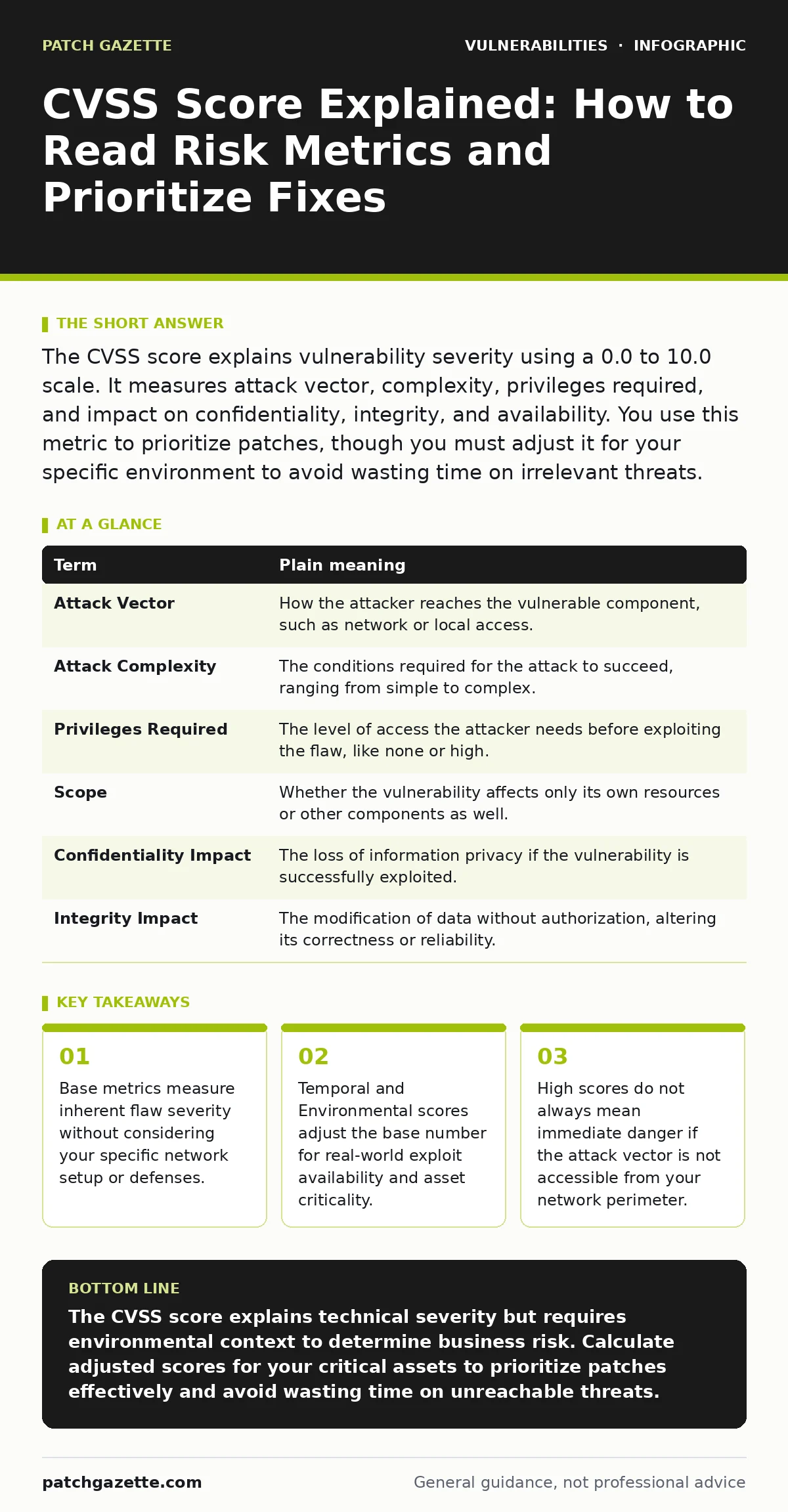
The CVSS score explains vulnerability severity using a 0.0 to 10.0 scale. It measures attack vector, complexity, privileges required, and impact on confidentiality, integrity, and availability. You use this metric to prioritize patches, though you must adjust it for your specific environment to avoid wasting time on irrelevant threats.
What Is the CVSS Score Explained
The CVSS score explains how dangerous a software flaw is by assigning it a numerical value. Common Vulnerability Scoring System (CVSS) is the open standard used by researchers and vendors to rate severity. It provides a single number that helps you compare different vulnerabilities. This system removes ambiguity from security reports. You receive a score between 0.0 and 10.0. The higher the number, the more severe the potential impact. This metric allows you to sort hundreds of alerts by urgency. It does not measure the likelihood of an attack occurring in your specific environment. It measures the theoretical worst-case scenario for that specific code defect.
The House Intrusion Analogy
Imagine a house represents your network. A CVSS score measures how easy it is for an intruder to enter and what they can steal. A broken window on the ground floor is a high score. The intruder needs no special tools and can enter immediately. A locked steel door on the second floor is a lower score. The intruder needs a ladder and a key. The score reflects the difficulty of entry and the value of the contents. If the house is empty, the impact is low. If it holds gold, the impact is high. This analogy carries through the entire scoring mechanism. You must look at both the entry method and the value inside.
Understanding the Three Metric Groups
CVSS divides its calculations into three distinct groups. Base metrics are static and never change for a specific vulnerability. They describe the inherent characteristics of the flaw itself. Temporal metrics change over time. They reflect the maturity of the exploit code and the availability of remediation. Environmental metrics are specific to your organization. They allow you to adjust the score based on your network layout and asset values. Most public databases only show the Base score. You must calculate the Environmental score to see the true risk to your business. Ignoring the temporal aspect means you might panic over unexploited flaws while ignoring active threats.
Mini Glossary of CVSS Terms
| Term | Plain meaning |
|---|---|
| Attack Vector | How the attacker reaches the vulnerable component, such as network or local access. |
| Attack Complexity | The conditions required for the attack to succeed, ranging from simple to complex. |
| Privileges Required | The level of access the attacker needs before exploiting the flaw, like none or high. |
| Scope | Whether the vulnerability affects only its own resources or other components as well. |
| Confidentiality Impact | The loss of information privacy if the vulnerability is successfully exploited. |
| Integrity Impact | The modification of data without authorization, altering its correctness or reliability. |
Why Base Scores Can Mislead
A high base score does not always mean you must patch immediately. Consider a critical flaw in a legacy system that sits behind a firewall with no external access. The base score might be 9.8. The environmental score might drop to 0.0 because the attack vector is unreachable. Conversely, a moderate score on an internet-facing web server poses an immediate threat.
The attack vector is network-based and the scope is wide. You must filter base scores through your network topology. Failing to do so leads to alert fatigue. You waste resources fixing low-risk issues while ignoring high-risk exposures. This is why virtual patching can be a smart interim measure for exposed services.
See also: Software Updates Best Practices: Secure Patching Without Downtime
Practical Steps to Improve Prioritization
- Collect all base scores from your vulnerability scanner and sort them from highest to lowest.
- Map each vulnerability to its host and determine if the host is internet-facing or internal-only.
- Adjust the score manually or via tooling to reflect the actual exposure and asset value.
This process turns a raw list into an actionable plan. You stop treating all vulnerabilities as equal. You focus on the ones that attackers can actually reach. This approach aligns security efforts with business risk. It prevents the common mistake of chasing perfect scores on irrelevant systems.
Hidden Costs of Score Dependency
Relying solely on CVSS scores creates a false sense of security. The score does not measure the sophistication of the attacker. It does not measure the value of the data to a specific criminal group. A low-score vulnerability might be the only entry point into a tightly secured network. Attackers often use chains of low-severity flaws to gain access.
This is similar to privilege escalation vulnerabilities where small steps lead to total control. You must look at the combination of flaws, not just individual scores. Additionally, scores do not account for broken access control issues that might bypass authentication entirely. These logical flaws often have lower technical complexity scores but high business impact.
Integrating Scores with Defense Strategies
CVSS scores should inform your patching strategy, not dictate it. Combine scores with threat intelligence and asset criticality. If a high-score flaw has no known exploit, you can delay patching for scheduled maintenance. If a moderate-score flaw has active exploitation, you must respond immediately. Use parameterized queries to prevent database injection flaws that often score highly due to data exposure.
Ensure output encoding is in place to mitigate cross-site scripting risks. These code-level fixes reduce the impact metric. They lower the effective score by reducing the potential damage. Remember that exposed admin panels often have high scores because they offer direct access. Secure these interfaces rigorously.
Key takeaways
- Base metrics measure inherent flaw severity without considering your specific network setup or defenses.
- Temporal and Environmental scores adjust the base number for real-world exploit availability and asset criticality.
- High scores do not always mean immediate danger if the attack vector is not accessible from your network perimeter.
The CVSS score explains technical severity but requires environmental context to determine business risk. Calculate adjusted scores for your critical assets to prioritize patches effectively and avoid wasting time on unreachable threats.
Frequently asked questions
Does a higher CVSS score mean a vulnerability is more likely to be exploited?
No. The score measures potential impact and ease of exploitation, not the actual likelihood. A high score on an internal system may never be exploited, while a moderate score on a public server might be attacked daily.
How often do CVSS scores change for known vulnerabilities?
Base scores rarely change. Temporal scores update as exploit code becomes available or patches are released. Environmental scores change whenever your network configuration or asset values change.
Can I trust the CVSS scores provided by vendors?
Vendor scores are often biased toward higher numbers to encourage patching. Independent researchers may assign different scores. Always verify the score against multiple sources and calculate your own environmental score.
What is the difference between CVSS v3 and v4?
CVSS v4 adds more granularity and support for new attack types like supply chain attacks. It provides a more detailed view of security requirements and remediation efforts, but v3 remains the most widely used standard.
How this guide was produced: written by the Patch Gazette editorial team with AI assistance, checked against the public references listed below, and reviewed when the facts change. See our editorial policy or report an error.