
Output Encoding Errors: 6 Misconceptions Blocking Secure Code
Output encoding fails when developers treat it as a generic filter rather than a context-specific translation layer for data boundaries.
Output encoding prevents injection by translating data into the syntax of the target context. It is not sanitization. You must encode for HTML, JavaScript, CSS, and URL contexts separately. Context shifts break protection. Use context-aware libraries, not manual string replacement, to ensure data remains inert in the renderer.
Misreading: Output encoding is the same as input validation
Correct reading: Input validation checks if data meets business rules. Output encoding translates data so the interpreter treats it as text, not code. Validation rejects bad input. Encoding renders all input safely. You cannot rely on validation alone because business rules change and edge cases emerge. Encoding ensures that even valid data, when placed in a dynamic template, does not execute unintended commands. Validation reduces the attack surface. Encoding neutralizes the remaining risk. They serve different architectural layers.
Imagine a user submits a username containing special characters. Validation might reject it if it does not match a strict alphanumeric pattern. If the application allows symbols, validation passes. Without encoding, that symbol could break the HTML structure. Encoding converts the symbol to its safe equivalent. The data remains visible but inert. This separation of concerns is fundamental to secure architecture.
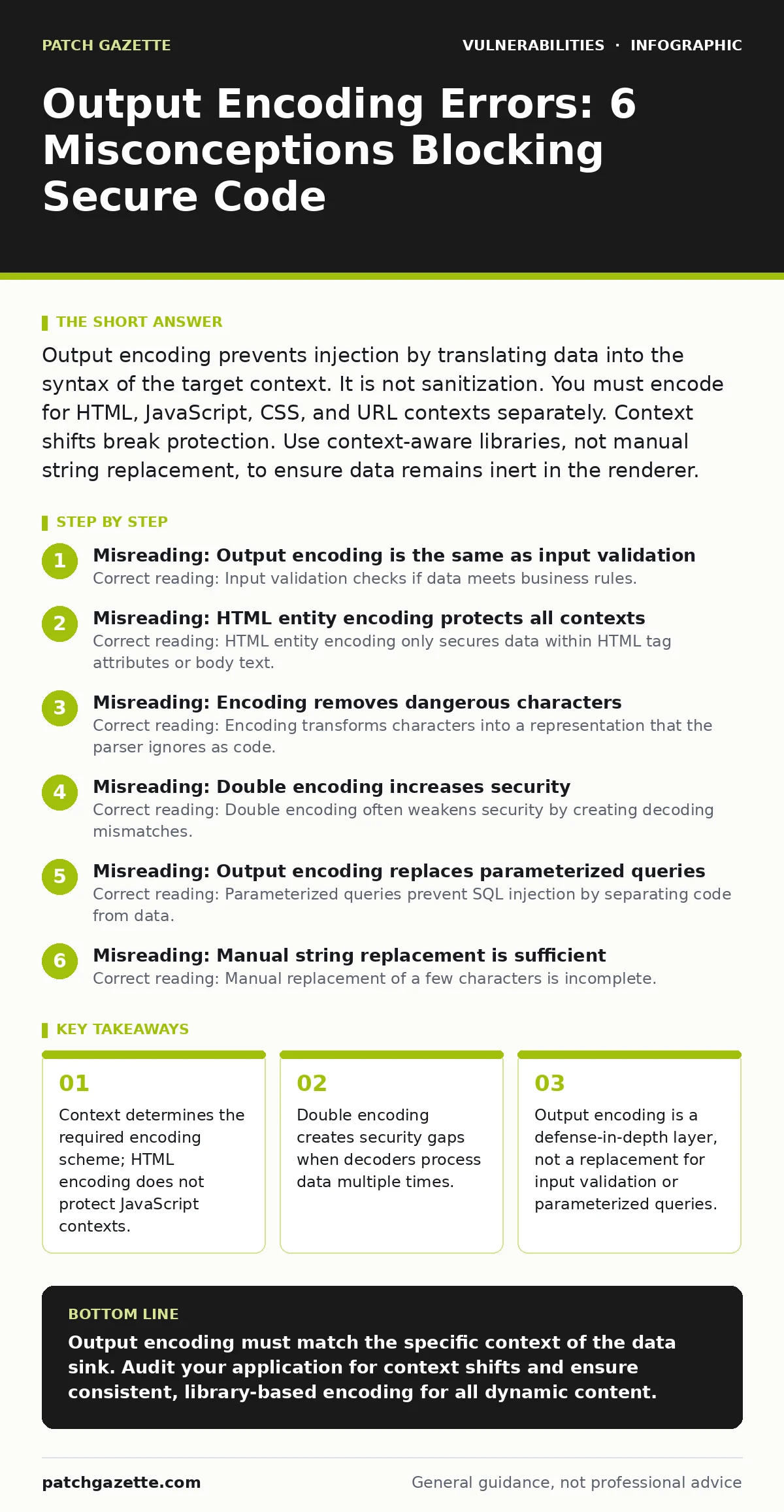
Misreading: HTML entity encoding protects all contexts
Correct reading: HTML entity encoding only secures data within HTML tag attributes or body text. It fails in JavaScript, CSS, and URL contexts. Each context has a different parser with different escape sequences. A character safe in HTML might execute code in JavaScript. You must identify the sink where the data is rendered. Then you must apply the encoding scheme specific to that sink. Using a single HTML encoder for all outputs leaves multiple injection vectors open. Context awareness is mandatory.
Consider a variable inserted into a JavaScript block. HTML encoding converts quotes to entities. The JavaScript parser still sees the quote as a string delimiter. It executes the content inside. You must use JavaScript-specific encoding. This often involves escaping backslashes and quotes differently than HTML does. The mechanism changes based on the interpreter. One encoder does not fit all sinks.
Misreading: Encoding removes dangerous characters
Correct reading: Encoding transforms characters into a representation that the parser ignores as code. It does not delete them. Sanitization removes content. Encoding preserves data while changing its syntax. If you delete characters, you alter user data. This causes functionality breaks. Encoding ensures the browser displays the original intent without executing it. The character set remains intact. The interpretation changes. This distinction matters for data integrity. You protect the application logic without corrupting the user’s input.
Suppose a user enters a smiley face emoji. Sanitization might strip it. Encoding converts it to a safe HTML entity or Unicode escape. The emoji displays correctly. The browser does not attempt to execute it as a script. The data survives the round-trip. This preservation is why encoding is preferred over blacklisting characters. Blacklists are incomplete. Encoding is exhaustive for the target context.
Misreading: Double encoding increases security
Correct reading: Double encoding often weakens security by creating decoding mismatches. If a framework decodes data once, a double-encoded string becomes single-encoded. The remaining encoded characters might then be interpreted as code. This occurs when different components use different decoding rules. One layer decodes HTML entities. The sequence matters. You must understand the decoding pipeline. Applying encoding twice can trigger unintended execution paths. Consistency in encoding and decoding is critical.
Imagine a value encoded twice for HTML. The first layer encodes it. The second layer encodes the result. The framework decodes the outer layer. The inner layer remains encoded. If that inner layer matches a script tag syntax, it executes. This race condition between encoding and decoding layers is subtle. It requires mapping the entire data flow. You must ensure only one encoding step occurs before the final render.
Misreading: Output encoding replaces parameterized queries
Correct reading: Parameterized queries prevent SQL injection by separating code from data. Output encoding prevents client-side injection like XSS. They address different interpreters. SQL injection targets the database. XSS targets the browser. You need both. Relying on encoding for SQL data leaves the database vulnerable. Relying on parameterized queries for HTML output leaves the browser vulnerable. Each defense handles a specific boundary. They do not overlap. You must implement defense-in-depth strategies that cover all data sinks.
Suppose you use parameterized queries for database storage. The data is safe in the database. When you retrieve it and display it on a webpage, you must encode it again. The database safety does not extend to the browser. The context changes from SQL to HTML. You must apply the appropriate encoding at the point of output. Ignoring this second step exposes users to injection attacks. The protection must follow the data to its final destination.
Misreading: Manual string replacement is sufficient
Correct reading: Manual replacement of a few characters is incomplete. Attackers use many encoding schemes and obfuscation techniques. Custom filters miss edge cases. Standard libraries handle the full character set and context rules. They update with new threats. Manual code stagnates. You introduce bugs by writing your own encoders. Use established, well-tested libraries. They implement the correct escape sequences for each context. They handle Unicode edge cases. They reduce the cognitive load on developers. Trust the standard, not the custom script.
Consider trying to escape quotes manually. You might miss backslashes or newlines. An attacker uses a different quote type. Your filter fails. A library handles all quote variants. It also handles context shifts. It ensures consistency. This reduces the chance of human error. Security libraries are maintained by experts. They cover the breadth of attack vectors. You should never write your own encoding logic for production systems.
Misreading: Encoding only matters for user input
Correct reading: Any dynamic data is a potential injection vector. This includes database values, API responses, and system-generated IDs. If data changes, it must be encoded. Static strings are safe. Dynamic content is not. Assume all data is hostile. Encode everything that reaches the browser. This includes error messages and debug data. Do not trust the source of the data. Trust the context where it is rendered. Consistent encoding policies prevent accidental exposure.
Imagine an error message containing a file path. The path is generated by the system. It is not user input. If displayed without encoding, it might break the HTML layout. It could also expose sensitive directory structures. Encoding ensures the path is displayed as text. It prevents layout breakage. It hides structural details from casual inspection. All dynamic content requires treatment. The source does not determine the risk. The sink does.
Misreading: Encoding fixes poor architecture
Correct reading: Encoding is a mitigation, not a design principle. Poor architecture relies on too many dynamic contexts. It mixes data and code. Encoding patches these flaws. It does not fix them. Good architecture minimizes dynamic content. It uses static templates where possible. It separates data from logic. Encoding handles the remaining dynamic parts. You cannot encode your way out of bad design. Simplify the application structure. Reduce the number of sinks. Use encoding as a final safety net.
Suppose your application injects user data into dozens of JavaScript variables. Encoding each one is error-prone. A better design uses a single data binding mechanism. This mechanism handles encoding automatically. It reduces the attack surface. It simplifies maintenance. You should aim for fewer injection points. Encoding is necessary but not sufficient. Good design reduces the need for complex encoding logic.
Key takeaways
- Context determines the required encoding scheme; HTML encoding does not protect JavaScript contexts.
- Double encoding creates security gaps when decoders process data multiple times.
- Output encoding is a defense-in-depth layer, not a replacement for input validation or parameterized queries.
Output encoding must match the specific context of the data sink. Audit your application for context shifts and ensure consistent, library-based encoding for all dynamic content.
Frequently asked questions
Does output encoding prevent SQL injection?
No. Output encoding protects client-side interpreters like browsers. SQL injection requires parameterized queries or stored procedures to separate data from code at the database level.
How do I know which encoder to use?
Identify the sink. If the data goes into HTML body text, use HTML entity encoding. If it goes into a JavaScript variable, use JavaScript encoding. If it goes into a URL, use URL encoding.
Can I use input validation instead of output encoding?
No. Validation checks business rules. Encoding ensures safe rendering. Validation can be bypassed or miss edge cases. Encoding is the final defense against injection at the point of display.
What is context-aware encoding?
Context-aware encoding applies the correct escape sequences based on where the data is rendered. It recognizes HTML, JavaScript, CSS, and URL contexts and applies the appropriate transformation for each.
How this guide was produced: written by the Patch Gazette editorial team with AI assistance, checked against the public references listed below, and reviewed when the facts change. See our editorial policy or report an error.