
APIs in Healthcare: Secure Data Exchange Without Breaches
Healthcare APIs enable machine-to-machine data sharing, but misconfigured permissions often expose patient records more severely than direct network attacks.
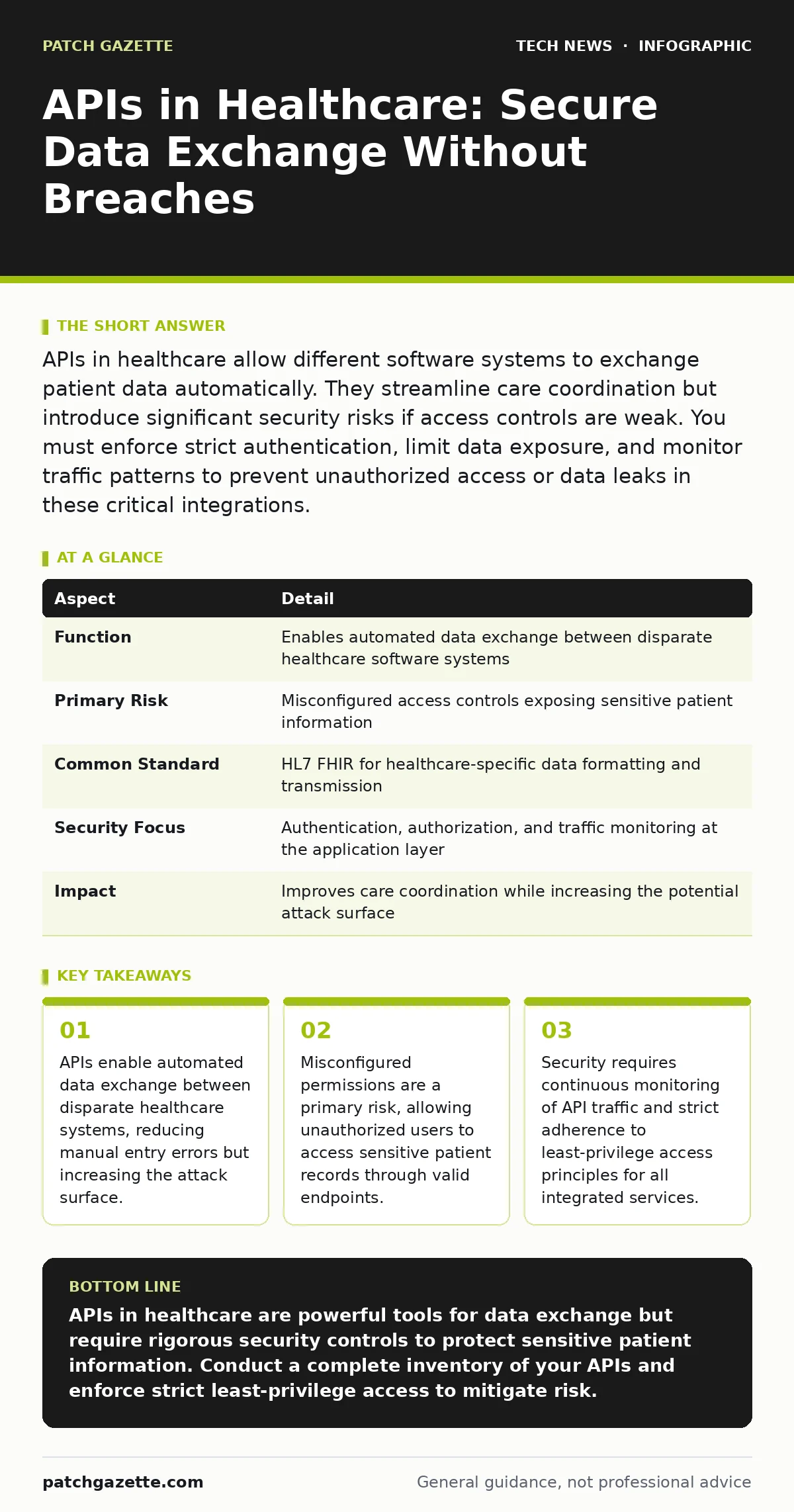
APIs in healthcare allow different software systems to exchange patient data automatically. They streamline care coordination but introduce significant security risks if access controls are weak. You must enforce strict authentication, limit data exposure, and monitor traffic patterns to prevent unauthorized access or data leaks in these critical integrations.
Understanding APIs in Healthcare
Application Programming Interfaces, or APIs, act as digital messengers that allow separate software applications to communicate. In healthcare, these interfaces let electronic health records, billing systems, and lab results talk to each other without human intervention. You use APIs in healthcare when a primary care physician’s system automatically pulls recent blood work from a specialist’s database. This automation speeds up diagnosis and reduces administrative burden. The mechanism relies on standardized requests and responses, typically using HTTP protocols.
The primary benefit is interoperability. Different vendors build systems that rarely speak the same language natively. APIs provide a common translation layer. This allows a hospital to integrate new diagnostic tools without replacing its entire record-keeping infrastructure. However, this connectivity creates new entry points for attackers. Every exposed API endpoint is a potential door into your network. You must treat these interfaces with the same scrutiny as your perimeter firewall.
| Aspect | Detail |
|---|---|
| Function | Enables automated data exchange between disparate healthcare software systems |
| Primary Risk | Misconfigured access controls exposing sensitive patient information |
| Common Standard | HL7 FHIR for healthcare-specific data formatting and transmission |
| Security Focus | Authentication, authorization, and traffic monitoring at the application layer |
| Impact | Improves care coordination while increasing the potential attack surface |
How API Security Works in Practice
Security for APIs differs from traditional network security. Firewalls inspect packets at the network layer, but APIs operate at the application layer. You need to validate every request, not just the connection. Authentication confirms the identity of the requester, while authorization determines what that identity is allowed to see. In healthcare, this distinction is critical. A billing system may need to authenticate to access a patient’s name but should not be authorized to view clinical notes.
APIs often use tokens for authentication. These tokens act as temporary keys, granting access without exposing long-term passwords. You must ensure these tokens expire quickly and are transmitted over encrypted channels. Encryption prevents eavesdroppers from reading the data in transit. Even if an attacker intercepts the request, the payload remains unreadable without the decryption key. This aligns with broader concepts found in digital certificates, which verify identities and encrypt connections.
You must also implement rate limiting. This prevents a single user or system from overwhelming the API with too many requests. Without limits, attackers can exhaust your server resources or brute-force their way into sensitive data. Rate limiting acts as a circuit breaker, stopping automated attacks before they cause damage. It does not stop a sophisticated, slow-moving attack, but it raises the barrier to entry.
Who Is Affected by API Vulnerabilities
Every organization that handles digital health data is affected. Hospitals, clinics, insurance providers, and pharmaceutical companies all rely on APIs to move information. The impact extends to patients whose privacy depends on these systems. A breach in one organization’s API can compromise data across the entire ecosystem. If a lab system is compromised, the hospital that ordered the test also faces reputational and legal risks.
Patients suffer the most direct harm. Identity theft, medical fraud, and blackmail are real consequences of exposed health records. Health data is particularly valuable on the black market because it is difficult for victims to change. You cannot reset your medical history like you reset a password. Organizations face regulatory fines and loss of trust. The cost of remediation often exceeds the cost of prevention.
Developers and IT managers bear the operational burden. They must design, test, and monitor these interfaces continuously. A single misconfigured endpoint can undo years of security investment. The responsibility is shared, but the liability often falls on the organization that holds the data. You must understand who owns the data at each step of the API chain.
What to Do About API Risks
Start by inventorying all active APIs. You cannot secure what you do not know exists. Shadow APIs, created by developers for testing and left in production, are a common blind spot. Use automated tools to discover these hidden endpoints. Document every API, its purpose, and its data flow. This inventory becomes the foundation for your security strategy.
Enforce strict access controls. Follow the principle of least privilege. Each API user should have only the permissions necessary for their function. Regularly review these permissions. Remove access for users who no longer need it. Implement multi-factor authentication for human users accessing API management consoles. For machine-to-machine communication, use client certificates or strong token-based authentication.
Monitor API traffic for anomalies. Establish a baseline of normal behavior. Look for unusual patterns, such as requests from new geographic locations or spikes in data volume. Automated monitoring tools can alert you to these deviations in real time. This allows you to respond before a breach occurs. You must also log all API interactions for audit purposes. These logs are essential for forensic analysis after an incident.
Common Mistakes in API Implementation
Many organizations treat APIs as an afterthought. They build the functionality first and add security later. This approach is flawed. Security must be integrated into the design phase. You cannot patch in robust security after the code is written. Developers must understand security requirements before they write a single line of code. This includes defining clear authentication and authorization rules.
Another frequent error is over-sharing data. APIs often return entire data objects, including fields the client does not need. This increases the risk of exposure. If an attacker gains access, they see more data than intended. You should design APIs to return only the specific fields requested by the client. This minimizes the damage if an endpoint is compromised. It also reduces bandwidth usage and improves performance.
Ignoring input validation is a critical mistake. APIs accept data from external sources. This data must be validated to ensure it matches expected formats. Failure to do so can lead to injection attacks, where malicious code is executed on the server. You must sanitize all inputs and reject anything that does not conform to strict schemas. This prevents many common web application attacks.
Integrating Related Security Controls
API security does not exist in a vacuum. It intersects with other security domains. For instance, software updates are vital for patching vulnerabilities in the API framework itself. Outdated libraries often contain known flaws that attackers can exploit. You must maintain a rigorous patch management process for all components involved in API development and hosting.
Network security also plays a role. Network address translation can hide the internal structure of your network, making it harder for attackers to map your API servers. However, it does not protect against application-layer attacks. You need both network and application defenses. Similarly, IP addresses are used to identify sources of requests. Monitoring unusual IP activity can help detect brute-force attempts or scanning.
Cookie and session management is another related area. If your API uses session-based authentication, you must manage cookies and sessions securely. Sessions should expire after a period of inactivity. Cookies should be marked as secure and http-only to prevent cross-site scripting attacks. Understanding these mechanisms helps you build a layered defense. You cannot rely on a single control to protect your APIs.
Building a Resilient API Strategy
A resilient API strategy is proactive, not reactive. You must anticipate how attackers might abuse your interfaces. This involves threat modeling, where you identify potential risks and design controls to mitigate them. Regular security testing, including penetration testing, helps find vulnerabilities before attackers do. Automated scanning tools can check for common misconfigurations continuously.
Collaboration between development and security teams is essential. Security cannot be a bottleneck that slows down innovation. Instead, it should be an enabler. By integrating security tools into the development pipeline, you catch issues early. This shift-left approach reduces the cost and effort of fixing vulnerabilities. It also fosters a culture of security awareness among developers.
Finally, educate your staff. Human error remains a significant risk. Developers, testers, and operators must understand API security best practices. Regular training keeps this knowledge fresh. As new threats emerge, your defenses must evolve. The goal is not perfect security, which is impossible, but resilience. You must be able to detect, respond to, and recover from incidents quickly. This minimizes the impact on your organization and your patients.
Key takeaways
- APIs enable automated data exchange between disparate healthcare systems, reducing manual entry errors but increasing the attack surface.
- Misconfigured permissions are a primary risk, allowing unauthorized users to access sensitive patient records through valid endpoints.
- Security requires continuous monitoring of API traffic and strict adherence to least-privilege access principles for all integrated services.
APIs in healthcare are powerful tools for data exchange but require rigorous security controls to protect sensitive patient information. Conduct a complete inventory of your APIs and enforce strict least-privilege access to mitigate risk.
Frequently asked questions
How do APIs in healthcare differ from standard web APIs?
Healthcare APIs handle highly sensitive personal data, requiring stricter compliance with regulations like HIPAA. They often use specialized standards like HL7 FHIR for data formatting, which adds complexity to security implementation.
What is the biggest risk associated with healthcare APIs?
Misconfigured access controls are the most common risk. This allows unauthorized users to access patient records through valid endpoints, often without triggering traditional network alarms.
Can APIs be secured without changing the application code?
You can add some protections, like rate limiting, via API gateways. However, true security, such as proper input validation and data minimization, requires changes to the application code itself.
How often should API security be tested?
Testing should be continuous. Automated scans should run regularly, while manual penetration testing should occur before major releases and at least annually to check for new vulnerabilities.
How this guide was produced: written by the Patch Gazette editorial team with AI assistance, checked against the public references listed below, and reviewed when the facts change. See our editorial policy or report an error.