Security Technical Debt: How to Measure and Pay It Down
Technical debt compounds over time, turning minor configuration oversights into systemic failures that cost more to fix than the original implementation.
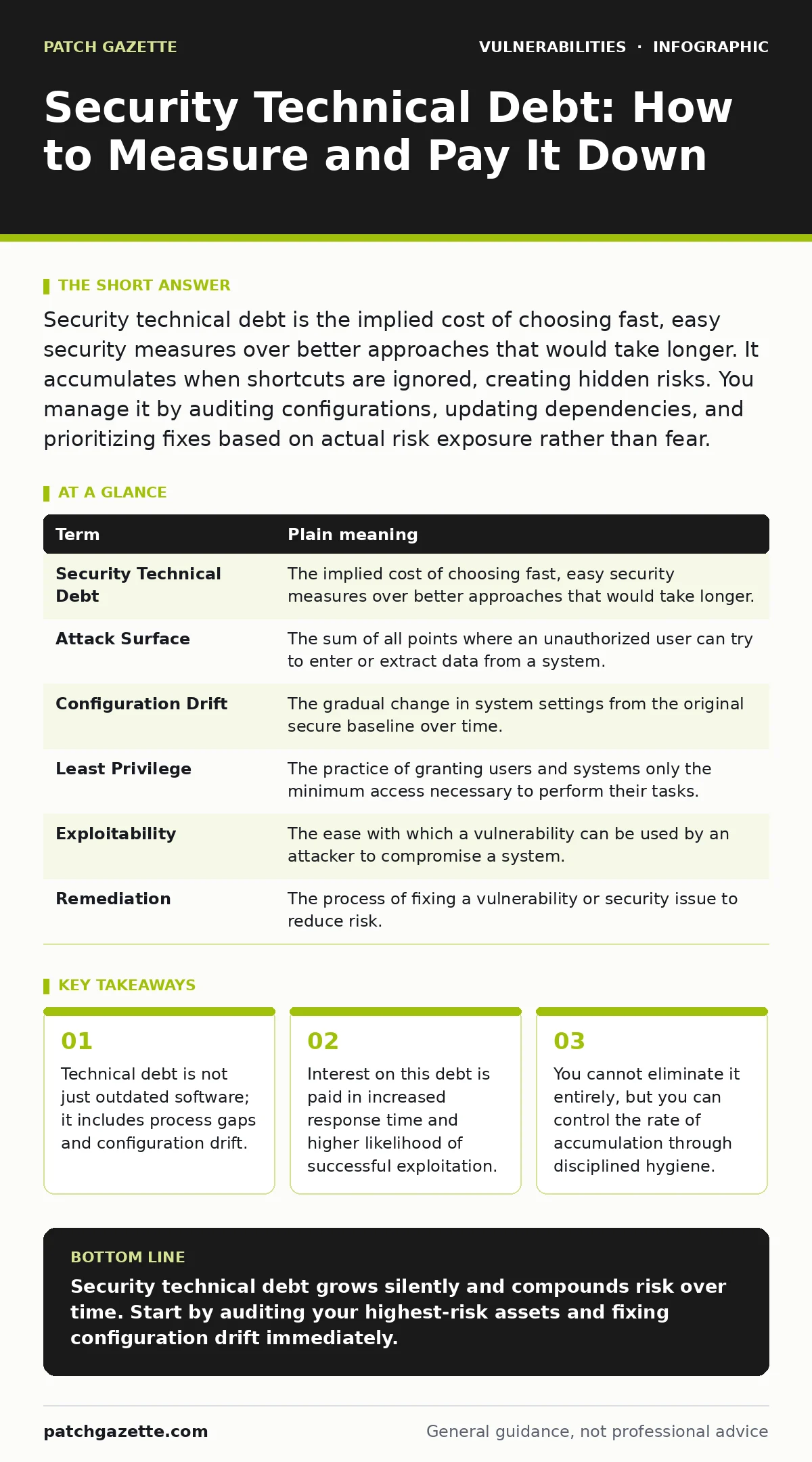
Security technical debt is the implied cost of choosing fast, easy security measures over better approaches that would take longer. It accumulates when shortcuts are ignored, creating hidden risks. You manage it by auditing configurations, updating dependencies, and prioritizing fixes based on actual risk exposure rather than fear.
The Leaky Roof Analogy
Imagine your infrastructure is a house with a leaking roof. You place a bucket under the drip to catch the water. This is your initial security control. It works for now. The bucket represents a temporary fix or a shortcut taken to meet a deadline.
Over time, the bucket fills up. You empty it regularly, which feels like maintenance. However, the roof continues to deteriorate. The wood rots. The shingles curl. The structural integrity weakens. You are not repairing the roof; you are managing the symptom. This is security technical debt.
You might add a second bucket for a new leak. Then a third. The floor becomes slippery with water. Eventually, the weight of the buckets and the rotting wood causes the ceiling to collapse. The cost of fixing the collapse far exceeds the cost of repairing the roof when you first noticed the drip.
Defining the Components
Technical debt in security differs from financial debt because the interest is not monetary. The interest is risk. Every day you delay a proper fix, the attack surface grows. The complexity of your environment increases. The likelihood of a successful breach rises.
This debt comes in two forms. Explicit debt is known. You know you are running an unsupported operating system. You know you have hardcoded credentials in a script. Implicit debt is unknown. You do not know that a library you depend on has a flaw. You do not know that your access controls have drifted from their intended state.
Explicit debt is easier to manage because you can see it. Implicit debt is dangerous because it hides in plain sight. It accumulates silently until an attacker finds the gap.
The Cost of Compounding
The most non-obvious consequence of security technical debt is the erosion of detection capabilities. When you have many temporary fixes, your monitoring tools generate more noise. Alerts become routine. Your team stops investigating every alert because they know many are false positives caused by known, ignored issues.
This creates a blind spot. When a real attack occurs, it blends in with the noise of your debt. You miss the signal. This is why vulnerability scanning must be paired with remediation. Scanning without fixing is like checking the bucket level without emptying it. You know the problem exists, but you do not reduce the risk.
Another hidden cost is the cognitive load on your team. Developers and operators spend time navigating around the debt. They write workarounds for workarounds. This slows down innovation and increases the chance of introducing new errors.
Common Points of Confusion
Many teams confuse technical debt with legacy systems. A legacy system is old software. Technical debt is the gap between the current state and the desired state. You can have technical debt in a brand-new system if you rushed the deployment. You can have no debt in an old system if it is well-maintained and isolated.
Another confusion is assuming that all debt must be paid immediately. This is financially and operationally impossible. You must triage. Not all debt carries the same risk. A misconfigured internal tool has less risk than an exposed admin panel facing the internet.
You must also distinguish between process debt and code debt. Code debt is in the software. Process debt is in how you work. For example, if you do not have a clear approval process for changes, you will introduce privilege escalation vulnerabilities accidentally. Fixing the code does not fix the process.
Managing the Interest Rate
To manage security technical debt, you must measure it. You cannot manage what you do not measure. Start by identifying your highest-risk assets. These are the systems that face the internet or hold sensitive data.
Apply the principle of least privilege. Ensure that every user and service has only the access they need. This reduces the impact of a breach. If an attacker exploits a minor flaw, they cannot move laterally. This limits the damage.
Regularly review your dependencies. Use tools to check for known vulnerabilities in your libraries. Update them promptly. This prevents dependency confusion attacks where attackers trick your build system into pulling malicious packages.
See also: Parameterized Queries Best Practices: Stop Injection Attacks · LDAP Injection: How to Stop Query Manipulation
The Remediation Cycle
Remediation is not a one-time event. It is a cycle. You identify the debt. You assess the risk. You plan the fix. You implement the fix. You verify the fix.
Prioritize fixes based on exploitability. A flaw that requires physical access is lower priority than one that can be triggered remotely. A flaw that allows command injection is higher priority than one that leaks non-sensitive data.
Document your decisions. If you choose to accept a risk, write down why. Record the expected cost of a breach versus the cost of the fix. This creates an audit trail. It shows that you made an informed decision, not a negligent one.
Practical Steps for Reduction
You do not need to fix everything at once. Start small. Pick one area of high debt. Fix it thoroughly. Then move to the next.
- Audit your configurations. Compare your current settings against a secure baseline. Look for default passwords, unnecessary services, and open ports.
- Update your dependencies. Check your software libraries for updates. Apply patches for known vulnerabilities. Remove unused libraries.
- Review access controls. Ensure that permissions are granted based on role, not individual request. Revoke access for employees who have left or changed roles.
These steps reduce the immediate risk. They also build a habit of continuous improvement. Over time, the rate of debt accumulation slows. The system becomes more resilient.
The Long View
Security technical debt is inevitable. You will always have some level of it. The goal is not zero debt. The goal is sustainable debt. You want a level of debt that you can manage without compromising your business operations.
This requires a shift in culture. Security is not a checkbox. It is a continuous process. Every decision has a security implication. Every shortcut has a cost.
By understanding the analogy of the leaky roof, you can see the value of proactive maintenance. You can see the danger of ignoring the drip. You can take steps to reinforce the structure before the ceiling collapses.
Mini Glossary
| Term | Plain meaning |
|---|---|
| Security Technical Debt | The implied cost of choosing fast, easy security measures over better approaches that would take longer. |
| Attack Surface | The sum of all points where an unauthorized user can try to enter or extract data from a system. |
| Configuration Drift | The gradual change in system settings from the original secure baseline over time. |
| Least Privilege | The practice of granting users and systems only the minimum access necessary to perform their tasks. |
| Exploitability | The ease with which a vulnerability can be used by an attacker to compromise a system. |
| Remediation | The process of fixing a vulnerability or security issue to reduce risk. |
Key takeaways
- Technical debt is not just outdated software; it includes process gaps and configuration drift.
- Interest on this debt is paid in increased response time and higher likelihood of successful exploitation.
- You cannot eliminate it entirely, but you can control the rate of accumulation through disciplined hygiene.
Security technical debt grows silently and compounds risk over time. Start by auditing your highest-risk assets and fixing configuration drift immediately.
Frequently asked questions
How do I calculate the value of security technical debt?
You cannot calculate a precise monetary value. Instead, estimate the cost of a potential breach and compare it to the cost of remediation. Use this ratio to prioritize fixes.
Is it better to patch old systems or replace them?
It depends on the risk. If the system is critical and cannot be secured, replace it. If it is isolated and low-risk, patching may be sufficient. Evaluate the context.
Does automation eliminate technical debt?
No. Automation can reduce the rate of accumulation by enforcing standards. However, it cannot fix poor design decisions or process gaps. You still need human oversight.
How often should I review my security posture?
Review your posture after every major change. Conduct a full audit at least once a year. More frequent reviews are better for high-risk environments.
How this guide was produced: written by the Patch Gazette editorial team with AI assistance, checked against the public references listed below, and reviewed when the facts change. See our editorial policy or report an error.