
BGP Hijacking Prevention Checklist for Network Security Teams
Routing announcements lack cryptographic verification by default, allowing attackers to redirect traffic without triggering standard intrusion detection alerts or firewall rules.
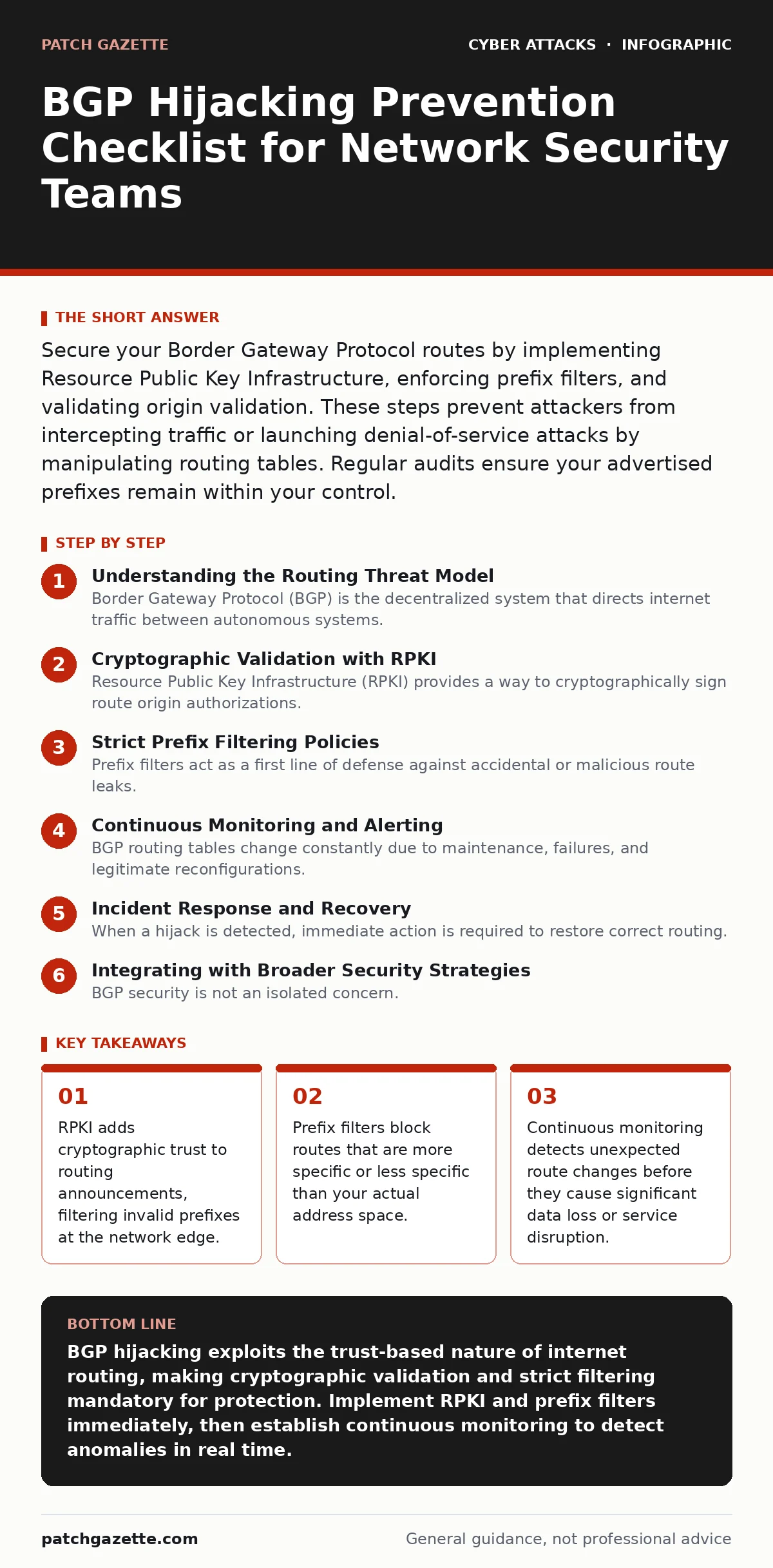
Secure your Border Gateway Protocol routes by implementing Resource Public Key Infrastructure, enforcing prefix filters, and validating origin validation. These steps prevent attackers from intercepting traffic or launching denial-of-service attacks by manipulating routing tables. Regular audits ensure your advertised prefixes remain within your control.
Understanding the Routing Threat Model
Border Gateway Protocol (BGP) is the decentralized system that directs internet traffic between autonomous systems. It relies on trust rather than verification. An attacker who controls a router can announce ownership of IP addresses that do not belong to them. Other networks then send traffic to this malicious router, believing it is the legitimate destination. This process, known as BGP hijacking, allows interceptors to read, modify, or drop data in transit.
The threat extends beyond simple interception. Attackers can use hijacked routes to amplify denial-of-service attacks by reflecting traffic toward a victim. They can also position themselves for adversary-in-the-middle phishing campaigns, where they inject malicious content into legitimate sessions. Because BGP operates at the network layer, traditional endpoint protection often fails to detect these anomalies. The traffic appears to come from a valid source, just via an unexpected path.
Cryptographic Validation with RPKI
Resource Public Key Infrastructure (RPKI) provides a way to cryptographically sign route origin authorizations. This system allows network operators to prove that they own the IP addresses they advertise. Without RPKI, there is no technical barrier stopping an attacker from claiming your IP space. Implementing RPKI validation ensures that routers only accept routes that have been signed by the rightful owner of the address block.
- Generate RPKI ROA objects for all your IP prefixes: This creates the cryptographic proof of ownership required for validation.
- Configure border routers to validate incoming routes: This filters out any announcements that do not match your signed authorizations.
- Monitor RPKI validation status continuously: This ensures that misconfigurations or expired certificates do not inadvertently block legitimate traffic.
RPKI does not prevent all forms of hijacking. It primarily stops prefix hijacking, where an attacker claims your entire IP block. It does not necessarily stop more-subnet hijacking, where an attacker announces a smaller portion of your block. For that, you need additional filtering mechanisms and careful prefix management.
Strict Prefix Filtering Policies
Prefix filters act as a first line of defense against accidental or malicious route leaks. A route leak occurs when a network incorrectly advertises routes it learned from one peer to another. This can cause traffic to take inefficient paths or be dropped entirely. By implementing strict inbound and outbound filters, you ensure that your network only accepts and advertises routes that you explicitly expect.
- Define inbound filters based on known upstream providers: This prevents your network from accepting routes from unauthorized sources.
- Implement outbound filters to restrict advertised prefixes: This ensures you only announce your own IP space to peers.
- Use maximum prefix limits on peer sessions: This protects your routers from being overwhelmed by excessive routing table entries.
Imagine a scenario where a misconfigured router at a partner network starts advertising the entire internet routing table to your border router. Without maximum prefix limits, your router might accept these routes, consuming memory and CPU resources. This could lead to a denial-of-service condition for your own network. Strict limits ensure that such anomalies are rejected before they impact stability.
Continuous Monitoring and Alerting
BGP routing tables change constantly due to maintenance, failures, and legitimate reconfigurations. Distinguishing between normal changes and malicious hijacking requires constant observation. Automated monitoring tools can detect sudden changes in route paths, unexpected origin autonomous systems, or the appearance of more-specific prefixes. Early detection allows you to respond before significant damage occurs.
- Set up alerts for route origin changes: This notifies you immediately if an unexpected autonomous system claims your IP space.
- Monitor for more-specific prefix announcements: This helps identify attempts to siphon off a subset of your traffic.
- Log and analyze BGP session state changes: This provides visibility into peer health and potential session hijacking attempts.
Monitoring alone is not enough. You must have a defined response plan. When an alert triggers, you need to know who to contact and what steps to take. This might involve contacting upstream providers to filter the malicious route or updating your own filters. Delayed response increases the window of exposure for your data and users.
Incident Response and Recovery
When a hijack is detected, immediate action is required to restore correct routing. This often involves contacting your upstream internet service providers to filter the malicious announcements. You may also need to update your RPKI ROA objects or prefix filters to block the attacker. Documenting the incident helps improve your defenses and provides evidence for legal or regulatory requirements.
- Establish a direct contact channel with upstream providers: This speeds up the process of filtering malicious routes during an incident.
- Document the hijack timeline and affected prefixes: This aids in post-incident analysis and improves future response capabilities.
- Test your incident response plan regularly: This ensures that your team knows how to react under pressure.
Consider how business email compromise attacks often exploit the confusion created by network disruptions. If users experience slow connectivity or dropped sessions due to a hijack, they may be more susceptible to phishing attempts. Integrating network security with email security strategies provides a more holistic defense. Ensure your communication channels remain secure even when routing is unstable.
See also: Callback Phishing Prevention Checklist for Secure Operations · Watering Hole Attacks Explained: How Attackers Target Your Routine
Integrating with Broader Security Strategies
BGP security is not an isolated concern. It intersects with many other areas of cybersecurity. For example, QR code phishing attacks might direct users to malicious websites that are only accessible via hijacked routes. Similarly, OAuth consent phishing could be facilitated if an attacker can intercept authentication traffic. By securing your routing infrastructure, you reduce the attack surface for these downstream threats.
- Review BGP security as part of your overall risk assessment: This ensures that routing vulnerabilities are considered alongside other risks.
- Educate staff on the signs of network anomalies: This helps non-technical employees report issues that might indicate a hijack.
- Collaborate with industry groups to share threat intelligence: This provides early warning of emerging hijacking techniques.
The complexity of BGP means that mistakes can have widespread consequences. A single misconfiguration can cause your IP space to disappear from the internet. Regular audits of your routing configuration help prevent these errors. Additionally, staying informed about changes in internet routing policies ensures that your defenses remain effective over time.
Final Checklist Review
Before deploying any changes, verify that your implementation aligns with best practices. Ensure that all prefixes are correctly signed in RPKI. Confirm that filters are applied consistently across all border routers. Test your monitoring alerts to ensure they trigger correctly. This final review helps catch errors before they cause outages.
- Verify RPKI ROA coverage for all active prefixes: This ensures complete cryptographic validation of your address space.
- Test inbound and outbound filter rules: This confirms that only expected routes are accepted and advertised.
- Validate monitoring alert thresholds: This ensures that alerts are generated for genuine anomalies without excessive noise.
Regular maintenance of your BGP security posture is critical. The internet routing environment is dynamic, and your defenses must adapt. By following this checklist, you reduce the risk of hijacking and improve the reliability of your network services. Remember that security is an ongoing process, not a one-time fix.
Key takeaways
- RPKI adds cryptographic trust to routing announcements, filtering invalid prefixes at the network edge.
- Prefix filters block routes that are more specific or less specific than your actual address space.
- Continuous monitoring detects unexpected route changes before they cause significant data loss or service disruption.
BGP hijacking exploits the trust-based nature of internet routing, making cryptographic validation and strict filtering mandatory for protection. Implement RPKI and prefix filters immediately, then establish continuous monitoring to detect anomalies in real time.
Frequently asked questions
How long does it take to implement RPKI?
Implementation varies based on your network size, but initial setup can take a few days to a few weeks. Ongoing maintenance requires regular updates to ROA objects.
Can firewalls prevent BGP hijacking?
No, firewalls operate at a different layer and cannot validate routing announcements. BGP security requires specific routing-level controls like RPKI and prefix filters.
What is the difference between hijacking and a route leak?
Hijacking is an intentional attack to intercept traffic, while a route leak is usually an accidental misconfiguration that causes incorrect routing. Both result in traffic going to the wrong place.
Do I need RPKI if I only have a small IP block?
Yes, small blocks are often targeted because they are easier to hijack unnoticed. RPKI provides the same level of protection regardless of block size.
How this guide was produced: written by the Patch Gazette editorial team with AI assistance, checked against the public references listed below, and reviewed when the facts change. See our editorial policy or report an error.