What Is Broken Access Control: Mechanisms, Risks, and Fixes
Broken access control occurs when systems fail to restrict user actions, allowing attackers to perform unauthorized operations on data or functions they should not touch.
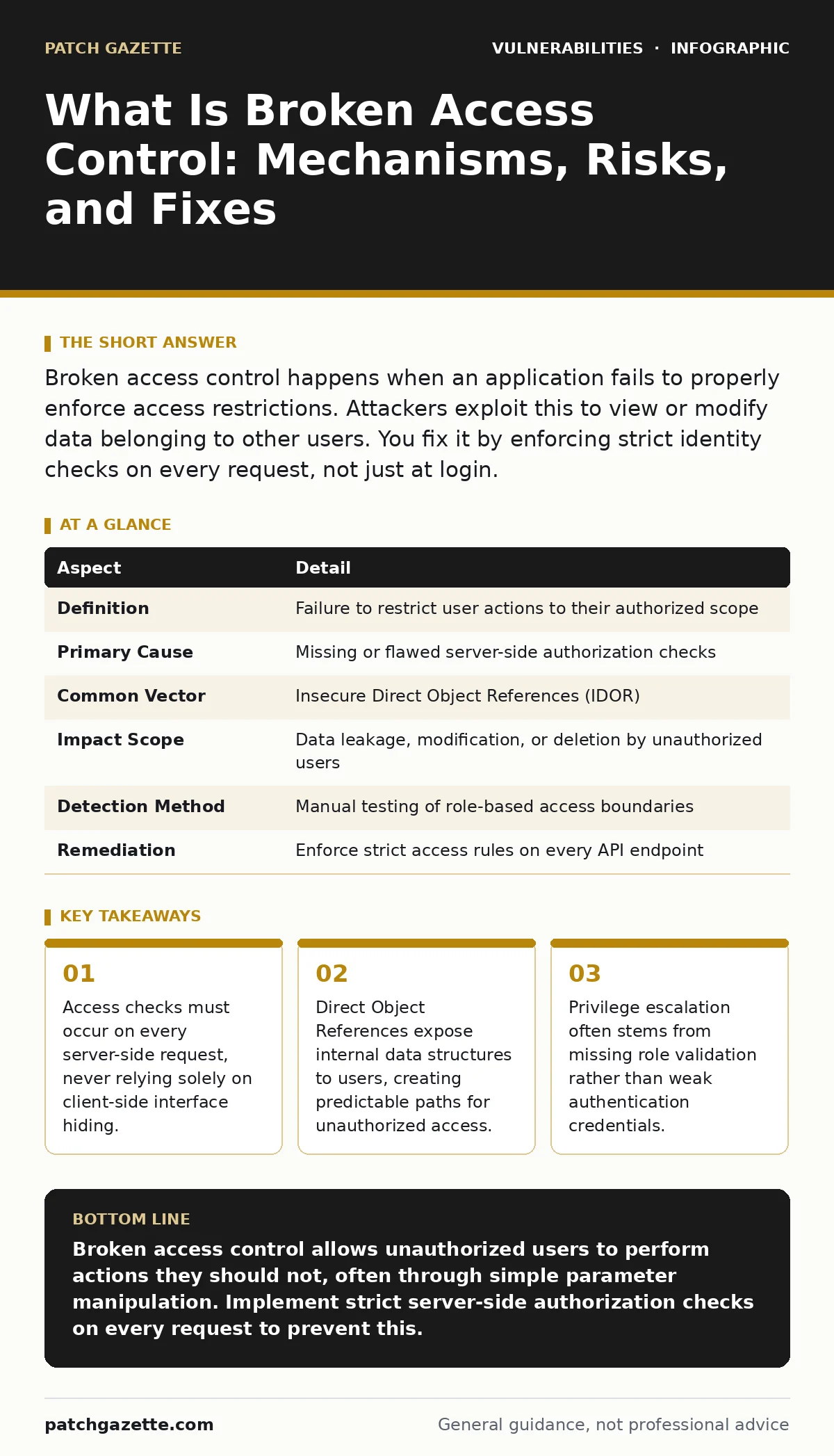
Broken access control happens when an application fails to properly enforce access restrictions. Attackers exploit this to view or modify data belonging to other users. You fix it by enforcing strict identity checks on every request, not just at login.
Everyday Analogy: The Office Badge System
Imagine a large office building where every employee receives a badge that grants access to their specific department. The badge works perfectly for entering the main lobby. However, the security guard at the executive floor only checks if the person holding the badge looks like an employee. They do not verify if that specific badge is authorized for the executive floor. An attacker with a valid, low-level badge can simply walk past the guard and enter restricted areas. The system authenticated the user but failed to authorize their specific location.
This analogy illustrates the core failure of broken access control. Authentication confirms who you are. Authorization determines what you are allowed to do. Many systems get the first part right and neglect the second. The badge is real, but the permission is missing.
At a Glance: Broken Access Control
| Aspect | Detail |
|---|---|
| Definition | Failure to restrict user actions to their authorized scope |
| Primary Cause | Missing or flawed server-side authorization checks |
| Common Vector | Insecure Direct Object References (IDOR) |
| Impact Scope | Data leakage, modification, or deletion by unauthorized users |
| Detection Method | Manual testing of role-based access boundaries |
| Remediation | Enforce strict access rules on every API endpoint |
What Is Broken Access Control
Broken access control describes a vulnerability where the application does not properly enforce access restrictions. A user gains access to a resource or function that they are not permitted to use. This flaw exists independently of authentication failures. The attacker may have a valid account. The system recognizes them but fails to check if they have the right to perform the specific action.
This vulnerability affects any system with multiple user roles or data partitions. E-commerce platforms, healthcare portals, and internal management tools are frequent targets. The impact ranges from viewing private customer records to deleting critical infrastructure data. The severity depends on the sensitivity of the exposed resource and the actions allowed.
Attackers exploit this by manipulating parameters, such as changing a user ID in a URL. If the server processes the request without verifying ownership, the attacker accesses the target data. The flaw lies in the trust model. The application assumes the interface hides enough, so the backend does not need to check permissions for every single request. This assumption is false.
How It Works: The Mechanics of Failure
The most common mechanism is Insecure Direct Object References, or IDOR. The application uses a user-supplied input to access a database object directly. For example, a profile page might use id=101 in the URL. If a user changes this to id=102, the server returns the data for user 102. The server lacks a check to confirm that the current session belongs to user 102.
Another mechanism is the lack of horizontal privilege checks. Two users at the same level should not access each other's data. If the system only checks if the user is "logged in" but not "owner of data," horizontal movement becomes trivial. Vertical privilege escalation occurs when a standard user accesses admin functions. This happens when the application does not verify the user's role before executing sensitive commands.
Hidden functionality is a subtle variant. Developers often remove admin buttons from the user interface for regular users. They assume attackers cannot see what they cannot click. Attackers use automated tools to scan for hidden endpoints. If the backend API does not enforce role checks, the hidden admin page works perfectly for anyone who finds the URL.
Who It Affects and Why It Persists
Broken access control affects organizations that manage sensitive data or complex user hierarchies. It persists because developers often prioritize authentication over authorization. Logging in is a binary state: you are in or you are out. Authorization is granular and contextual. It requires constant validation against a policy engine.
Business pressure accelerates this gap. Features ship quickly. Security reviews focus on login flows and encryption. Authorization logic is treated as a secondary concern. Over time, this creates security technical debt. The codebase grows with implicit trust assumptions that are hard to track. Refactoring later is expensive and risky.
Attackers target these systems because the payoff is high. Accessing a single admin account can compromise an entire environment. Accessing customer data enables identity theft or fraud. The barrier to entry is low. No complex exploit code is needed. Simple parameter manipulation often suffices. This makes broken access control a top-tier risk for web applications.
See also: Video Conferencing Security: How To Lock The Digital Door · Secure File Sharing: Answers to Your Most Pressing Questions
What People Usually Get Wrong
Many teams believe that hiding functionality prevents access. Removing a button from the HTML does not remove the API endpoint. Attackers do not browse websites like users. They send raw HTTP requests. If the server does not enforce access controls, the hidden feature is fully exposed.
Another common mistake is relying on session tokens for authorization. A token proves identity. It does not prove permission. You must decode the token and check the claims against the resource policy. Storing the role in the token is risky if the token can be tampered with. Always verify permissions server-side.
Some developers assume that input validation prevents this. Validating that an ID is a number does not validate that the user owns that ID. Sanitization protects against injection, not authorization. You need distinct logic for each. Mixing these concerns leads to gaps where valid input is used for unauthorized access.
How to Fix Broken Access Control
Fixing this requires a shift in mindset. Every request is a potential attack. Assume the user is malicious. Verify every action.
- Enforce Default Deny: Start with no access. Grant permissions explicitly. Do not assume access is allowed unless a rule permits it. This reduces the attack surface significantly.
- Check Permissions Server-Side: Never trust client-side controls. The server must verify the user's role and data ownership for every request. Use middleware or decorators to automate these checks.
- Use Indirect References: Avoid exposing internal IDs. Use opaque tokens or indirect references that map to internal IDs. This prevents attackers from guessing valid resource identifiers.
- Implement Least Privilege: Users should have only the permissions necessary for their role. Regularly audit access rights. Remove unused privileges. This limits the damage of any single compromised account.
- Log and Monitor Access: Record all access attempts, especially failures. Monitor for patterns that suggest enumeration or privilege escalation. Alerts help you detect exploitation before data is exfiltrated.
Consider using virtual patching to mitigate risks while you fix the code. This adds a layer of protection at the network or application layer. It blocks malicious requests without changing the application code. This buys time for proper remediation.
Related Vulnerabilities and Context
Broken access control often overlaps with other issues. Privilege escalation vulnerabilities are a direct result of poor access controls. If a user can elevate their privileges, the access control model has failed. Understanding the connection helps you prioritize fixes.
Dependency confusion attacks exploit build systems, but they can introduce code that bypasses access controls. Keeping dependencies updated reduces this risk. Similarly, parameterized queries prevent injection, but they do not fix authorization. You need both.
Output encoding protects against cross-site scripting, which can steal session tokens. A stolen token can bypass access controls if the session is valid. LDAP injection can allow attackers to bypass authentication entirely. Each of these is a separate vector, but they all converge on unauthorized access. Refer to the CWE weakness categories for a structured view of these flaws. They provide a common language for tracking and fixing these issues.
Testing and Validation
Automated scanners often miss broken access control. They test for known signatures, not logical flaws. You need manual testing. Create accounts with different roles. Try to access resources belonging to other roles. Change parameters and observe the response.
Test for horizontal and vertical movement. Try to access another user's data at the same level. Try to access admin functions from a standard account. Use tools to automate parameter fuzzing, but review the results manually. Automated tools cannot understand business logic.
Include access control checks in your CI/CD pipeline. Static analysis can find missing checks in code. Dynamic analysis can test running applications. Combine these methods for better coverage. Regular penetration testing ensures that new features do not introduce regressions.
Summary of Actions
Address broken access control by enforcing strict server-side checks. Do not trust the client. Use indirect references. Audit permissions regularly. Monitor for anomalies. This approach reduces risk and protects sensitive data.
Key takeaways
- Access checks must occur on every server-side request, never relying solely on client-side interface hiding.
- Direct Object References expose internal data structures to users, creating predictable paths for unauthorized access.
- Privilege escalation often stems from missing role validation rather than weak authentication credentials.
Broken access control allows unauthorized users to perform actions they should not, often through simple parameter manipulation. Implement strict server-side authorization checks on every request to prevent this.
Frequently asked questions
How do I find broken access control in my code?
Review every endpoint for missing role checks. Test with different user accounts to see if you can access other users' data or admin functions.
Is hiding admin buttons enough to secure them?
No. Hiding buttons only affects the user interface. Attackers can send direct requests to the backend. The server must enforce access rules regardless of the interface.
What is the difference between authentication and authorization?
Authentication verifies who you are. Authorization determines what you are allowed to do. Both are necessary for security.
Can a WAF fix broken access control?
A WAF can block known attack patterns, but it cannot understand business logic. It may miss logical flaws. Server-side fixes are required for complete protection.
How this guide was produced: written by the Patch Gazette editorial team with AI assistance, checked against the public references listed below, and reviewed when the facts change. See our editorial policy or report an error.