
Internet of Things for Business: Secure Your Connected Operations
Business IoT devices often bypass standard network controls, creating hidden entry points that traditional firewalls cannot detect or block effectively.
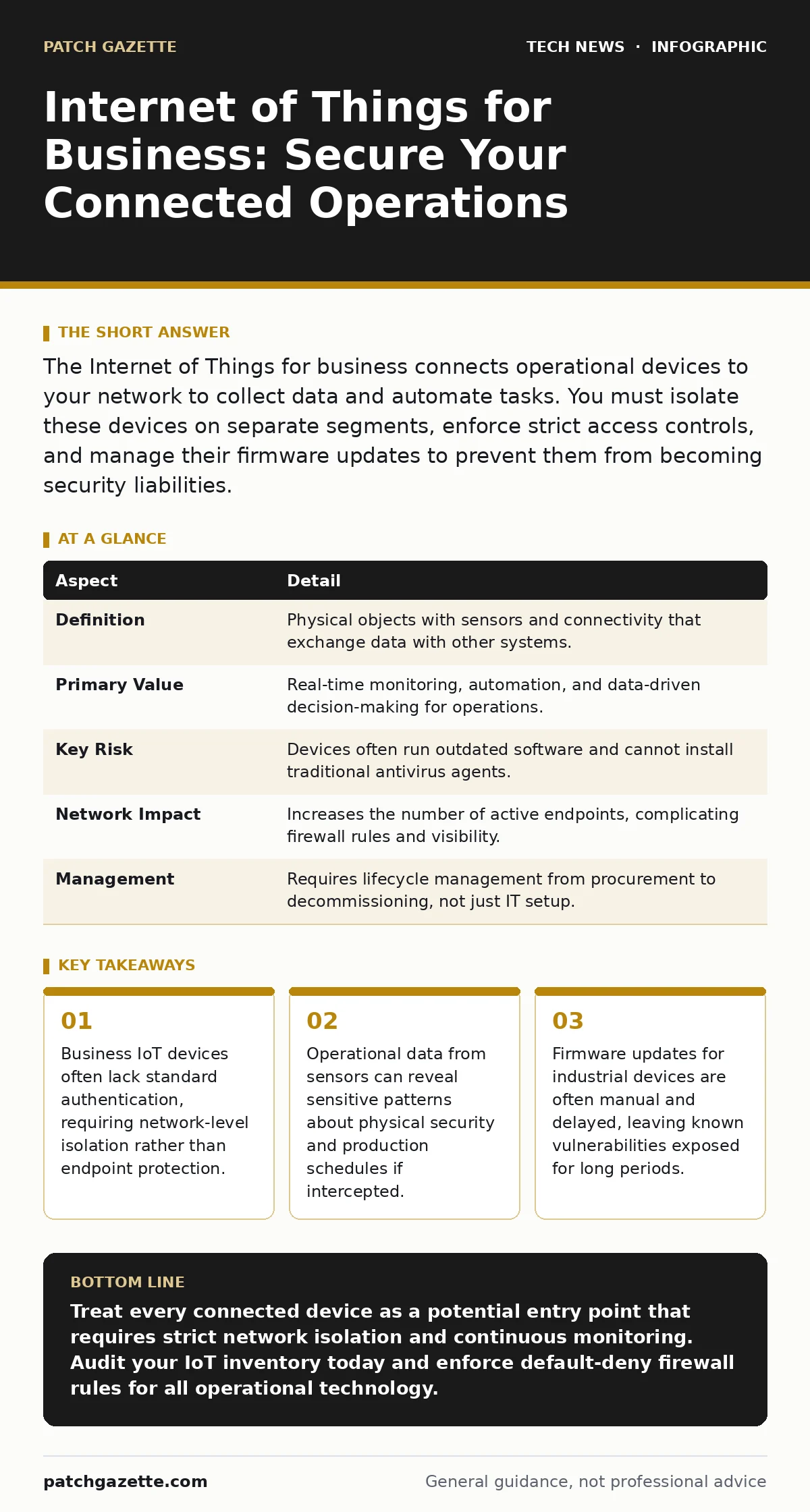
The Internet of Things for business connects operational devices to your network to collect data and automate tasks. You must isolate these devices on separate segments, enforce strict access controls, and manage their firmware updates to prevent them from becoming security liabilities.
Why the Internet of Things for Business Changes Your Risk Profile
Think of your corporate network as a high-security office building. Traditional computers are like employees with ID badges; they log in, follow rules, and can be monitored. The Internet of Things for business consists of the building’s HVAC system, smart locks, and security cameras. These devices do not have keyboards for passwords or screens for updates. They sit in the background, constantly transmitting data. This shift moves your attack surface from logical endpoints to physical infrastructure that is difficult to patch or monitor.
| Aspect | Detail |
|---|---|
| Definition | Physical objects with sensors and connectivity that exchange data with other systems. |
| Primary Value | Real-time monitoring, automation, and data-driven decision-making for operations. |
| Key Risk | Devices often run outdated software and cannot install traditional antivirus agents. |
| Network Impact | Increases the number of active endpoints, complicating firewall rules and visibility. |
| Management | Requires lifecycle management from procurement to decommissioning, not just IT setup. |
How Business IoT Devices Communicate and Operate
These devices operate by sensing physical conditions and transmitting that data to a central platform. A temperature sensor in a warehouse reads the ambient heat and sends a packet to a cloud server. The server analyzes the trend and alerts a manager if cooling fails. This process relies on standard protocols like MQTT or HTTP, but the devices themselves often have minimal processing power. They cannot run complex security software. You must secure them at the network edge, not on the device itself. This architectural constraint means your firewall and intrusion detection systems bear the full weight of protection.
Who Is Affected by Connected Operational Technology
Every department that relies on physical assets is affected. Facilities management controls lighting and climate. Logistics teams track inventory with RFID tags. Healthcare providers monitor patient vitals through wearable sensors. Each of these groups generates data that travels across your network. The risk is not limited to IT staff. A compromised smart thermostat can be used to launch a denial-of-service attack against your internal servers. A hacked camera can provide attackers with visual reconnaissance of your security protocols. You must treat operational technology as part of your critical infrastructure, not as a convenience feature.
What to Do About IoT Security Gaps
You cannot apply the same security model to a sensor as you do to a laptop. Start by inventorying every connected device. You must know what is on your network to protect it. Next, segment your network. Place IoT devices on a separate VLAN, isolated from your core business data. This ensures that if a device is compromised, the attacker cannot move laterally to your file servers. Enforce strict firewall rules that allow only necessary traffic. A smart lock should only communicate with its management server, not with the internet or your email server.
Implementing Network Segmentation
Network segmentation divides your infrastructure into smaller, isolated zones. For IoT, this means creating a dedicated zone for all connected devices. Traffic from this zone is restricted. It can send data to your analytics platform, but it cannot initiate connections to other internal networks. This approach limits the blast radius of a breach. If a device is hijacked, the attacker remains trapped in that segment. You must configure your switches and firewalls to enforce these boundaries strictly. Default allow rules are dangerous; use default deny policies instead.
Managing Firmware and Credentials
Many IoT devices ship with hardcoded default passwords. You must change these immediately upon deployment. If the device does not allow you to change the password, do not deploy it. Firmware updates are equally critical. Manufacturers release patches to fix vulnerabilities. You must have a process to apply these updates. Some industrial devices require downtime for updates. Plan for this during maintenance windows. Failure to patch leaves known vulnerabilities open. Attackers scan for unpatched devices constantly. You are racing against automated scripts that exploit these weaknesses.
Common Misconceptions About IoT Security
People often assume that because a device is small, it is low risk. This is incorrect. A simple sensor can be a foothold for a major breach. Another common mistake is relying on obfuscation for security. Hiding the device’s IP address or using non-standard ports does not protect it. Attackers map networks automatically. They will find your device regardless of its port number. You must assume your devices are visible to adversaries. Security must come from strong authentication and network isolation, not from hiding.
Another error is assuming that IoT devices are secure by design. Many are built for cost and speed, not security. They may lack encryption or use weak algorithms. You must verify the security features during procurement. Ask vendors about their update policies and encryption standards. Do not accept vague assurances. If a vendor cannot explain how they protect the device, you cannot trust it in your environment.
See also: Load Balancers Examples: Real-World Scenarios and Hidden Risks
Integrating IoT with Existing Security Controls
Your IoT strategy must align with your broader security framework. For instance, ensure that any data collected by IoT devices is handled with the same care as other sensitive information. If data is transmitted over the internet, it should be encrypted. While RSA encryption is a standard for securing data in transit, you must ensure the device supports modern key lengths and protocols. Weak encryption can be broken, exposing your operational data.
Consider how IoT devices interact with user authentication systems. If a smart door lock integrates with your identity provider, it must use secure methods like OAuth to request access. This ensures that the device only gets the permissions it needs, and nothing more. This principle of least privilege applies to devices just as it does to human users. Review your access logs regularly to detect unusual activity from IoT endpoints.
Procurement and Lifecycle Management
Security begins before the device arrives. Include security requirements in your purchase contracts. Vendors must commit to providing security patches for a defined period. When the device reaches the end of its life, you must decommission it securely. Wipe any stored data and remove it from your network inventory. A forgotten device in a storage closet can still be a risk if it is accidentally reconnected. Maintain a living inventory of all IoT assets. Update it whenever a device is added, moved, or removed. This discipline prevents shadow IT from creating blind spots in your security posture.
Check your physical security as well. IoT devices are often placed in accessible areas. An attacker who can physically touch a device may be able to reset it or extract data. Use tamper-evident seals and secure mounting. Monitor physical access logs. Combining physical and logical security controls creates a deeper defense. You are protecting not just data, but the physical operations that depend on these devices.
Key takeaways
- Business IoT devices often lack standard authentication, requiring network-level isolation rather than endpoint protection.
- Operational data from sensors can reveal sensitive patterns about physical security and production schedules if intercepted.
- Firmware updates for industrial devices are often manual and delayed, leaving known vulnerabilities exposed for long periods.
Treat every connected device as a potential entry point that requires strict network isolation and continuous monitoring. Audit your IoT inventory today and enforce default-deny firewall rules for all operational technology.
Frequently asked questions
Can I use standard antivirus software on IoT devices?
Most IoT devices lack the operating system resources to run traditional antivirus agents. You must rely on network segmentation and behavioral monitoring instead.
How do I find hidden IoT devices on my network?
Use network scanning tools that detect active connections and device fingerprints. Compare these findings against your approved inventory to identify unauthorized devices.
Is cloud-based IoT management secure?
Cloud platforms can be secure if they enforce strong authentication and encryption. You must verify the vendor’s compliance with security standards and their data handling practices.
What happens if an IoT device manufacturer goes out of business?
You lose access to security patches and support. Plan for this by ensuring devices can be replaced or isolated. Consider the vendor’s financial stability during procurement.
How this guide was produced: written by the Patch Gazette editorial team with AI assistance, checked against the public references listed below, and reviewed when the facts change. See our editorial policy or report an error.