Spot Privilege Escalation Warning Signs Before Breach
Privilege escalation often hides in silent configuration drifts and permission inheritance errors that standard monitoring tools ignore until lateral movement begins.
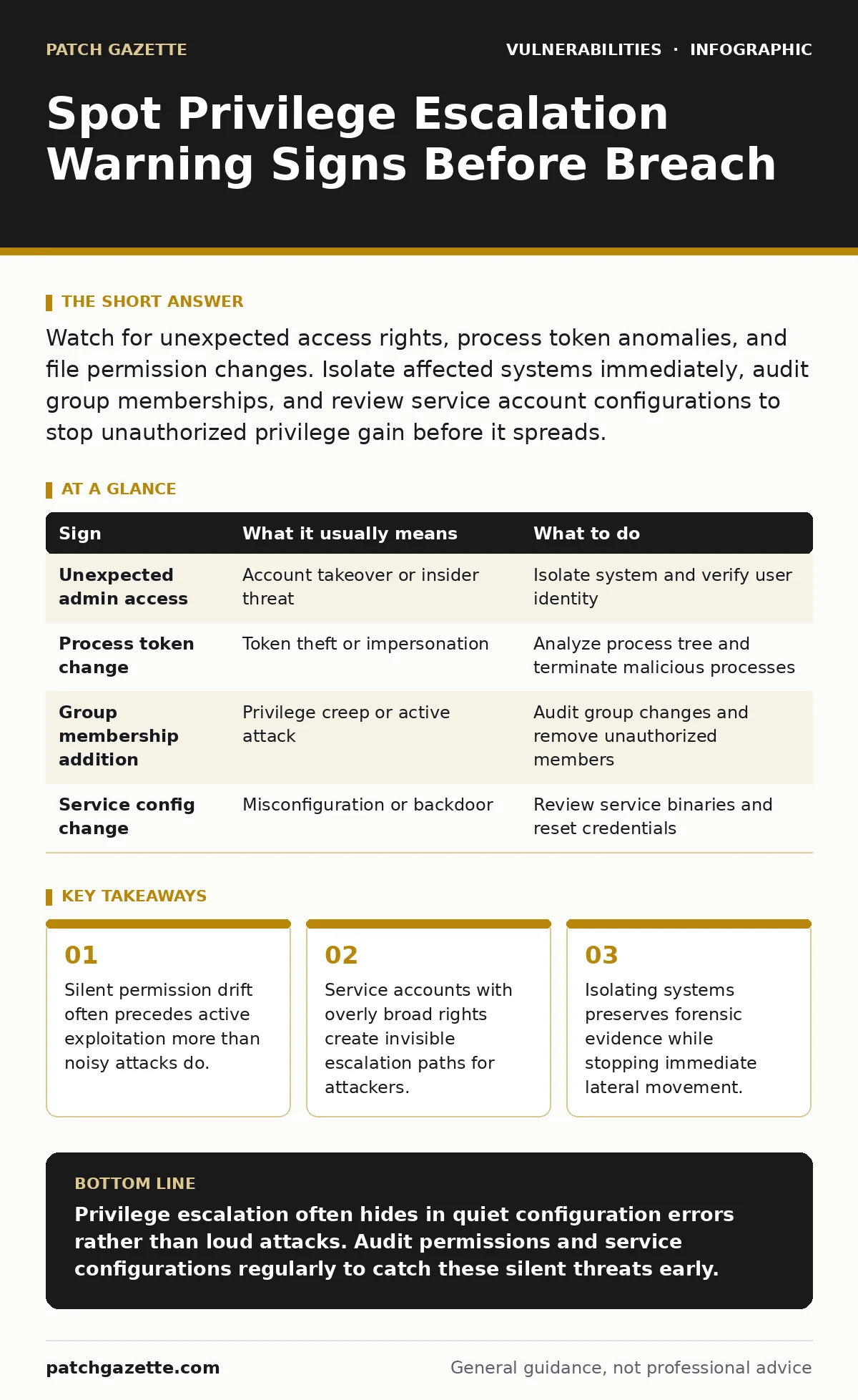
Watch for unexpected access rights, process token anomalies, and file permission changes. Isolate affected systems immediately, audit group memberships, and review service account configurations to stop unauthorized privilege gain before it spreads.
The Obvious Outliers
Some privilege escalation attempts are loud. You will see them immediately if your logging is active. An administrator account suddenly accessing production databases from a developer workstation raises a red flag. This is a clear violation of least privilege principles.
Another obvious sign is a process running with higher privileges than necessary. If a web server process executes with root or system rights, it is a prime target. Attackers exploit this mismatch to gain full control. You should also watch for new admin users appearing in logs without corresponding HR records.
These signs are easy to catch because they break established baselines. Your security information and event management systems will likely alert on these anomalies. Do not ignore these alerts assuming they are false positives. Verify the legitimacy of every sudden privilege change.
The Silent Drift
The most dangerous escalation paths are quiet. They rely on misconfigurations that existed for months or years. A shared service account with broad file permissions is a common example. Developers might use it for convenience, unaware that an attacker can hijack the session.
Permission inheritance errors are another silent killer. A folder with write access for a low-privilege group might inherit rights to a critical configuration file. If an attacker modifies that file, they can inject malicious code. This is similar to how path traversal vulnerabilities allow access to unintended directories.
You often miss these because they do not generate login events. The attacker is already inside, moving laterally using existing rights. Standard monitoring tools focus on network traffic and logins. They frequently ignore file system permission changes and group membership updates.
Process Token Anomalies
Operating systems manage access through security tokens. These tokens contain the user’s identity, group memberships, and privileges. An escalation attempt often involves manipulating or stealing these tokens. Look for processes that suddenly acquire new tokens or change their integrity levels.
Imagine a scenario where a standard user process spawns a child process with administrator rights. This is known as token impersonation or theft. It often happens when a privileged process handles a request from a lower-privileged one. If your monitoring does not track token creation and inheritance, you will miss this.
Check for processes running under unexpected user contexts. A scheduled task running as SYSTEM when it should run as a service account is a warning sign. This indicates that someone has modified the task configuration to elevate privileges.
Group Membership Changes
Group membership defines what a user can do. Changes to these memberships are a primary vector for escalation. An attacker might add a user to the "Domain Admins" or "Local Administrators" group. This grants immediate, broad access to resources.
These changes can be subtle. An attacker might join a distribution list that has access to a shared drive containing sensitive credentials. They might also exploit nested groups, where membership in one group grants membership in another. This indirect path is harder to audit.
Regularly audit group memberships. Compare them against authorized personnel lists. Look for recent additions or changes to high-privilege groups. If you see a user added to a group they do not need, investigate immediately. This is often the first step in a larger attack chain.
Service Configuration Weaknesses
Services run in the background and often have elevated privileges. Misconfigured services are a goldmine for attackers. If a service can be started or stopped by low-privilege users, it can be abused. The attacker might replace the service binary with malicious code.
Another weakness is the use of hardcoded credentials in service configurations. If an attacker reads the configuration file, they gain the service’s password. This allows them to authenticate as the service, which often has high privileges. This is related to the risks of exposed admin panels where credentials are easily accessible.
Review service configurations regularly. Ensure that only administrators can modify service binaries and settings. Use strong, unique passwords for service accounts. Rotate these passwords periodically to limit the damage if they are compromised.
See also: Secure File Sharing: Answers to Your Most Pressing Questions · SAML vs OAuth: Which Protocol Fits Your Cloud Architecture?
Response Protocol
When you detect a potential escalation, act quickly. Isolate the affected system from the network. This stops lateral movement and preserves evidence. Do not shut down the system, as this destroys memory contents.
Capture a memory dump if possible. This helps forensic analysts identify the root cause. Analyze logs to determine the scope of the compromise. Identify all accounts that may have been affected.
Reset passwords for compromised accounts. Review and revoke unnecessary privileges. Patch the vulnerability that allowed the escalation. If you are unsure how to proceed, consult your incident response plan. Do not attempt to fix the issue without proper documentation.
| Sign | What it usually means | What to do |
|---|---|---|
| Unexpected admin access | Account takeover or insider threat | Isolate system and verify user identity |
| Process token change | Token theft or impersonation | Analyze process tree and terminate malicious processes |
| Group membership addition | Privilege creep or active attack | Audit group changes and remove unauthorized members |
| Service config change | Misconfiguration or backdoor | Review service binaries and reset credentials |
Key takeaways
- Silent permission drift often precedes active exploitation more than noisy attacks do.
- Service accounts with overly broad rights create invisible escalation paths for attackers.
- Isolating systems preserves forensic evidence while stopping immediate lateral movement.
Privilege escalation often hides in quiet configuration errors rather than loud attacks. Audit permissions and service configurations regularly to catch these silent threats early.
Frequently asked questions
How can I detect privilege escalation in cloud environments?
Monitor for unusual API calls and permission changes in identity management services. Look for roles with excessive permissions and unused credentials.
What is the difference between local and remote privilege escalation?
Local escalation requires initial access to the system, while remote escalation happens over the network. Both result in higher privileges, but remote is harder to detect.
Should I use vulnerability scanning to find these issues?
Yes, **vulnerability scanning** can identify known misconfigurations and unpatched software. However, it may miss logical flaws and permission drift.
How do I prevent token theft?
Limit the number of privileged processes running. Use mandatory access controls to restrict which processes can interact with others. Regularly patch your operating system to fix known token manipulation flaws.
How this guide was produced: written by the Patch Gazette editorial team with AI assistance, checked against the public references listed below, and reviewed when the facts change. See our editorial policy or report an error.