LDAP Injection: How to Stop Query Manipulation
Directory servers treat input as code, turning simple search fields into backdoors for unauthorized access and data exfiltration.
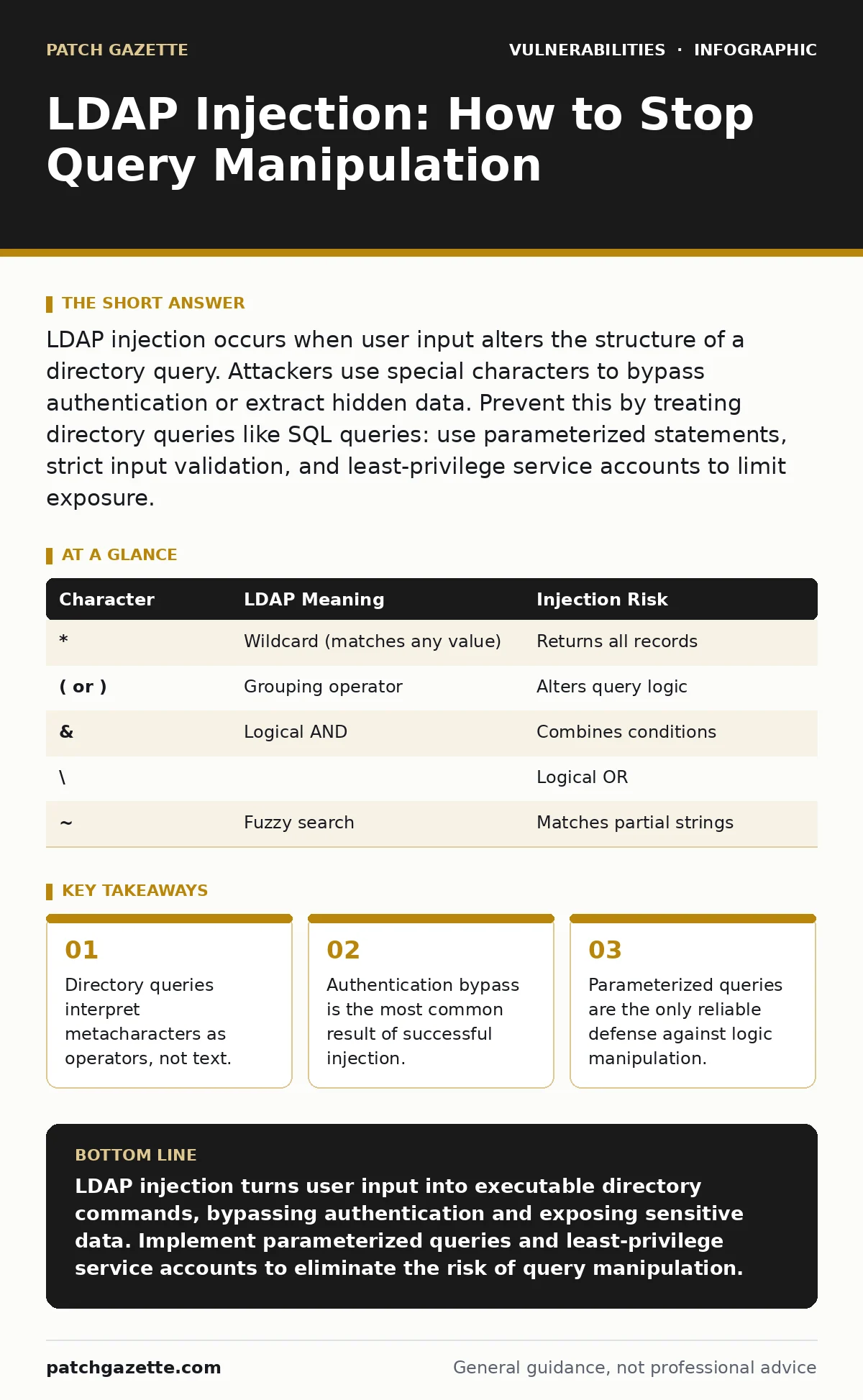
LDAP injection occurs when user input alters the structure of a directory query. Attackers use special characters to bypass authentication or extract hidden data. Prevent this by treating directory queries like SQL queries: use parameterized statements, strict input validation, and least-privilege service accounts to limit exposure.
What exactly is LDAP injection?
LDAP injection is a code injection technique that exploits the lack of input validation in applications that query Lightweight Directory Access Protocol servers. When an application takes user input and inserts it directly into an LDAP query string, an attacker can append special characters to change the query’s logic. This turns a simple search into a command that the directory server executes.
Why do directory servers interpret input as code?
LDAP is a protocol designed for querying hierarchical data structures, not for storing flat text. The server parses the query string to find attributes, operators, and values. It expects parentheses, ampersands, and pipes to define search conditions. When an application fails to escape these characters, the server treats them as structural elements rather than literal data. This design choice enables powerful searches but creates a parsing ambiguity that attackers exploit.
How does an attacker bypass authentication?
Imagine a login form that sends the username and password to the backend. The application constructs a query like (&(uid=INPUT)(password=INPUT)). An attacker enters )(& as the username and )(& as the password. The resulting query becomes (&(uid=)(&(password=)(&(password=). The first part uid= matches any user. The second part is syntactically broken but often ignored or evaluated as true depending on the server implementation. The authentication check returns a match for the first user in the directory, granting access without a valid password.
What data can be extracted through injection?
Beyond authentication, injection allows an attacker to enumerate directory contents. By injecting a wildcard * into a search field, the attacker can retrieve all entries in the directory. They can then iterate through attributes to find sensitive information like email addresses, phone numbers, or internal group memberships. This mapping of the directory structure helps the attacker plan further attacks, such as targeting high-privilege accounts or understanding the organization’s hierarchy.
| Character | LDAP Meaning | Injection Risk |
|---|---|---|
* | Wildcard (matches any value) | Returns all records |
( or ) | Grouping operator | Alters query logic |
& | Logical AND | Combines conditions |
| \ | Logical OR | |
~ | Fuzzy search | Matches partial strings |
Is input validation enough to stop it?
Simple input validation that blocks special characters is insufficient. Attackers can often bypass blacklist filters using Unicode encodings or alternate character representations that the application accepts but the directory server interprets as metacharacters. Relying on validation alone creates a false sense of security. You must assume that malicious input will reach the query layer. The defense must happen at the point where the query is constructed, not at the point where the user types.
See also: Security Technical Debt: How to Measure and Pay It Down · Exposed Admin Panels: 6 Myths That Leave Systems Wide Open
How do parameterized queries prevent injection?
Parameterized queries send the query template and the data values to the server separately. The server binds the values to placeholders in the template. This process ensures that the values are treated strictly as data, not as part of the query syntax. Even if the input contains parentheses or wildcards, the server treats them as literal characters to be matched, not as operators to be executed. This method is the standard defense against injection in relational databases and applies equally to directory services.
What is the risk of using generic service accounts?
Many applications use a single, high-privilege account to connect to the directory server. If an injection vulnerability exists, the attacker inherits the privileges of that account. This allows them to read, modify, or delete any object the service account can access. This turns a single injection flaw into a system-wide compromise. Using least-privilege accounts limits the damage. Each application should have its own account with permissions restricted to the specific data it needs to read or write.
Can LDAP injection lead to remote code execution?
In most configurations, LDAP injection does not directly execute code on the server. The directory server processes the query and returns data. However, the data returned can be used to facilitate other attacks. For example, an attacker might extract email addresses to launch targeted phishing campaigns. They might also find configuration details that reveal other vulnerabilities. While the injection itself is a data breach, the consequences can escalate into broader network compromise.
How do you detect existing LDAP injection flaws?
Vulnerability scanning tools can identify potential injection points by sending test payloads and analyzing the response. However, static analysis is often required to confirm the vulnerability. You must review the source code to see how the application constructs LDAP queries. Look for string concatenation where user input is added to query strings. Check for the use of dynamic query building without parameterization. This manual review is necessary because automated tools cannot always distinguish between safe and unsafe query construction patterns.
What is the long-term cost of ignoring this risk?
Ignoring LDAP injection creates security technical debt that compounds over time. As the directory grows, the amount of sensitive data exposed increases. Attackers can use the leaked data to tailor more sophisticated attacks. Remediation becomes harder as the application grows and dependencies increase. Fixing the root cause requires changing how the application interacts with the directory, which may involve refactoring core authentication modules. Early prevention is significantly cheaper and less disruptive than post-breach remediation.
Key takeaways
- Directory queries interpret metacharacters as operators, not text.
- Authentication bypass is the most common result of successful injection.
- Parameterized queries are the only reliable defense against logic manipulation.
LDAP injection turns user input into executable directory commands, bypassing authentication and exposing sensitive data. Implement parameterized queries and least-privilege service accounts to eliminate the risk of query manipulation.
Frequently asked questions
Is LDAP injection the same as SQL injection?
They are similar in mechanism but target different systems. SQL injection affects relational databases, while LDAP injection affects directory services. Both exploit the interpretation of input as code.
Can I use escape functions to fix LDAP injection?
Escape functions can help, but they are error-prone and often incomplete. Parameterized queries are more reliable because they separate data from code at the protocol level.
Does TLS prevent LDAP injection?
No. TLS encrypts the connection between the client and the server, preventing eavesdropping. It does not stop the server from interpreting malicious input as commands.
How do I test for LDAP injection safely?
Use a dedicated test environment that mirrors production. Send benign test payloads to see if the application returns unexpected data or errors. Never test on live systems without proper authorization.
How this guide was produced: written by the Patch Gazette editorial team with AI assistance, checked against the public references listed below, and reviewed when the facts change. See our editorial policy or report an error.