Shadow IT: What It Is and How to Reduce the Hidden Risk
Unsanctioned software often bypasses security controls because it operates outside your visibility, creating blind spots that traditional monitoring cannot detect.
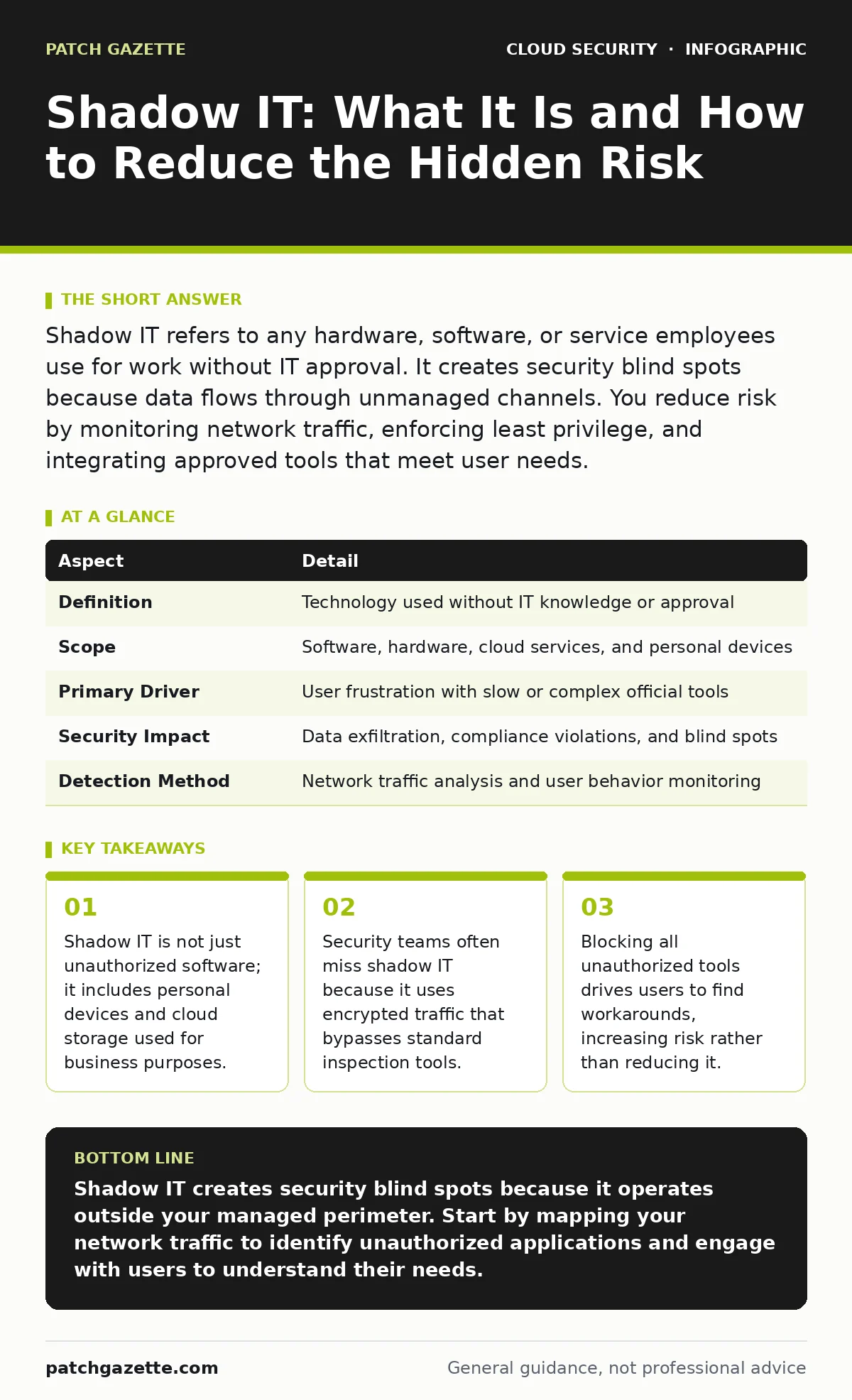
Shadow IT refers to any hardware, software, or service employees use for work without IT approval. It creates security blind spots because data flows through unmanaged channels. You reduce risk by monitoring network traffic, enforcing least privilege, and integrating approved tools that meet user needs.
The Coffee Shop Analogy
Imagine your organization is a coffee shop. The official IT systems are the espresso machine, the cash register, and the inventory system. You know exactly how they work, who uses them, and where the data goes. Now imagine a barista decides to take orders on a personal tablet because the register is slow. That tablet is shadow IT. You do not know what apps are on it, where the customer data is stored, or if it is secure. The work gets done, but you have lost control of the process.
This analogy highlights the core issue. Shadow IT is not necessarily malicious. It is usually an attempt to solve a business problem more efficiently. However, when IT does not know the tool exists, it cannot secure it. This creates a gap between business operations and security policy.
Defining the Unseen
Shadow IT encompasses any technology used within an organization that the IT department does not control or approve. This definition is broader than many assume. It is not limited to unauthorized software downloads. It includes personal smartphones used for work emails, personal cloud storage accounts for file sharing, and communication apps installed on company laptops.
The term "shadow" implies invisibility. If IT can see the traffic and manage the device, it is not shadow IT. It becomes shadow IT the moment it operates outside the managed perimeter. This distinction matters because visibility is the primary defense. If you cannot see it, you cannot patch it, monitor it, or restrict it.
| Aspect | Detail |
|---|---|
| Definition | Technology used without IT knowledge or approval |
| Scope | Software, hardware, cloud services, and personal devices |
| Primary Driver | User frustration with slow or complex official tools |
| Security Impact | Data exfiltration, compliance violations, and blind spots |
| Detection Method | Network traffic analysis and user behavior monitoring |
Why It Happens
Users adopt shadow IT for two main reasons: speed and functionality. Official tools often require lengthy approval processes. They may lack features that external competitors offer. When a team needs to collaborate quickly, waiting for IT procurement slows them down. So, they find a solution that works today.
This behavior is rational from a productivity standpoint. However, it ignores the security trade-off. The user prioritizes immediate task completion over long-term data safety. IT departments often contribute to this by creating friction. If the approved tools are difficult to use, users will bypass them. This is a common failure point in cloud misconfigurations where users enable features to make tools easier to use, inadvertently exposing data.
Common Forms of Shadow IT
Shadow IT takes many forms. The most common is cloud storage. Employees upload sensitive files to personal accounts to share them with colleagues. This creates a copy of data that IT cannot encrypt or delete. Another form is communication platforms. Teams use personal messaging apps to discuss work because they are faster than official email systems.
SaaS applications are also prevalent. Marketing teams might subscribe to social media management tools that access company data. These tools often require OAuth tokens, granting them access to corporate resources. If the tool is compromised, the attacker gains access to the connected corporate accounts. This risk extends to service account security, where automated tools use credentials that are rarely rotated or monitored.
Who It Affects
Shadow IT affects everyone in the organization. For users, it means their personal accounts may be at risk if work data is mixed with personal data. For IT, it means increased complexity. You must manage more endpoints, more data flows, and more potential vulnerabilities. For leadership, it means compliance risk. Regulations often require strict controls over data handling. Shadow IT bypasses these controls.
The impact is not limited to large enterprises. Small organizations are often more vulnerable because they lack the resources to monitor traffic. In small teams, one person might handle IT, security, and operations. If that person is not aware of the shadow IT, there is no one to stop it. This is why multi-cloud security strategies must account for decentralized decision-making, not just centralized infrastructure.
See also: Cloud Misconfigurations: Definition, Risks, and Remediation Strategies · How Cloud Ransomware Works: The Step-by-Step Attack Chain
Reducing the Risk
You cannot eliminate shadow IT entirely. Users will always find ways to work around restrictions. The goal is to reduce the risk. The first step is visibility. You need to know what is happening on your network. Network detection and response tools can identify unknown SaaS applications by analyzing traffic patterns. Look for connections to unknown IP addresses or domains.
Once you have visibility, you can engage with users. Ask why they are using the unauthorized tool. Often, you can find an approved alternative that meets their needs. If no alternative exists, you may need to secure the tool. This involves applying security controls, such as multi-factor authentication and data loss prevention policies. This approach aligns with hybrid cloud security principles, where you manage security across different environments and ownership models.
What People Usually Get Wrong
Many organizations assume that blocking unauthorized tools is the best solution. This is a mistake. Blocking tools drives users to find more obscure workarounds. They may use personal devices with mobile data, which bypasses network monitoring entirely. This increases the risk rather than reducing it.
Another common error is assuming that shadow IT is only a security issue. It is also a compliance and legal issue. Data may be stored in jurisdictions with different privacy laws. Contracts with unauthorized vendors may not include liability clauses. These risks are often harder to detect than technical vulnerabilities. This is why cloud vulnerability management must include contract review and legal compliance checks, not just technical scanning.
Building a Sustainable Strategy
A sustainable strategy balances security with usability. You must make the right thing the easy thing. If approved tools are secure and easy to use, users are less likely to seek alternatives. This requires investment in user experience and training. You must also accept that some shadow IT will remain. Your goal is to manage the risk, not eliminate the behavior.
This approach requires continuous monitoring and adaptation. New tools emerge constantly. User needs change. Your security posture must evolve with them. By focusing on visibility, engagement, and data protection, you can mitigate the risks of shadow IT without stifling productivity. This is particularly relevant for tenant isolation in multi-tenant cloud environments, where unauthorized apps might access shared resources if not properly segmented.
Key takeaways
- Shadow IT is not just unauthorized software; it includes personal devices and cloud storage used for business purposes.
- Security teams often miss shadow IT because it uses encrypted traffic that bypasses standard inspection tools.
- Blocking all unauthorized tools drives users to find workarounds, increasing risk rather than reducing it.
Shadow IT creates security blind spots because it operates outside your managed perimeter. Start by mapping your network traffic to identify unauthorized applications and engage with users to understand their needs.
Frequently asked questions
How do I detect shadow IT on my network?
Use network traffic analysis tools to identify connections to unknown SaaS providers and monitor DNS queries for unusual domains.
Should I block all unauthorized applications?
No, blocking drives users to unmonitored channels. Instead, assess the risk and secure the data flow or find an approved alternative.
Is shadow IT a legal issue?
Yes, unauthorized tools may violate data privacy laws and create liability issues if they handle sensitive customer or employee data.
How does shadow IT relate to cloud security?
Shadow IT often involves cloud services that bypass your security controls, creating gaps in your **cloud vulnerability management** and data protection strategies.
How this guide was produced: written by the Patch Gazette editorial team with AI assistance, checked against the public references listed below, and reviewed when the facts change. See our editorial policy or report an error.