IP Address Mechanics: 10 Questions Network Engineers Actually Ask
The distinction between public and private addressing determines your attack surface, while subnetting choices dictate internal data flow and isolation.
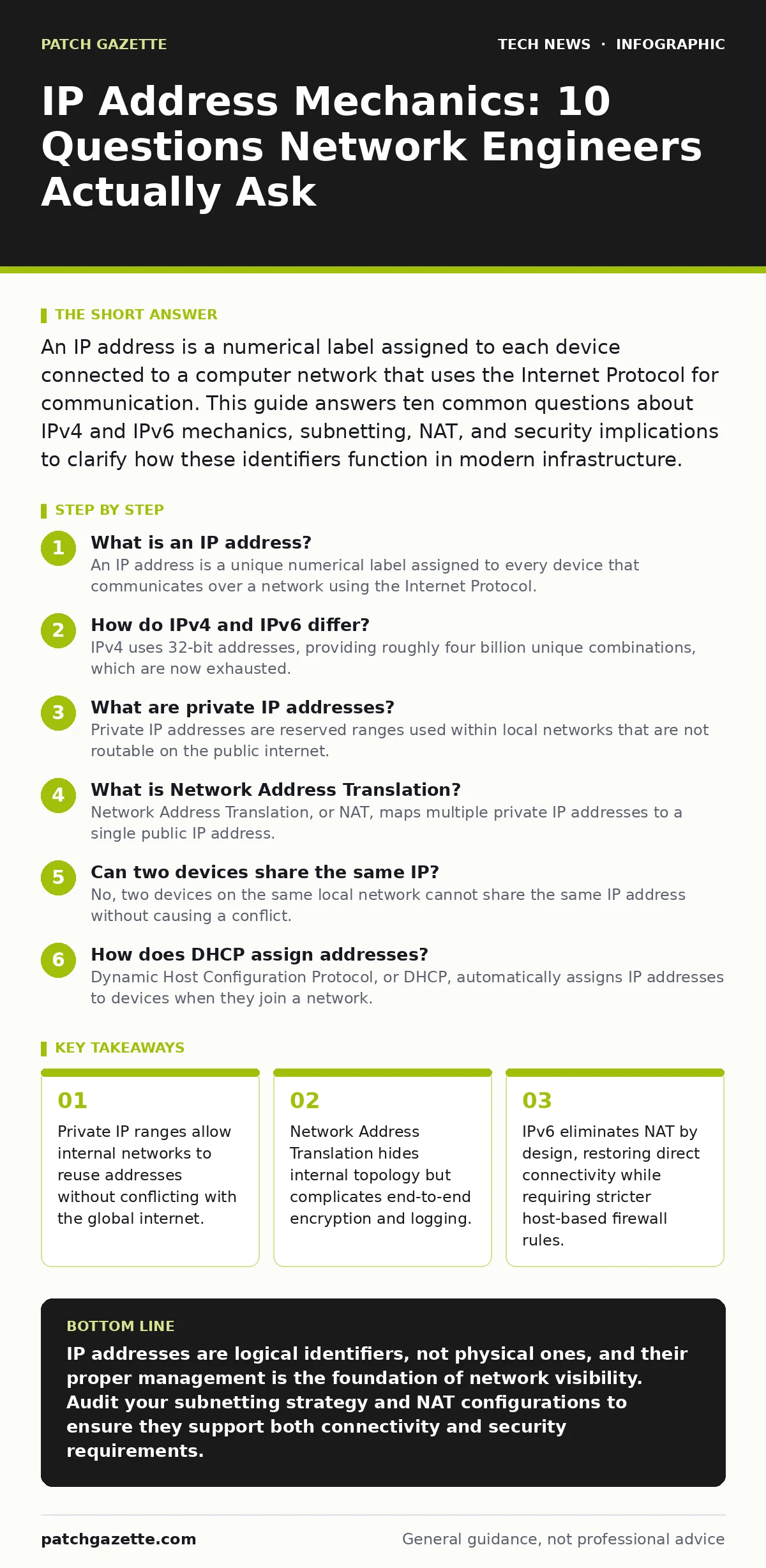
An IP address is a numerical label assigned to each device connected to a computer network that uses the Internet Protocol for communication. This guide answers ten common questions about IPv4 and IPv6 mechanics, subnetting, NAT, and security implications to clarify how these identifiers function in modern infrastructure.
What is an IP address?
An IP address is a unique numerical label assigned to every device that communicates over a network using the Internet Protocol. It functions like a postal address, ensuring data packets reach the correct destination. Without this identifier, routers cannot determine where to forward information.
How do IPv4 and IPv6 differ?
IPv4 uses 32-bit addresses, providing roughly four billion unique combinations, which are now exhausted. IPv6 uses 128-bit addresses, offering a virtually unlimited number of unique identifiers. The shift to IPv6 also simplifies header processing and improves routing efficiency.
What are private IP addresses?
Private IP addresses are reserved ranges used within local networks that are not routable on the public internet. These ranges include 10.0.0.0/8, 172.16.0.0/12, and 192.168.0.0/16. Devices using these addresses must rely on a gateway to communicate externally.
| Range Start | Range End | Subnet Mask | Usage Context |
|---|---|---|---|
| 10.0.0.0 | 10.255.255.255 | 255.0.0.0 | Large internal networks |
| 172.16.0.0 | 172.31.255.255 | 255.240.0.0 | Medium enterprise networks |
| 192.168.0.0 | 192.168.255.255 | 255.255.0.0 | Small offices and homes |
What is Network Address Translation?
Network Address Translation, or NAT, maps multiple private IP addresses to a single public IP address. This technique conserves public address space and hides internal network structure from external observers. However, it breaks strict end-to-end connectivity, which can complicate peer-to-peer applications.
Can two devices share the same IP?
No, two devices on the same local network cannot share the same IP address without causing a conflict. When a conflict occurs, both devices experience intermittent or total loss of connectivity. Routers become confused about which device should receive incoming traffic.
See also: Guest Wi-Fi Explained: Isolate Traffic Without Compromising Security · Cloud Firewalls: Real Benefits and Hidden Limits
How does DHCP assign addresses?
Dynamic Host Configuration Protocol, or DHCP, automatically assigns IP addresses to devices when they join a network. The server leases an address for a specific duration, after which the device must renew it. This automation reduces manual configuration errors but requires careful scope management.
What is a subnet mask?
A subnet mask defines which part of an IP address identifies the network and which part identifies the host. It acts as a filter, allowing devices to determine if a destination is local or remote. Incorrect mask settings cause devices to send local traffic to the default gateway unnecessarily.
Why use IPv6 instead of IPv4?
IPv6 provides a larger address space, eliminating the need for complex NAT configurations. It also includes mandatory IPsec support for encryption and authentication at the network layer. The protocol supports better auto-configuration, reducing the administrative overhead of managing address assignments.
Is an IP address enough for security?
No, relying solely on IP addresses for access control is insufficient because addresses are easily spoofed. Attackers can craft packets with false source addresses to bypass simple filters. You must combine network segmentation with application-level authentication and monitoring.
Imagine a scenario where an attacker spoofs a trusted server's IP to inject malicious data into a cache. Without additional verification, other servers accept the data as legitimate. This highlights why IP-based trust is fragile.
How does IP tracking work?
IP tracking logs the source address of incoming requests to identify geographic location and internet service provider. It does not identify the specific individual, especially behind NAT or proxy servers. Law enforcement requires additional legal processes to correlate IP logs with subscriber accounts.
What is the impact on virtualization?
Virtualization allows multiple virtual machines to share a single physical host's network interface. Each VM requires its own IP address, either from a private range or a public pool. Proper isolation between VMs is critical to prevent lateral movement by attackers.
How does this relate to other controls?
Understanding IP mechanics supports broader security strategies, including virtualization security for isolating workloads. It also informs DevOps security by clarifying how containers interact with network namespaces. Proper addressing is a prerequisite for effective IT asset management, ensuring every device is accounted for.
What about endpoint encryption?
While IP addresses route traffic, they do not protect data in transit. You must implement encryption at the endpoint, such as FileVault for macOS or BitLocker for Windows, to protect data at rest. Network-level encryption complements these measures but does not replace them.
Final considerations for network design
Design your network with the principle of least privilege in mind. Segment critical assets into separate subnets to limit blast radius. Regularly review access control lists to ensure they align with current business needs.
Key takeaways
- Private IP ranges allow internal networks to reuse addresses without conflicting with the global internet.
- Network Address Translation hides internal topology but complicates end-to-end encryption and logging.
- IPv6 eliminates NAT by design, restoring direct connectivity while requiring stricter host-based firewall rules.
IP addresses are logical identifiers, not physical ones, and their proper management is the foundation of network visibility. Audit your subnetting strategy and NAT configurations to ensure they support both connectivity and security requirements.
Frequently asked questions
Can I hide my IP address completely?
You can mask your public IP using proxies or VPNs, but your local network administrator can still see your private IP and activity.
Do IPv6 addresses change frequently?
Many operating systems generate temporary IPv6 addresses for privacy, which change periodically to prevent long-term tracking.
Is it legal to scan IP addresses?
Scanning your own network is generally legal, but scanning external networks without permission may violate laws against unauthorized access.
How do I find my public IP?
You can determine your public IP by visiting a web service that displays the source address of your request.
How this guide was produced: written by the Patch Gazette editorial team with AI assistance, checked against the public references listed below, and reviewed when the facts change. See our editorial policy or report an error.