
Hybrid Cloud Security Mistakes: 7 Errors That Break Your Defense
Identity misconfigurations and unmanaged service accounts create silent backdoors that bypass perimeter controls and expose sensitive data across environments.
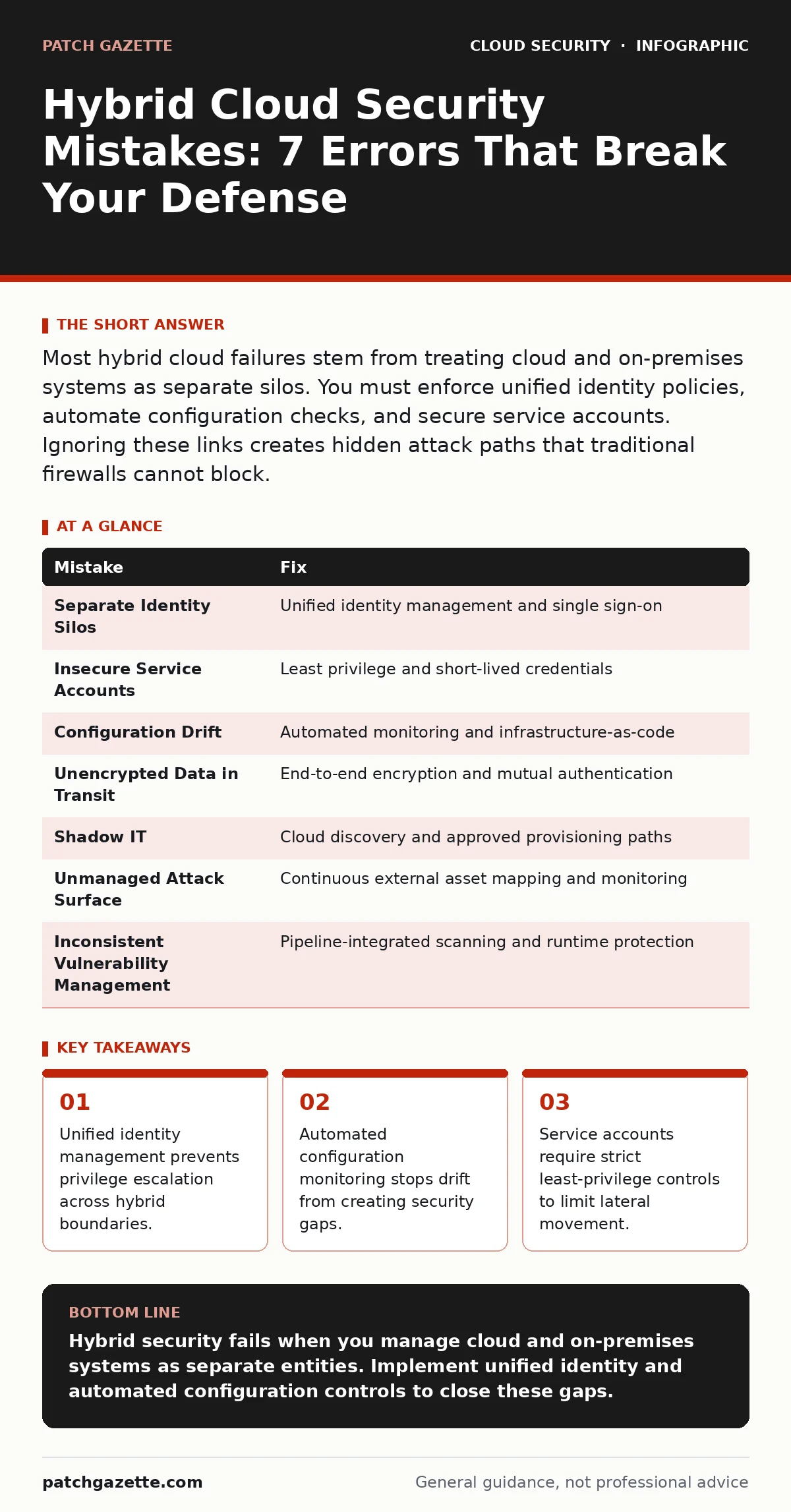
Most hybrid cloud failures stem from treating cloud and on-premises systems as separate silos. You must enforce unified identity policies, automate configuration checks, and secure service accounts. Ignoring these links creates hidden attack paths that traditional firewalls cannot block.
Mistake 1: Treating Cloud and On-Premises Identity as Separate Silos
Why it hurts:
You maintain distinct identity directories for your data center and your cloud provider. This fragmentation creates blind spots. An attacker who compromises a low-privilege on-premises account can pivot to the cloud if identity verification is not synchronized. The lack of a single source of truth allows inconsistent permission levels. You cannot easily audit who has access to what. This gap enables privilege escalation attacks that bypass standard monitoring tools. The security team sees two separate logs but misses the connection between them.
The fix:
Implement a unified identity and access management system. Connect your on-premises directory service to your cloud identity provider using standard protocols. Enforce single sign-on across all environments. This ensures that when an employee leaves or changes roles, their access is revoked everywhere simultaneously. You gain a complete view of user activity. Regularly review access rights to ensure they match current job functions. Centralized logging helps you detect anomalies that span both environments.
Mistake 2: Ignoring Service Account Security in Automation Pipelines
Why it hurts:
Service accounts power your automation tools, CI/CD pipelines, and backup systems. You often grant these accounts broad permissions to ensure reliability. This convenience becomes a liability. If an attacker compromises a service account, they gain automated access to critical infrastructure. These accounts rarely have human oversight, so unusual activity goes unnoticed. The broad permissions allow lateral movement across the hybrid environment. You effectively hand the attacker a master key that works in both cloud and on-premises systems.
The fix:
Apply the principle of least privilege to every service account. Define the exact permissions required for each task. Use short-lived credentials instead of long-term static keys. Rotate secrets automatically through a secure vault. Monitor service account activity with the same rigor as human user activity. Alert on any deviation from expected behavior. This limits the blast radius if a credential is stolen. You reduce the risk of automated attacks spreading unchecked.
Mistake 3: Allowing Configuration Drift Without Automated Checks
Why it hurts:
Your initial cloud setup meets security standards. Over time, engineers make manual changes to fix issues or add features. These changes accumulate and diverge from the baseline. This configuration drift creates vulnerabilities. A firewall rule might be opened for debugging and never closed. A storage bucket might become publicly accessible. You lose visibility into your actual security posture. Manual audits are too slow to catch these changes. The gap between intended and actual configuration grows wider. Attackers exploit these temporary openings before you notice.
The fix:
Deploy continuous configuration monitoring tools. Compare your live environment against approved baselines automatically. Alert immediately when any resource deviates from the standard. Use infrastructure-as-code to enforce desired states. This ensures that any manual change is either rejected or recorded. You can revert unauthorized changes quickly. Regular audits of the infrastructure-as-code templates prevent bad practices from entering the pipeline. This approach maintains consistency across your hybrid setup.
Mistake 4: Failing to Secure Data in Transit Between Environments
Why it hurts:
Data moves between your on-premises data center and cloud services constantly. You might assume the private network connection is secure. However, misconfigured encryption settings can expose this traffic. If you do not enforce strong encryption protocols, attackers can intercept sensitive data. This includes intellectual property, customer records, and authentication tokens. The assumption of security creates a false sense of safety. You also face compliance risks if data residency requirements are violated during transmission. Unencrypted traffic is easy to sniff and analyze.
The fix:
Enforce end-to-end encryption for all data in transit. Use strong, modern cryptographic protocols for all connections. Verify certificates and enforce mutual authentication where possible. Monitor for any attempts to downgrade encryption standards. Ensure that your private network connections are properly segmented. This prevents unauthorized access even if the perimeter is breached. Regularly update your encryption keys and algorithms. This protects your data regardless of where it travels.
Mistake 5: Overlooking Shadow IT in Hybrid Deployments
Why it hurts:
Teams often provision cloud resources without IT approval to speed up projects. This shadow IT creates unmanaged assets. These resources lack security controls, monitoring, and patching. They become easy entry points for attackers. You have no visibility into data stored or processed on these instances. Compliance violations occur because you cannot audit or control them. The financial cost of cleaning up these resources is high. More importantly, they expand your attack surface significantly. You are defending a perimeter you do not fully understand.
The fix:
Implement cloud discovery tools that scan for unauthorized resources. Integrate these tools with your security information and event management system. Establish clear policies for cloud resource provisioning. Provide approved, secure alternatives that meet team needs. Educate developers on the risks of unmanaged resources. Make it easier to do the right thing than the wrong thing. Regularly review and decommission unused resources. This reduces clutter and improves security visibility.
See also: Digital certificates examples: real-world uses and hidden risks · How Cloud Ransomware Works: The Step-by-Step Attack Chain
Mistake 6: Neglecting Cloud Attack Surface Management
Why it hurts:
Your attack surface grows with every new service and integration. You might focus on known vulnerabilities but miss exposed endpoints. Publicly accessible storage buckets, open management ports, and misconfigured APIs create risks. Attackers scan for these exposures automatically. Once found, they can exploit them without needing to breach your perimeter. Traditional vulnerability scanners often miss cloud-specific configurations. You are defending against threats you cannot see. This blind spot allows attackers to establish a foothold undetected.
The fix:
Continuously map your external attack surface. Identify all internet-facing assets and their configurations. Prioritize remediation based on risk exposure. Integrate cloud attack surface management with your incident response plans. This ensures you can react quickly to new exposures. Regularly test for common misconfigurations. Use automated tools to detect changes in your external footprint. This proactive approach keeps your defenses aligned with your current state.
Mistake 7: Inconsistent Cloud Vulnerability Management
Why it hurts:
You scan on-premises servers regularly but treat cloud instances differently. Cloud resources are ephemeral and scale dynamically. Traditional scanning methods fail to keep up. Unpatched vulnerabilities in container images or serverless functions go unnoticed. Attackers exploit these known weaknesses quickly. The lack of consistent vulnerability management leaves gaps in your defense. You cannot prioritize fixes effectively without a unified view. This inconsistency leads to a fragmented security posture.
The fix:
Integrate vulnerability scanning into your CI/CD pipeline. Scan images and configurations before deployment. Use runtime protection to detect threats in live environments. Correlate findings across hybrid environments. Prioritize remediation based on exploitability and impact. Automate patching where possible. This ensures that vulnerabilities are addressed before they become incidents. Consistent processes reduce the complexity of managing diverse infrastructure.
| Mistake | Fix |
|---|---|
| Separate Identity Silos | Unified identity management and single sign-on |
| Insecure Service Accounts | Least privilege and short-lived credentials |
| Configuration Drift | Automated monitoring and infrastructure-as-code |
| Unencrypted Data in Transit | End-to-end encryption and mutual authentication |
| Shadow IT | Cloud discovery and approved provisioning paths |
| Unmanaged Attack Surface | Continuous external asset mapping and monitoring |
| Inconsistent Vulnerability Management | Pipeline-integrated scanning and runtime protection |
Key takeaways
- Unified identity management prevents privilege escalation across hybrid boundaries.
- Automated configuration monitoring stops drift from creating security gaps.
- Service accounts require strict least-privilege controls to limit lateral movement.
Hybrid security fails when you manage cloud and on-premises systems as separate entities. Implement unified identity and automated configuration controls to close these gaps.
Frequently asked questions
How do I secure service accounts in a hybrid environment?
Use short-lived credentials generated by a secure vault. Apply least-privilege permissions and monitor activity for anomalies. Rotate secrets automatically to limit exposure.
What is the biggest risk of configuration drift?
Drift creates unmanaged vulnerabilities that deviate from security baselines. Automated monitoring detects these changes immediately, allowing you to enforce compliance and revert unauthorized modifications.
How can I detect shadow IT in the cloud?
Deploy cloud discovery tools that scan for unauthorized resources. Integrate these findings with your security monitoring to identify unmanaged assets and enforce provisioning policies.
Why is unified identity management critical for hybrid security?
It provides a single source of truth for access rights. This prevents privilege escalation and ensures that access is revoked consistently across all environments when roles change.
How this guide was produced: written by the Patch Gazette editorial team with AI assistance, checked against the public references listed below, and reviewed when the facts change. See our editorial policy or report an error.