How Cloud Ransomware Works: The Step-by-Step Attack Chain
Attackers bypass perimeter defenses by exploiting misconfigurations and legitimate credentials to encrypt data directly within the cloud storage layer.
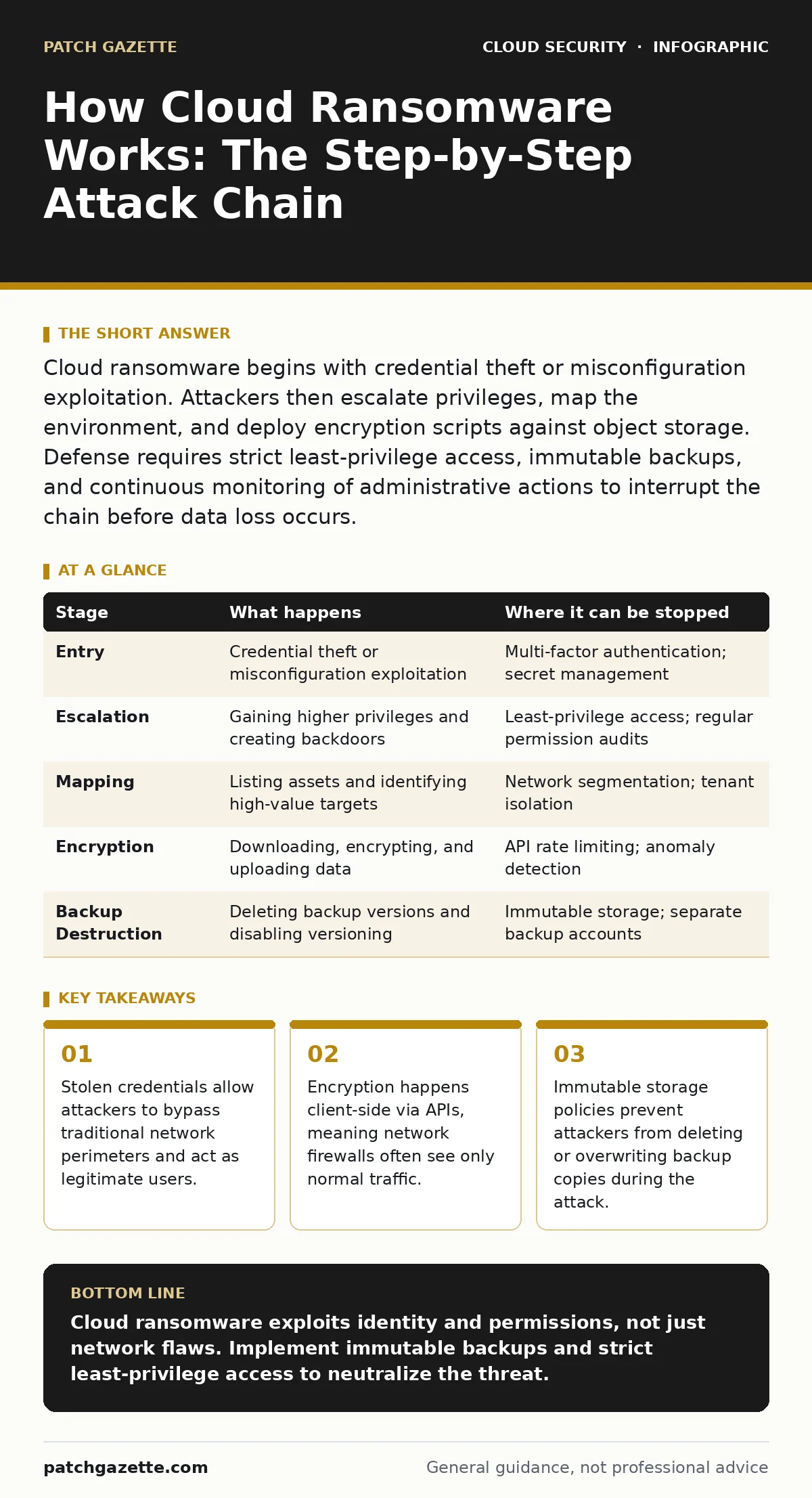
Cloud ransomware begins with credential theft or misconfiguration exploitation. Attackers then escalate privileges, map the environment, and deploy encryption scripts against object storage. Defense requires strict least-privilege access, immutable backups, and continuous monitoring of administrative actions to interrupt the chain before data loss occurs.
The Entry Vector: Beyond the Perimeter
Traditional ransomware relies on exploiting network vulnerabilities or phishing emails to gain initial access. In the cloud, the perimeter is porous. Attackers rarely brute-force external ports. Instead, they look for exposed administrative interfaces or compromised credentials. This shift changes the fundamental assumption that a firewall protects your data. The cloud provider’s infrastructure is secure, but your configuration of that infrastructure is the weak link.
Imagine an attacker finds a public-facing management console with weak authentication. They log in not as a hacker, but as a legitimate administrator. This is where cloud misconfigurations often provide the easiest entry. An open S3 bucket or a shared secret key in a public code repository gives them the keys to the kingdom without triggering any intrusion detection systems.
Privilege Escalation and Persistence
Once inside, the attacker needs more power. Initial access often comes with limited rights, sufficient to view data but not to encrypt it. The attacker searches for higher-level permissions. They exploit overly broad roles or forgotten service accounts. This phase is quiet. The goal is to create a backdoor that survives password resets or session timeouts.
They may create new administrative users or add their own API keys to existing roles. This persistence mechanism ensures that even if you detect the initial breach, they can return. Cloud vulnerability management must extend beyond software patches to include identity and access management reviews. If a service account has write access to production databases, it is a liability waiting to be exploited.
Environment Mapping and Data Discovery
The attacker now needs to know what to encrypt. They run scripts to list all storage buckets, databases, and virtual machines. This reconnaissance is rapid and automated. They identify high-value assets such as customer records, intellectual property, or financial data. They also look for backup systems. If backups are accessible with the same credentials as production data, they are marked for deletion.
This stage relies on the attacker’s ability to query the cloud API. The traffic looks like normal administrative activity. Most security tools do not flag listing objects or reading metadata. The attacker builds a map of your data topology. They prioritize targets that will cause the most operational disruption. This is why tenant isolation is critical; if one service is compromised, it should not reveal the structure of other services.
The Encryption Payload
Unlike traditional ransomware that installs malware on a server, cloud ransomware often uses the cloud’s own features. The attacker writes a script that iterates through the identified objects. For each object, they download it, encrypt it locally using a strong algorithm, and upload the encrypted version. They then delete the original. This client-side approach means the encryption happens outside the cloud provider’s control plane.
The attacker uses the legitimate API credentials they stole. To the cloud provider, this looks like a user modifying their own files. Cloud firewalls inspect network traffic, but they cannot easily distinguish between a legitimate bulk upload and a malicious encryption job if the traffic is encrypted and authenticated. The speed of execution depends on the attacker’s compute resources and the bandwidth available.
Backup Destruction and Exfiltration
Encryption is useless if you can restore from a clean backup. The attacker targets backup storage with the same fervor as production data. They look for versioning settings that allow deletion. If backups are stored in the same account with the same permissions, they are vulnerable. The attacker deletes recent versions and disables versioning if possible.
Some attackers also exfiltrate data before encryption. This adds leverage. If you refuse to pay, they threaten to publish the stolen data. This dual threat increases pressure. CIS Benchmarks recommend separating backup storage into a different account or region with distinct access controls. If the attacker cannot reach the backups, the ransomware loses its primary coercive power.
See also: Shadow IT: What It Is and How to Reduce the Hidden Risk · Cloud Vulnerability Management Mistakes That Leave Gaps Open
Extortion and Negotiation
With data encrypted and backups gone, the attacker leaves a note. They demand payment in cryptocurrency. They provide instructions for decryption. They may threaten further data release. This is the visible part of the attack. The damage is already done. The negotiation phase is where many organizations feel forced to pay. However, paying does not guarantee recovery. The attacker may not provide working keys.
Interrupting the Chain
You can stop this attack at multiple stages. The most effective defense is preventing initial access through strong identity controls. Multi-factor authentication blocks stolen passwords. Least-privilege access limits what an attacker can do if they do get in. If an account only has read access, it cannot encrypt data.
Monitoring is the next line of defense. Alert on unusual API calls, such as bulk deletions or changes to security settings. Serverless security risks often involve functions that have broad permissions. Review these functions regularly. Finally, immutable backups ensure that even if the attacker reaches your backups, they cannot delete them. This breaks the final step of the attack chain.
| Stage | What happens | Where it can be stopped |
|---|---|---|
| Entry | Credential theft or misconfiguration exploitation | Multi-factor authentication; secret management |
| Escalation | Gaining higher privileges and creating backdoors | Least-privilege access; regular permission audits |
| Mapping | Listing assets and identifying high-value targets | Network segmentation; tenant isolation |
| Encryption | Downloading, encrypting, and uploading data | API rate limiting; anomaly detection |
| Backup Destruction | Deleting backup versions and disabling versioning | Immutable storage; separate backup accounts |
The Hidden Cost of Trust
The cloud model shifts trust from the network to the identity. You trust the provider to secure the infrastructure. You must secure the identity. This is a harder problem. Identities are complex. They are shared, rotated, and often forgotten. Hybrid cloud security adds another layer of complexity, as identities may span on-premises and cloud environments.
The cost of this attack is not just the ransom. It is the downtime, the reputation damage, and the regulatory penalties. Preventing it requires a shift in mindset. You must assume that credentials will be stolen. Design your systems to limit the damage when that happens. This is the core of cloud security resilience.
Key takeaways
- Stolen credentials allow attackers to bypass traditional network perimeters and act as legitimate users.
- Encryption happens client-side via APIs, meaning network firewalls often see only normal traffic.
- Immutable storage policies prevent attackers from deleting or overwriting backup copies during the attack.
Cloud ransomware exploits identity and permissions, not just network flaws. Implement immutable backups and strict least-privilege access to neutralize the threat.
Frequently asked questions
Can cloud providers recover data from ransomware?
Providers secure the infrastructure, not your data. If you encrypt or delete your data, they cannot reverse it. Responsibility lies with the customer.
Does multi-factor authentication stop cloud ransomware?
It stops credential theft, which is the most common entry point. It does not stop attacks that exploit misconfigurations or compromised sessions.
What is immutable storage?
It is storage that cannot be modified or deleted for a set period. This prevents attackers from wiping backups even if they gain access.
How do I detect ransomware in the cloud?
Monitor for unusual API activity, such as bulk deletions or permission changes. Look for spikes in data transfer or encryption operations.
How this guide was produced: written by the Patch Gazette editorial team with AI assistance, checked against the public references listed below, and reviewed when the facts change. See our editorial policy or report an error.