Configuration Drift: 6 Misreadings That Break Cloud Security
Configuration drift is not a one-time error but a continuous process where automated tools and human edits slowly degrade your security posture over time.
Configuration drift occurs when cloud resources diverge from their intended secure state due to manual changes, automated scaling, or silent API updates. It is not a static misconfiguration but a moving target. You must treat drift as a continuous process, not a one-time audit failure, to maintain security.
Misreading: Drift is a one-time setup error
Correct reading: Configuration drift is a continuous process, not a static snapshot. Many teams run a compliance scan at deployment, fix the findings, and assume the environment is secure. This assumption fails because cloud infrastructure is dynamic. Automated scaling groups create new instances that may inherit outdated templates. Emergency manual changes bypass change management workflows and remain in place long after the incident resolves. The baseline state decays the moment the deployment pipeline closes. You are not protecting a fixed object; you are managing a flowing river of settings.
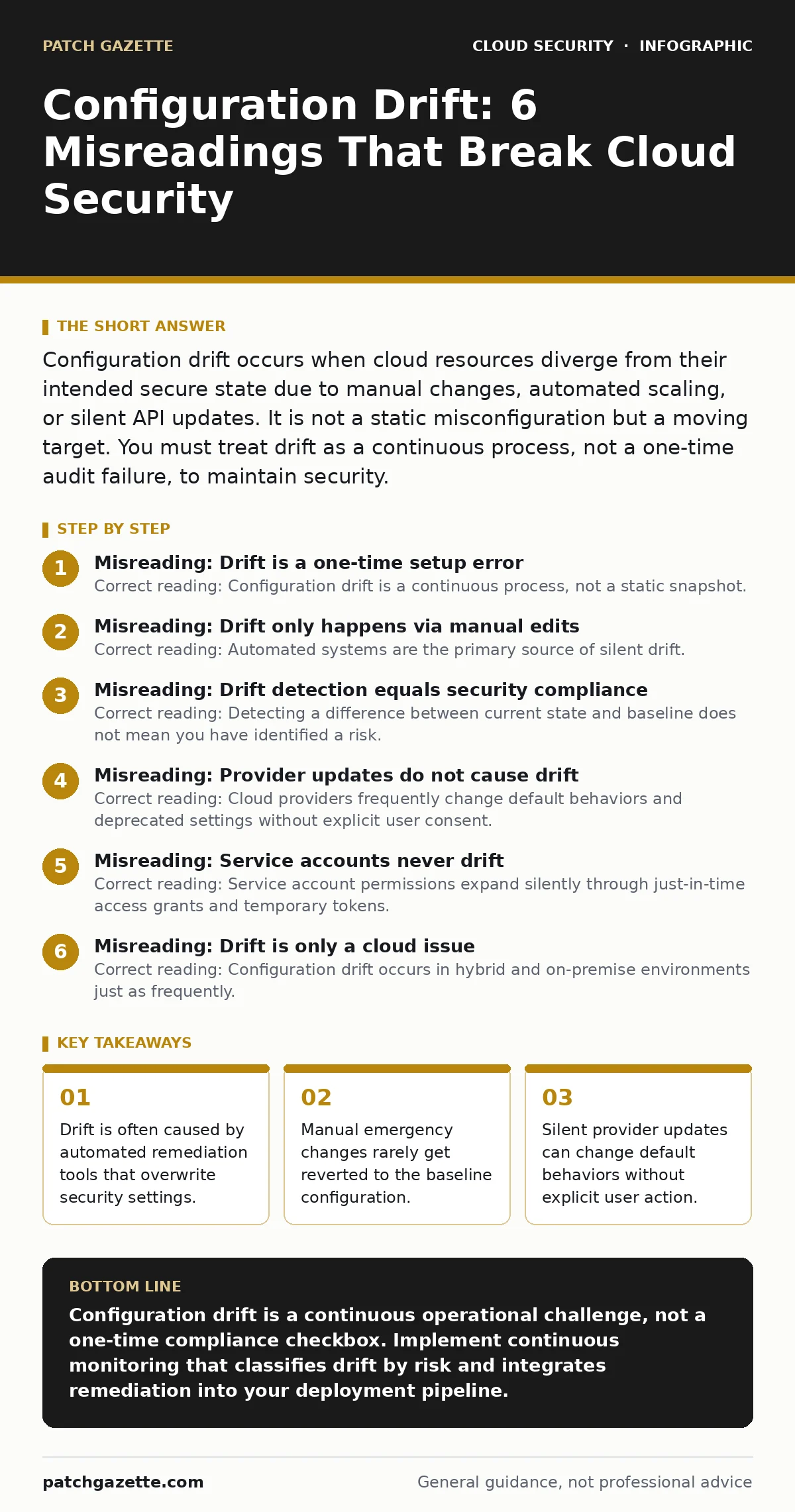
Misreading: Drift only happens via manual edits
Correct reading: Automated systems are the primary source of silent drift. Infrastructure as Code (IaC) tools often lack idempotency in complex cloud environments. When a script runs twice, it may not revert a setting to its original state if the cloud provider’s API behaves unexpectedly. Auto-remediation bots can conflict with each other, creating a cycle of changes that drifts further from the intended policy. For example, a bot might close a port to fix a vulnerability, while another bot reopens it to restore application functionality. The result is a configuration that satisfies neither security nor availability requirements.
Misreading: Drift detection equals security compliance
Correct reading: Detecting a difference between current state and baseline does not mean you have identified a risk. Most drift is benign, such as timestamp updates or internal IP address changes. Treating every deviation as a threat creates alert fatigue, causing operators to ignore genuine violations. You must classify drift by risk impact, not just by existence. A change to a logging retention policy is low risk. A change to network access control lists is high risk. Without this context, your monitoring tools become noise generators rather than security assets. This relates directly to how you manage your cloud attack surface.
Misreading: Provider updates do not cause drift
Correct reading: Cloud providers frequently change default behaviors and deprecated settings without explicit user consent. A service might update its default encryption standard or change the visibility scope of a resource. If your IaC templates rely on implicit defaults rather than explicit declarations, your infrastructure drifts as soon as the provider ships an update. You must pin versions and explicitly define all critical settings in your code. Relying on "secure by default" assumptions is dangerous because the definition of default shifts over time. This is a subtle form of cloud misconfigurations that audits often miss.
Misreading: Service accounts never drift
Correct reading: Service account permissions expand silently through just-in-time access grants and temporary tokens. Developers often request elevated permissions for debugging or maintenance tasks. These permissions are rarely revoked immediately after the task completes. Over time, a service account accumulates broad access rights that far exceed its operational needs. This drift is invisible to standard network monitors because no new network connections are made. The account already has the authority to act. You must audit permission scopes regularly, not just user identities. This overlaps significantly with service account security practices.
See also: Security Technical Debt: How to Measure and Pay It Down · Single Sign-On Misconceptions That Compromise Cloud Security
Misreading: Drift is only a cloud issue
Correct reading: Configuration drift occurs in hybrid and on-premise environments just as frequently. Hybrid cloud architectures introduce additional complexity because policies must align across disparate platforms. A security rule might be enforced strictly in the cloud but loosely in the data center due to legacy constraints. This inconsistency creates a path for attackers to pivot from the weaker environment to the stronger one. You cannot secure the cloud in isolation. Your security posture is only as strong as the weakest link in your hybrid chain. This is a core challenge in hybrid cloud security management.
Misreading: Shadow IT is separate from drift
Correct reading: Unmanaged resources created by developers without IT approval are a major source of drift. These resources often lack security baselines entirely. When they are eventually discovered and brought under management, they introduce new configuration patterns that differ from the official standard. Integrating these resources requires significant effort to align them with existing policies. If you do not have a process for discovering and onboarding unmanaged resources, your drift metrics will always be incomplete. This is a common symptom of shadow IT that undermines centralized control.
Misreading: Serverless eliminates drift
Correct reading: Serverless architectures still suffer from configuration drift, particularly in environment variables and permission bindings. Developers often update environment variables directly in the console for quick fixes. These changes are not captured in version control. When the function is redeployed from source, the manual changes are lost, or worse, they persist if the deployment script does not overwrite them. This creates inconsistency between environments. You must treat serverless configurations with the same rigor as traditional infrastructure. This is a hidden risk in serverless security risks that many teams overlook.
Misreading: Public repos are safe from drift
Correct reading: If your IaC templates are stored in public code repository leaks or accessible repositories, attackers can study your architecture and identify drift patterns. They can see how your security settings evolve over time. This historical data helps them predict your current state and find weaknesses that have not yet been patched. You must treat your infrastructure code as sensitive intellectual property. Restrict access to your repositories and audit who has push permissions. This reduces the risk of attackers exploiting known configuration patterns.
Key takeaways
- Drift is often caused by automated remediation tools that overwrite security settings.
- Manual emergency changes rarely get reverted to the baseline configuration.
- Silent provider updates can change default behaviors without explicit user action.
- Drift detection without context creates alert fatigue and missed threats.
Configuration drift is a continuous operational challenge, not a one-time compliance checkbox. Implement continuous monitoring that classifies drift by risk and integrates remediation into your deployment pipeline.
Frequently asked questions
How often should I scan for configuration drift?
Scan continuously or at least every hour. Cloud environments change rapidly, and manual scans miss transient vulnerabilities that exist for only minutes.
Can I automate all drift remediation?
No. Automate low-risk, well-understood corrections. Require human approval for changes that affect network access, encryption, or logging to prevent accidental outages.
Does drift affect serverless functions?
Yes. Environment variables and permission bindings in serverless architectures drift just like traditional servers. Treat function configurations as code and version them.
How do I distinguish intentional changes from drift?
Tag all intentional changes with a change request ID. Your monitoring tool should ignore deviations that have a valid, recent change record attached to them.
How this guide was produced: written by the Patch Gazette editorial team with AI assistance, checked against the public references listed below, and reviewed when the facts change. See our editorial policy or report an error.