Cloud Attack Surface Management: Mapping Hidden Entry Points
Static asset lists miss the dynamic nature of cloud infrastructure, leaving hidden entry points open to exploitation by attackers who exploit configuration drift.
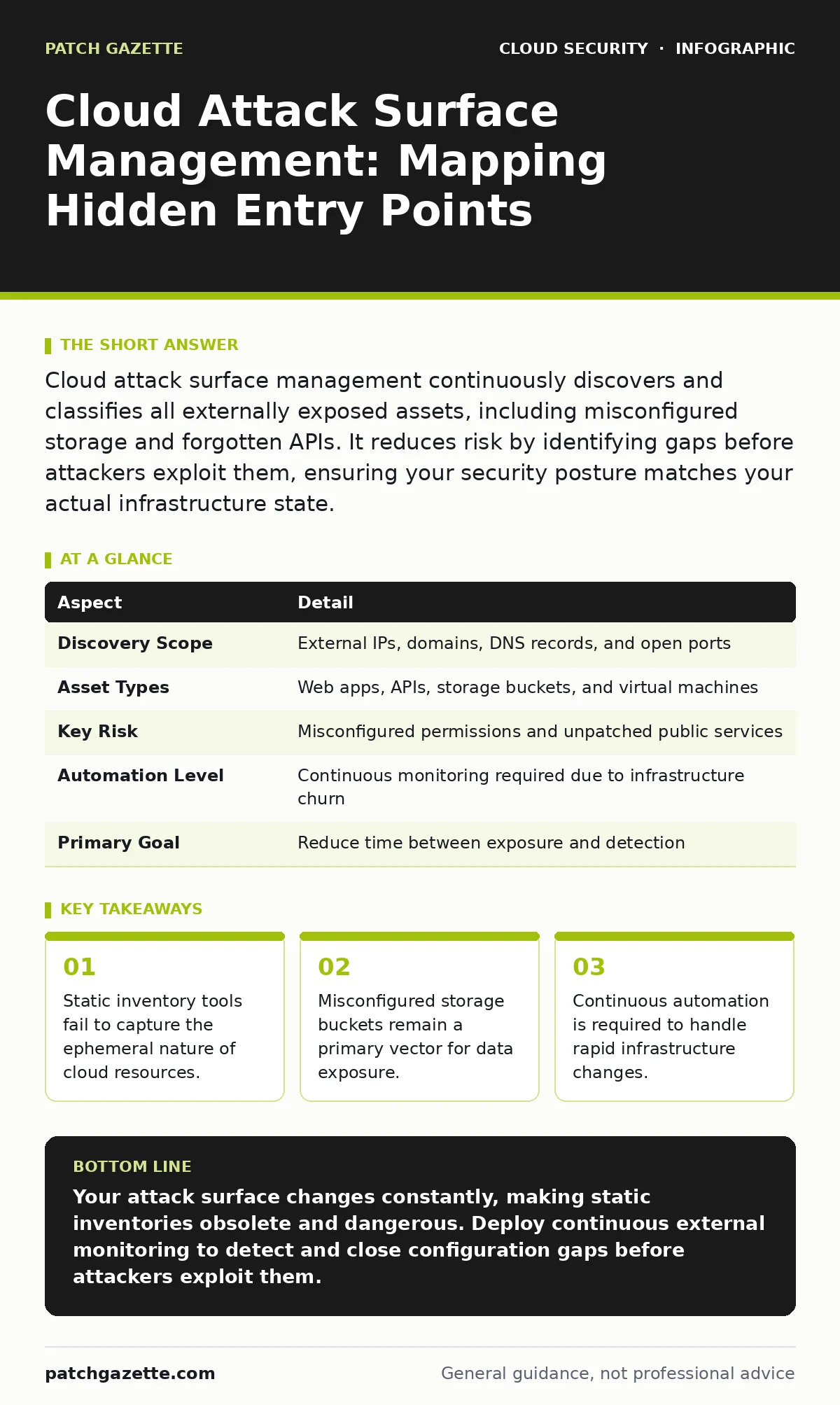
Cloud attack surface management continuously discovers and classifies all externally exposed assets, including misconfigured storage and forgotten APIs. It reduces risk by identifying gaps before attackers exploit them, ensuring your security posture matches your actual infrastructure state.
Defining the Cloud Attack Surface
The cloud attack surface consists of every point where an unauthorized user can try to enter or extract data from your cloud environment. This includes public-facing applications, storage containers, and API endpoints that connect services.
Traditional perimeter defense assumes a fixed boundary around your network. The cloud dissolves this boundary. Resources are created and destroyed in minutes. An attack surface is not a wall; it is a shifting map of exposed interfaces. You must track every IP address, domain, and service that accepts traffic from the internet.
Cloud attack surface management is the process of discovering, classifying, and monitoring these exposed points. It differs from internal vulnerability scanning. Internal scans check what you own. Attack surface management checks what the internet can see. This distinction matters because attackers do not need to breach your firewall. They only need to find one exposed configuration error.
At a Glance: Core Components
| Aspect | Detail |
|---|---|
| Discovery Scope | External IPs, domains, DNS records, and open ports |
| Asset Types | Web apps, APIs, storage buckets, and virtual machines |
| Key Risk | Misconfigured permissions and unpatched public services |
| Automation Level | Continuous monitoring required due to infrastructure churn |
| Primary Goal | Reduce time between exposure and detection |
How Continuous Discovery Works
Static inventory tools rely on what you tell them exists. They fail in dynamic environments. Cloud attack surface management tools probe the internet for your digital footprint. They map every asset that responds to external queries.
The process begins with passive monitoring. Tools watch for DNS changes and new certificate registrations. This reveals new domains or subdomains you may have forgotten. Next, active scanning checks these assets for open ports and known vulnerabilities. This step identifies misconfigured services that should not be public.
Imagine a developer deploys a test database for three days. They forget to delete it. The database remains accessible to the public internet. A static inventory tool might not list it if it was not tagged correctly. An attack surface management tool detects the open port and alerts the security team. This prevents data leakage before an attacker notices the exposure.
Who Bears the Risk
Every organization using public cloud services faces this risk. Small teams often lack the manual capacity to track changes. Large enterprises suffer from complexity. Multiple teams deploy resources independently. This creates shadow IT where assets exist outside central control.
Cloud attack surface management affects infrastructure teams, developers, and security officers. Developers create the exposure. Infrastructure teams manage the platforms. Security officers must detect the gaps. Misalignment between these groups leads to blind spots. If a developer assumes a service is private but configures it as public, the security team may never see the change.
The risk extends to third-party vendors. Many organizations grant vendors access to cloud environments. These connections expand the attack surface. You must monitor not only your own assets but also the interfaces your vendors use. Unmanaged third-party access introduces significant vulnerability.
Common Misconceptions About Exposure
Many organizations believe their firewall protects them. Firewalls block traffic based on rules. They do not prevent misconfiguration. If you set a storage bucket to "public," the firewall allows the traffic. The configuration error bypasses the defense.
Another misconception is that internal networks are safe. In cloud environments, internal services can accidentally become public. A simple error in a security group or network ACL can expose sensitive data. You cannot assume isolation. You must verify isolation continuously.
People also assume that cloud providers handle security. Providers secure the infrastructure. You secure your data and configurations. This shared responsibility model means you are liable for misconfigurations. Do not outsource your attack surface management to your provider.
See also: Why CIS Benchmarks Matter for Cloud Security Posture · Cloud Misconfigurations: Definition, Risks, and Remediation Strategies
Integrating With Existing Security Practices
Cloud attack surface management must integrate with your broader security strategy. It feeds data into your risk management process. When a new asset is detected, it must be classified. Is it approved? Is it configured securely?
This integration requires automation. Manual review cannot keep pace with cloud changes. You need automated workflows that flag anomalies. For example, if a new public IP appears, the system should check if it matches a known deployment pattern. If not, it triggers an alert.
Consider how this relates to configuration drift. Drift occurs when resources deviate from their intended state. Attack surface management detects the result of drift. It shows you what is different from your baseline. This allows you to correct errors before they become incidents.
Practical Steps for Implementation
Start by establishing a baseline. Map all currently known public assets. Compare this list against your asset inventory. Identify discrepancies. These discrepancies represent unknown risks.
Next, implement continuous monitoring. Set up automated scans that run daily or hourly. Frequency depends on your deployment velocity. Fast-moving environments need frequent checks. Configure alerts for high-risk findings, such as open database ports or public storage.
Integrate findings into your ticketing system. Security alerts must become actionable tasks. Assign ownership for each asset. If an asset is unowned, it becomes a liability. Define clear policies for asset retirement. Delete resources that are no longer needed. This reduces the surface area over time.
- Audit current public-facing assets and DNS records.
- Deploy automated scanning tools for continuous discovery.
- Establish alerts for misconfigured storage and open ports.
- Integrate findings with incident response workflows.
Addressing Specific Vulnerability Types
Storage misconfiguration is a frequent issue. Publicly accessible storage buckets leak sensitive data. You must enforce strict access controls on all storage containers. Use automated checks to verify that no bucket is open to the world.
Service account security is another critical area. Compromised service accounts allow attackers to move laterally. Ensure that service accounts use least-privilege principles. Rotate credentials regularly. Monitor for unusual access patterns from these accounts.
API exposure is growing. APIs provide functionality but also entry points. Secure your APIs with authentication and rate limiting. Document all APIs and ensure they are registered in your asset inventory. Unregistered APIs are hard to protect.
Key takeaways
- Static inventory tools fail to capture the ephemeral nature of cloud resources.
- Misconfigured storage buckets remain a primary vector for data exposure.
- Continuous automation is required to handle rapid infrastructure changes.
Your attack surface changes constantly, making static inventories obsolete and dangerous. Deploy continuous external monitoring to detect and close configuration gaps before attackers exploit them.
Frequently asked questions
How often should I scan my cloud attack surface?
Scan at least daily for most organizations. High-velocity environments require hourly or real-time scanning to catch ephemeral exposures quickly.
How do I handle false positives?
Establish a baseline of known good assets. Configure your tools to ignore these. Focus alerts on new or changed assets that do not match your baseline.
How this guide was produced: written by the Patch Gazette editorial team with AI assistance, checked against the public references listed below, and reviewed when the facts change. See our editorial policy or report an error.