
Why CIS Benchmarks Matter for Cloud Security Posture
CIS Benchmarks replace subjective security guesses with machine-readable configurations that reduce the attack surface before deployment.
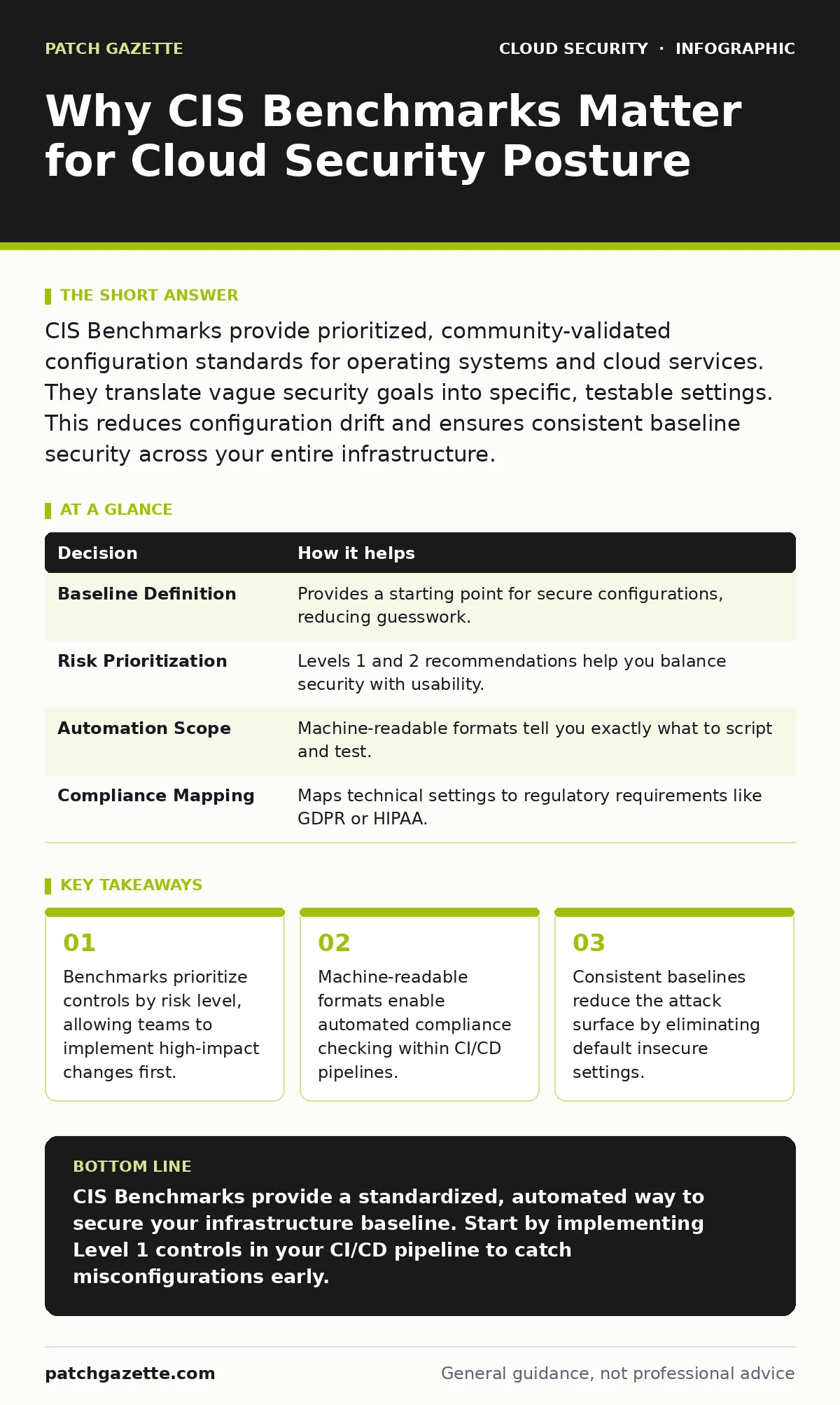
CIS Benchmarks provide prioritized, community-validated configuration standards for operating systems and cloud services. They translate vague security goals into specific, testable settings. This reduces configuration drift and ensures consistent baseline security across your entire infrastructure.
The Problem with Default Configurations
Cloud services and operating systems ship with defaults designed for usability, not security. These defaults often leave ports open, allow weak authentication methods, or grant excessive permissions. You inherit these settings every time you provision a new resource. Relying on manual review to fix them is slow and error-prone. Humans miss details when tired or rushed. Automated processes do not get tired.
The Center for Internet Security (CIS) Benchmarks address this gap. They are community-developed configuration standards for specific technologies. These documents detail exactly which settings to enable and which to disable. They prioritize recommendations based on risk and operational impact. This allows you to secure systems without breaking functionality.
How Teams Use the Standards
Teams use these benchmarks to define their security baseline. This baseline becomes the source of truth for all infrastructure. You integrate the checks into your deployment pipeline. Before any code or configuration reaches production, a tool scans it against the benchmark. If it fails, the deployment stops. This shift-left approach catches issues early.
You also use them for continuous monitoring. Existing infrastructure drifts over time. Administrators change settings to fix immediate problems. These changes often bypass security controls. Automated tools compare live configurations against the benchmark. They alert you when a system deviates from the expected state. This maintains integrity over time.
Decisions Informed by the Framework
The benchmarks inform critical architectural and operational decisions. They help you determine which controls are mandatory and which are optional. This clarity prevents analysis paralysis. You can focus resources on high-risk areas.
| Decision | How it helps |
|---|---|
| Baseline Definition | Provides a starting point for secure configurations, reducing guesswork. |
| Risk Prioritization | Levels 1 and 2 recommendations help you balance security with usability. |
| Automation Scope | Machine-readable formats tell you exactly what to script and test. |
| Compliance Mapping | Maps technical settings to regulatory requirements like GDPR or HIPAA. |
What Goes Wrong Without It
Without a standardized baseline, your environment becomes inconsistent. Different teams configure servers differently. Some lock down access; others leave it wide open for convenience. This inconsistency creates blind spots. Attackers exploit the weakest link. They do not care if most of your infrastructure is secure. They only need one vulnerable entry point.
This lack of standardization also complicates incident response. When a breach occurs, you cannot quickly determine the scope. You do not know which systems share the same misconfiguration. You must manually inspect each resource. This delays containment and increases damage. Consistent baselines allow you to query your entire fleet for specific risks instantly.
The Hidden Cost of Rigidity
A common mistake is treating the benchmarks as a rigid checklist. You implement every recommendation without context. This often breaks legitimate business functionality. For example, disabling all outbound traffic might stop a critical update mechanism. You end up with a secure but unusable system.
The benchmarks are designed to be layered. Level 1 contains hardening measures that are easy to implement and have low impact. Level 2 adds stricter controls that may require more effort. You should start with Level 1. Evaluate Level 2 controls against your specific use case. This balanced approach ensures security does not hinder operations.
See also: Shadow IT: What It Is and How to Reduce the Hidden Risk · Cloud Vulnerability Management Mistakes That Leave Gaps Open
Integrating with Cloud Controls
These benchmarks work best when combined with other security measures. They define the configuration state, but they do not control network traffic. You need separate mechanisms for that. For instance, cloud firewalls manage ingress and egress rules. The benchmarks tell you to disable unused ports, while the firewall enforces that rule.
They also complement identity management. Secure configurations are useless if credentials are compromised. Service account security ensures that only authorized processes can access resources. The benchmarks help you configure these accounts correctly, but you must also monitor their usage. Combining configuration hardening with strict access controls creates a defense in depth.
Addressing Configuration Drift
Configuration drift is the natural tendency of systems to change from their secure baseline. Administrators make small tweaks to solve immediate problems. These tweaks accumulate and degrade security. Manual audits cannot keep pace with this change. You need automated enforcement.
Tools that support the benchmarks can detect drift in real-time. They compare the current state of a resource against the desired state. If a difference is found, they can alert you or even auto-remediate the issue. This keeps your environment consistent. It also provides an audit trail for compliance purposes. You can prove that your systems remained secure throughout their lifecycle.
Beyond the Basics
While the benchmarks cover core infrastructure, they do not address every cloud-specific risk. You must also consider cloud misconfigurations in storage buckets and databases. These are often separate from OS-level settings. Additionally, shadow IT can bypass your standardized configurations entirely. Users may spin up resources outside your control.
You should also look at serverless security risks. Traditional benchmarks focus on persistent infrastructure. Serverless functions are ephemeral. They require different validation strategies. Combining CIS Benchmarks with specialized cloud security guides ensures full coverage. This layered approach protects your environment from multiple angles.
Key takeaways
- Benchmarks prioritize controls by risk level, allowing teams to implement high-impact changes first.
- Machine-readable formats enable automated compliance checking within CI/CD pipelines.
- Consistent baselines reduce the attack surface by eliminating default insecure settings.
CIS Benchmarks provide a standardized, automated way to secure your infrastructure baseline. Start by implementing Level 1 controls in your CI/CD pipeline to catch misconfigurations early.
Frequently asked questions
Are CIS Benchmarks legally required?
No, they are voluntary standards. However, many regulatory frameworks reference them as best practices for demonstrating due care.
How often should I update my benchmarks?
Review them whenever the underlying software or service receives a major update. New vulnerabilities or features may require configuration changes.
Can I use these for on-premise servers?
Yes, CIS provides benchmarks for many operating systems and applications regardless of where they are hosted.
What is the difference between Level 1 and Level 2?
Level 1 focuses on basic hardening with minimal impact. Level 2 includes stricter controls that may require more resources and careful testing.
How this guide was produced: written by the Patch Gazette editorial team with AI assistance, checked against the public references listed below, and reviewed when the facts change. See our editorial policy or report an error.