Serverless Security Risks: Protecting Small Teams from Hidden Cloud Threats
Small teams face unique serverless risks because the provider manages infrastructure, shifting the security burden entirely to code and configuration.
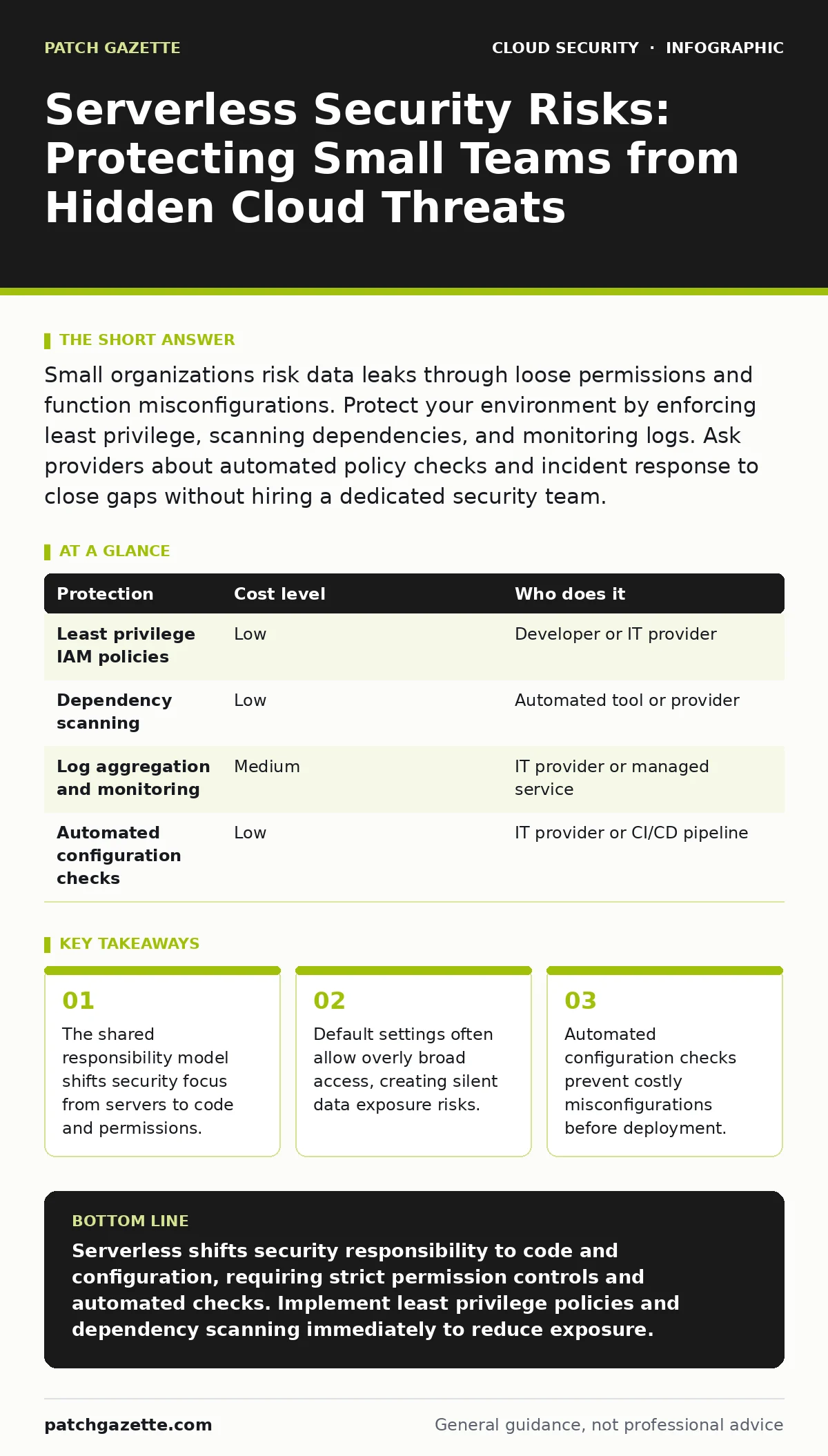
Small organizations risk data leaks through loose permissions and function misconfigurations. Protect your environment by enforcing least privilege, scanning dependencies, and monitoring logs. Ask providers about automated policy checks and incident response to close gaps without hiring a dedicated security team.
The Shared Responsibility Shift
Serverless computing removes the need to manage operating systems or patch servers. The cloud provider handles the underlying infrastructure. You manage the code, the configuration, and the data. This shift creates a false sense of security. Many teams assume that because the provider secures the hardware, their application is secure by default. It is not.
The attack surface moves from network perimeters to application logic. In a traditional server, you might block ports. In serverless, you must verify that every function has the minimum permissions required. If a function can read all storage buckets, a compromised function exposes all data. This is a fundamental change in how you think about defense.
Small organizations are exposed because they often reuse code snippets without auditing permissions. They lack the processes to review every deployment. The speed of serverless development outpaces manual security checks. Without automation, mistakes propagate quickly.
Default Permissions as Silent Risks
Cloud platforms often assign default permissions that are too broad for production use. These defaults enable rapid testing but create serious vulnerabilities when forgotten. A function might inherit the ability to modify resources it only needs to read. This violates the principle of least privilege.
Imagine a billing function that only needs to write to a specific database. If it is granted full database access, an attacker who exploits a bug in that function can delete other customers' records. The damage extends beyond the intended scope.
You must audit permissions regularly. Look for wildcard permissions that allow access to all resources of a type. Replace them with specific resource IDs. This limits the blast radius of any single compromise. It is a low-cost change that significantly reduces risk.
| Protection | Cost level | Who does it |
|---|---|---|
| Least privilege IAM policies | Low | Developer or IT provider |
| Dependency scanning | Low | Automated tool or provider |
| Log aggregation and monitoring | Medium | IT provider or managed service |
| Automated configuration checks | Low | IT provider or CI/CD pipeline |
Code Dependencies and Supply Chain
Serverless functions rely on external libraries. These libraries are part of your supply chain. If a library contains a vulnerability, your function is vulnerable. You do not control the code in these libraries. You must verify their safety.
Many small teams install packages without checking for known issues. This is a common entry point for attackers. They exploit known bugs in popular libraries to execute malicious code. The attack does not target your code directly. It targets the tools you trust.
Use automated scanning tools to check dependencies before deployment. These tools compare your libraries against databases of known vulnerabilities. They alert you to risky versions. You can then update or replace the library. This step adds minutes to your deployment but prevents hours of incident response.
Configuration Drift and Misconfigurations
Serverless architectures are complex. They involve multiple services interacting through APIs. Misconfigurations in one service can expose others. For example, a storage bucket might be publicly readable if not configured correctly. This is a common error in cloud misconfigurations.
Configuration drift occurs when settings change over time. A developer might open an API for testing and forget to close it. The application continues to work, but it is now exposed. Manual reviews cannot catch these changes reliably.
Automate your configuration checks. Use policy-as-code tools to define allowed settings. These tools enforce rules during deployment. They reject configurations that violate security standards. This prevents drift before it becomes a problem. Review related topics in our guide on cloud firewalls to understand how network controls complement these application-level checks.
Logging and Visibility Challenges
Serverless functions are ephemeral. They run and then disappear. This makes logging difficult. If you do not capture logs at the point of execution, you lose them. Without logs, you cannot detect attacks or debug issues.
Many teams neglect logging to save costs. This is a mistake. Logs are your only evidence of what happened. They show who accessed data and when. They help you understand the impact of a breach. You need centralized logging to correlate events across functions.
Set up log aggregation early. Ensure logs include context like user identity and request details. Do not log sensitive data like passwords or credit card numbers. Balance visibility with privacy. Proper logging is critical for service account security as it tracks automated access patterns.
See also: How Cloud Ransomware Works: The Step-by-Step Attack Chain · Shadow IT: What It Is and How to Reduce the Hidden Risk
Protecting Against Shadow IT
Serverless makes it easy for individual developers to create applications. They might use personal accounts or unapproved services. This is shadow IT. It bypasses security controls and visibility. You do not know what is running or where data is going.
Small teams often lack formal approval processes. A developer might spin up a function to test an idea. If it works, it stays. This function is not monitored. It is not patched. It is a blind spot.
Establish clear policies for resource creation. Require all serverless resources to be deployed through a central pipeline. This ensures security checks are applied. It also provides visibility into all running functions. Check our guide on shadow IT for strategies to manage unauthorized cloud usage.
Questions for Your IT Provider
If you outsource serverless management, you must verify their security practices. Ask specific questions to ensure they are protecting your environment. Do not accept vague assurances.
- How do you enforce least privilege for IAM roles?
- What tools do you use to scan dependencies for vulnerabilities?
- How do you monitor for configuration drift and misconfigurations?
- What is your process for incident response in a serverless environment?
- How do you ensure logs are collected and retained securely?
Integrating with Broader Security
Serverless security does not exist in isolation. It must align with your broader cloud strategy. If you use multiple providers, consider multi-cloud security challenges. Consistent policies are harder to enforce across different platforms.
Ensure your serverless functions are properly secured within virtual private clouds. Network segmentation limits lateral movement if a function is compromised. Also, review hybrid cloud security if you mix serverless with on-premises systems.
Use CIS Benchmarks as a starting point for configuration. These are industry-standard guidelines for securing cloud environments. They provide a baseline for best practices. Adapting them to your specific needs ensures you cover critical areas.
Key takeaways
- The shared responsibility model shifts security focus from servers to code and permissions.
- Default settings often allow overly broad access, creating silent data exposure risks.
- Automated configuration checks prevent costly misconfigurations before deployment.
Serverless shifts security responsibility to code and configuration, requiring strict permission controls and automated checks. Implement least privilege policies and dependency scanning immediately to reduce exposure.
Frequently asked questions
Does serverless automatically secure my data?
No. Serverless secures the underlying infrastructure, but you must secure the data, permissions, and application code yourself.
How do I prevent permission creep in serverless?
Use automated tools to audit and enforce least privilege policies on every deployment, removing unnecessary access.
Is serverless more secure than traditional servers?
It reduces infrastructure risks but increases application and configuration risks. Both require distinct security approaches.
What is the biggest risk for small teams using serverless?
Misconfigurations and overly broad permissions, which often go unnoticed due to lack of automated monitoring.
How this guide was produced: written by the Patch Gazette editorial team with AI assistance, checked against the public references listed below, and reviewed when the facts change. See our editorial policy or report an error.