Cloud Misconfigurations: Definition, Risks, and Remediation Strategies
Most cloud breaches occur not because of software flaws, but because administrators left default settings open to the public internet by accident.
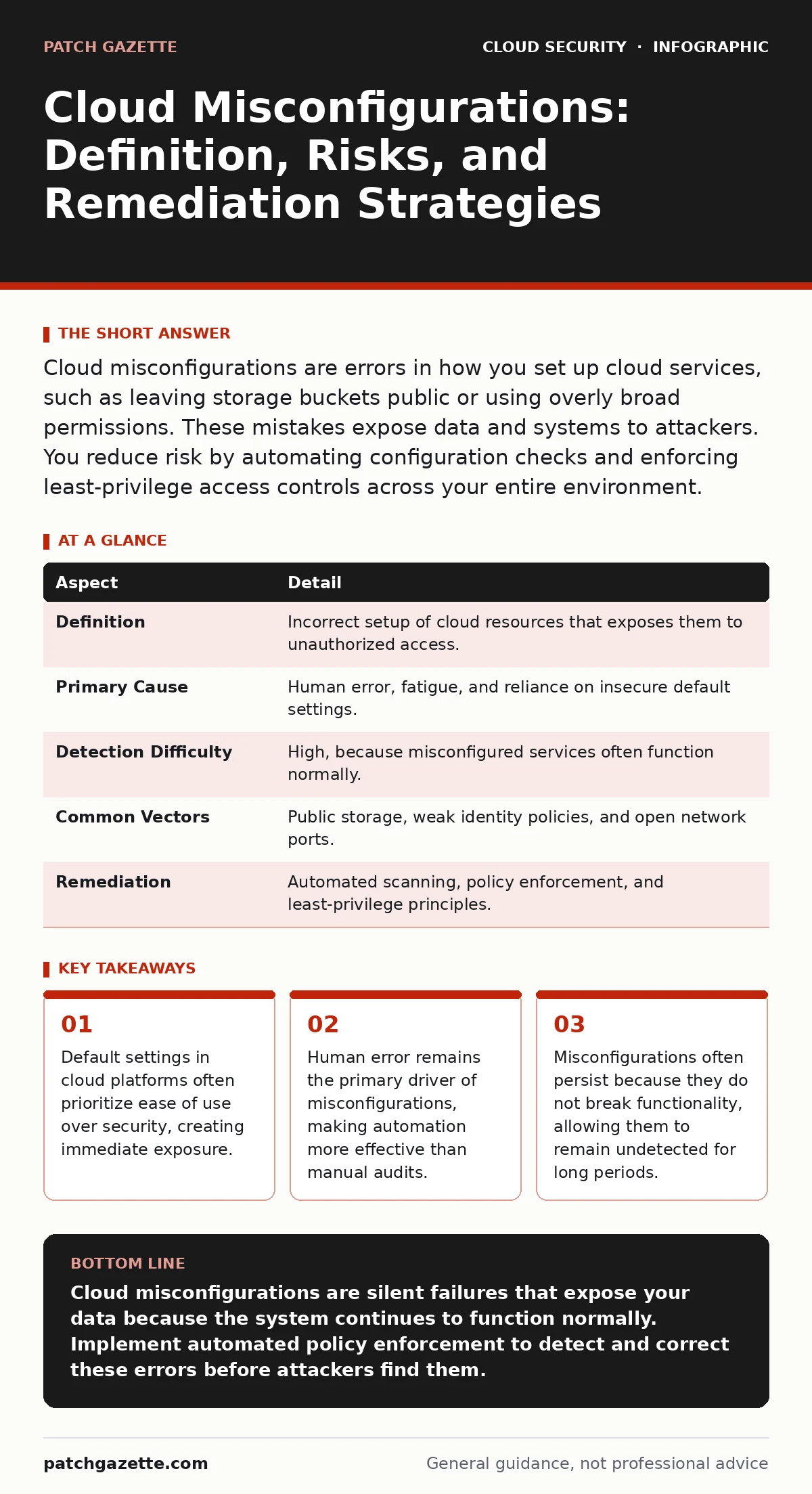
Cloud misconfigurations are errors in how you set up cloud services, such as leaving storage buckets public or using overly broad permissions. These mistakes expose data and systems to attackers. You reduce risk by automating configuration checks and enforcing least-privilege access controls across your entire environment.
The Open Door Analogy
Imagine renting a safe deposit box. The bank provides the vault, but you choose the combination. If you set the combination to 0-0-0-0 because you were in a hurry, the vault is technically secure, but your settings are not. Cloud misconfigurations work the same way. The underlying infrastructure is built by experts, but you control how it is exposed and accessed.
When you deploy a service, you make dozens of choices about visibility, access, and encryption. A misconfiguration happens when one of those choices defaults to an insecure state, or when you manually select an insecure option. The cloud provider does not fix this for you. They assume you know what you are doing.
Anatomy of a Configuration Error
A cloud misconfiguration is a deviation from the intended secure state of a resource. It is not a bug in the code of the application, nor is it a flaw in the hypervisor. It is a mistake in the policy or setup. These errors create attack surfaces where none should exist.
The root cause is almost always human. Developers want speed. Administrators want simplicity. Cloud consoles are complex, with thousands of toggle switches. It is easy to miss a single checkbox that changes a resource from private to public.
| Aspect | Detail |
|---|---|
| Definition | Incorrect setup of cloud resources that exposes them to unauthorized access. |
| Primary Cause | Human error, fatigue, and reliance on insecure default settings. |
| Detection Difficulty | High, because misconfigured services often function normally. |
| Common Vectors | Public storage, weak identity policies, and open network ports. |
| Remediation | Automated scanning, policy enforcement, and least-privilege principles. |
How Exposure Happens
Cloud platforms use Infrastructure as Code (IaC) and management consoles to provision resources. When you launch a server or create a database, the platform assigns default permissions. These defaults are often permissive to ensure the service works out of the box.
If you do not explicitly restrict access, the resource remains open. For example, a storage bucket might default to "private," but if you upload a file with a public-read tag, that file is accessible to anyone on the internet. The bucket is secure, but the object inside it is not. This distinction confuses many teams.
Another common path is identity confusion. Cloud services use service accounts to talk to each other. If you give a service account the ability to read all data in the account, and that account’s credentials are leaked, the attacker has full access. This is not a hack of the cloud provider. It is a failure of your permission model.
Common Forms of Misconfiguration
Storage exposure is the most visible form. Object storage services are designed to host websites, so they make it easy to make data public. When you use them for backups or logs, you must actively disable public access. If you do not, the data is indexed by search engines.
Database exposure is equally dangerous. Databases like MongoDB or Redis often run with no authentication by default. If you launch one of these services and forget to set a password or restrict the network access, the internet can connect to it instantly. Attackers scan for these open ports constantly.
Identity and Access Management (IAM) errors are harder to see. These involve giving users or services more permissions than they need. This is known as privilege creep. Over time, teams add permissions to fix immediate problems. They rarely remove them later. The result is a sprawling web of access that is difficult to audit.
Network security groups and firewalls also suffer from misconfiguration. A rule that allows traffic from "0.0.0.0/0" (the entire internet) to a management port is a classic mistake. It might be necessary for a brief debugging session, but if you forget to remove it, you leave a backdoor open.
The Hidden Cost of Functionality
The reason misconfigurations persist is that they do not break your application. A publicly accessible storage bucket still serves your website correctly. A database with no password still accepts connections from your app. The system works, so no alerts trigger.
This creates a false sense of security. You assume that because the service is running, it is secure. It is not. The misconfiguration is silent. It sits in your environment until an attacker finds it. This is why manual checks are insufficient. You cannot visually inspect thousands of resources for subtle permission errors.
This is where cloud vulnerability management differs from traditional patching. You are not looking for software bugs. You are looking for policy deviations. You need tools that continuously compare your current state against a desired secure state.
See also: Shadow IT: What It Is and How to Reduce the Hidden Risk · Cloud Vulnerability Management Mistakes That Leave Gaps Open
What People Usually Get Wrong
Many teams believe that buying a cloud firewall solves configuration errors. It does not. A firewall controls network traffic, but it cannot stop an attacker who has valid credentials. If you misconfigure your identity settings, the firewall is irrelevant. The attacker walks in the front door.
Another misconception is that multi-cloud environments are more secure because they are complex. Complexity is a liability. Managing configurations across multiple providers increases the chance of error. You must apply consistent standards across all platforms. This is the core challenge of multi-cloud security.
Teams also often ignore shadow IT. When developers spin up resources outside of the central IT team’s knowledge, those resources lack security controls. They are configured by people who may not understand security policies. These rogue instances are often the first point of failure.
Reducing the Risk
You must shift from manual checks to automated enforcement. Use policy-as-code tools to define what a secure configuration looks like. Then, scan your environment continuously to find deviations. If a bucket becomes public, the tool should alert you or fix it automatically.
Implement the principle of least privilege. Give users and services only the permissions they need to do their job. No more, no less. Review these permissions regularly. Remove access that is no longer needed. This limits the damage if a credential is stolen.
Secure your service accounts. These are not human users. They do not need interactive login access. They should use short-lived tokens and restricted scopes. This is the foundation of service account security. If a service account is compromised, the attacker should not be able to pivot to other parts of your environment.
Finally, educate your team on the specific risks of their cloud provider. Defaults change. Features change. What was secure last year might be risky today. Stay updated on best practices, such as the CIS Benchmarks, which provide detailed configuration guidelines for major cloud platforms.
Key takeaways
- Default settings in cloud platforms often prioritize ease of use over security, creating immediate exposure.
- Human error remains the primary driver of misconfigurations, making automation more effective than manual audits.
- Misconfigurations often persist because they do not break functionality, allowing them to remain undetected for long periods.
Cloud misconfigurations are silent failures that expose your data because the system continues to function normally. Implement automated policy enforcement to detect and correct these errors before attackers find them.
Frequently asked questions
How do I know if I have a cloud misconfiguration?
You likely do not know until an alert triggers or data is leaked. Use automated scanning tools to continuously check your resources against secure baseline configurations.
Can a cloud provider fix my misconfigurations?
No. Cloud providers secure the infrastructure, but you are responsible for securing your data and settings. They will not change your permissions for you.
Are misconfigurations more common than software vulnerabilities?
In cloud environments, yes. Most breaches involve exposed data or weak credentials rather than exploits of software code flaws.
Does encryption prevent misconfiguration risks?
Encryption protects data at rest, but it does not stop unauthorized access. If you misconfigure permissions, an attacker can still access the encrypted data or use the service maliciously.
How this guide was produced: written by the Patch Gazette editorial team with AI assistance, checked against the public references listed below, and reviewed when the facts change. See our editorial policy or report an error.