Cloud Firewalls: Real Benefits and Hidden Limits
Cloud firewalls filter traffic at the network edge, but they cannot inspect encrypted payloads without breaking trust or adding latency to your applications.
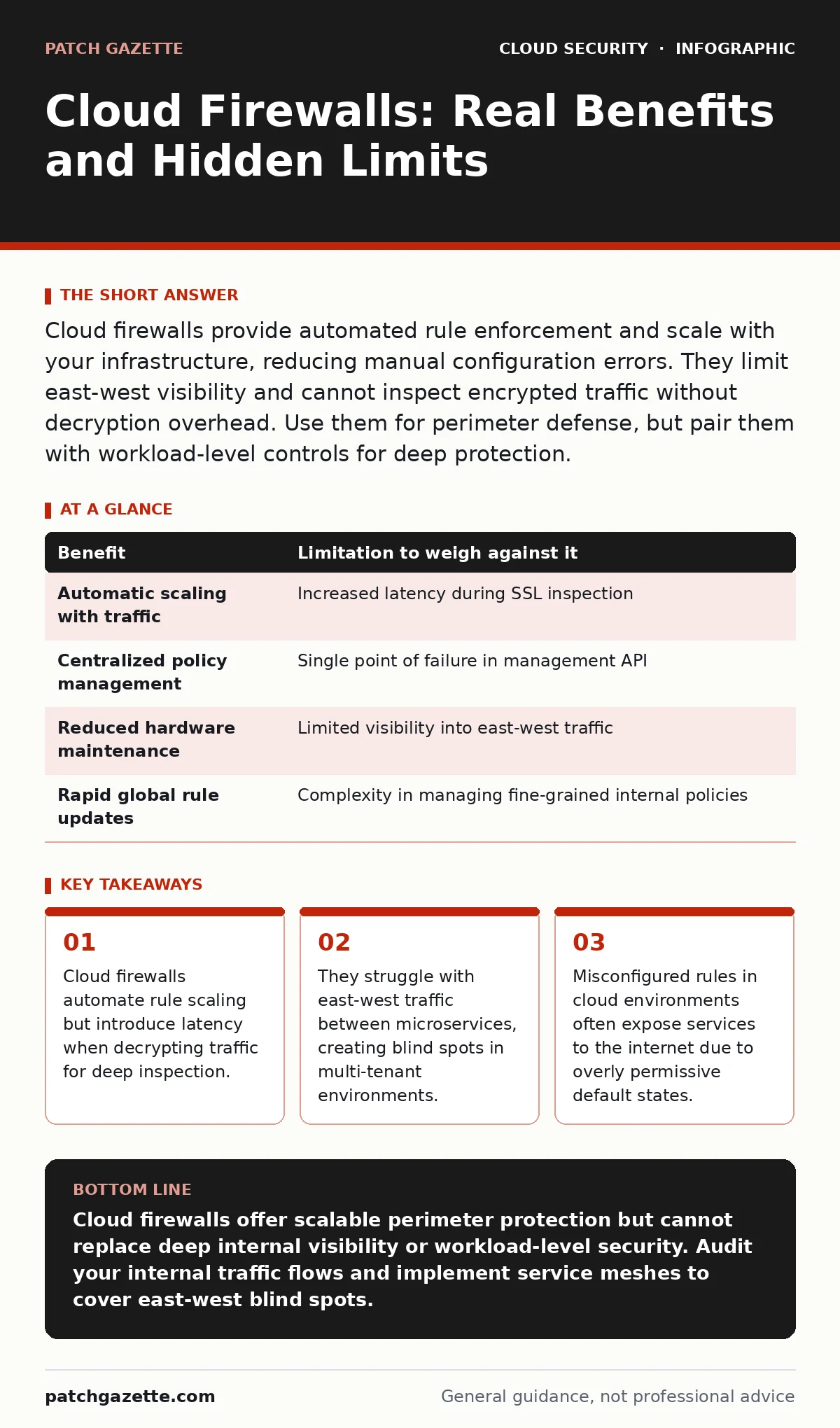
Cloud firewalls provide automated rule enforcement and scale with your infrastructure, reducing manual configuration errors. They limit east-west visibility and cannot inspect encrypted traffic without decryption overhead. Use them for perimeter defense, but pair them with workload-level controls for deep protection.
The Mechanism of Cloud-Native Filtering
Cloud firewalls operate differently from traditional hardware appliances. They exist as software-defined services integrated directly into your cloud provider’s networking fabric. Instead of sitting in a physical rack, they inspect packets as they traverse virtual networks. This integration allows them to scale automatically with your workload. You do not provision capacity for peak traffic spikes. The firewall capacity grows as your network traffic grows.
This architecture changes how you manage security policies. Rules are applied via API calls or configuration files rather than manual CLI commands on a device. This reduces the risk of human error during deployment. However, it also means that policy drift can occur if your configuration management tools are not tightly coupled. You must treat firewall rules as code. Version control and automated testing become necessary for your security policies.
Automated Scaling and Consistency
The primary benefit of cloud firewalls is their ability to handle variable loads. Traditional firewalls require careful capacity planning. You must predict future traffic growth and purchase hardware accordingly. Cloud firewalls remove this constraint. They allocate resources dynamically based on current demand. This ensures that your security controls do not become a bottleneck during traffic surges.
Consistency is another advantage. In a distributed environment, maintaining identical rules across multiple physical devices is difficult. Cloud firewalls apply a single rule set across all regions and availability zones. This eliminates configuration inconsistencies that attackers often exploit. You define the policy once, and the cloud provider enforces it everywhere. This simplifies compliance audits and reduces the operational overhead of managing disparate devices.
However, this centralization creates a single point of failure in your management plane. If the API used to manage the firewall is compromised, an attacker could modify rules globally. You must secure the management interfaces with strict access controls. Refer to best practices for service account security to ensure that only authorized identities can modify firewall configurations.
The Encryption Inspection Dilemma
Modern applications rely heavily on encrypted traffic. HTTPS protects data in transit, but it also hides the payload from security tools. Cloud firewalls cannot inspect encrypted traffic without decrypting it first. This process, known as SSL inspection, requires the firewall to terminate the TLS connection, inspect the content, and then re-encrypt it.
This introduces significant latency. Every packet must be decrypted and re-encrypted, consuming CPU resources and increasing response times. For latency-sensitive applications, this overhead can degrade user experience. It also raises privacy concerns. Decrypting traffic requires the firewall to have access to private keys. If the firewall is compromised, those keys are exposed.
You face a trade-off between visibility and performance. Full inspection provides deep threat detection but slows down your network. No inspection preserves performance but leaves you blind to threats hidden in encrypted payloads. Many organizations choose to inspect only high-risk traffic or specific user groups. This selective approach balances security needs with operational constraints.
East-West Traffic Blind Spots
Cloud firewalls are primarily designed for north-south traffic. This is traffic entering or leaving your cloud environment. They are less effective at monitoring east-west traffic. This is traffic moving between services within your cloud network. Microservices architectures generate massive amounts of internal communication. Traditional firewalls often miss this traffic because it does not cross the perimeter.
This creates a blind spot. An attacker who breaches the perimeter can move laterally between services without triggering firewall alerts. They exploit the trust relationships between internal components. Cloud firewalls may not have the granularity to inspect this internal traffic effectively. You need additional controls to monitor and restrict internal communication.
Consider integrating your firewall with a service mesh. A service mesh provides visibility and control over service-to-service communication. It can enforce policies at the application layer, complementing the network-level controls of the firewall. This layered approach ensures that both external and internal traffic are monitored. For more on securing distributed services, see serverless security risks and how they relate to internal traffic flows.
When It Is Worth It
Cloud firewalls are worth the investment when you operate in a dynamic environment. If your infrastructure scales frequently, the automated nature of cloud firewalls saves significant operational effort. They eliminate the need for manual hardware provisioning and rule synchronization. This is particularly valuable for organizations with multi-region deployments.
They are also worth it when you lack dedicated network security staff. Cloud firewalls reduce the complexity of managing security devices. The cloud provider handles maintenance, updates, and patching. You focus on defining policies rather than maintaining hardware. This allows smaller teams to manage large-scale security operations effectively.
Additionally, cloud firewalls are valuable when you need rapid incident response. You can update rules globally in seconds. If a new threat emerges, you can block it across all regions immediately. This speed is critical for containing breaches and minimizing damage. The ability to react quickly to changing threats is a key advantage over static hardware solutions.
See also: Software Updates Best Practices: Secure Patching Without Downtime · Guest Wi-Fi Explained: Isolate Traffic Without Compromising Security
When It Is Not Worth It
Cloud firewalls are not a silver bullet. They are not worth it if you rely on them for deep packet inspection of all traffic. The latency and privacy concerns associated with decryption make this impractical for many use cases. You must accept that some traffic will remain uninspected.
They are also not sufficient if you have complex internal architectures. If your application relies on intricate service-to-service communication, a standard cloud firewall will not provide adequate visibility. You will miss lateral movement and internal threats. In these cases, you must invest in additional monitoring tools.
Finally, cloud firewalls are not worth it if your cloud provider’s service does not meet your compliance requirements. Some industries require specific logging and auditing capabilities. If the native firewall service does not provide these, you may need a third-party solution. Always verify that the firewall meets your regulatory obligations before relying on it.
Balancing Benefits and Limitations
| Benefit | Limitation to weigh against it |
|---|---|
| Automatic scaling with traffic | Increased latency during SSL inspection |
| Centralized policy management | Single point of failure in management API |
| Reduced hardware maintenance | Limited visibility into east-west traffic |
| Rapid global rule updates | Complexity in managing fine-grained internal policies |
Integrating with Broader Security
Cloud firewalls are one component of a layered defense. They protect the perimeter but do not secure the workload. You must combine them with other controls. For instance, ensure that your cloud tenants are properly isolated to prevent cross-tenant attacks. See tenant isolation strategies to understand how to separate environments effectively.
You should also monitor for unauthorized resources. Shadow IT can bypass your firewall rules entirely. Regular audits are necessary to identify and remediate these assets. Additionally, ensure that your firewall rules align with established security baselines. Refer to CIS Benchmarks for recommended configurations that reduce common misconfigurations.
For organizations operating across multiple providers, consistency is challenging. Each cloud provider has its own firewall implementation. You must standardize your policies to ensure uniform protection. Explore multi-cloud security frameworks to manage this complexity. Finally, remember that firewalls do not protect against ransomware that enters through legitimate channels. See cloud ransomware prevention strategies for additional layers of defense.
Key takeaways
- Cloud firewalls automate rule scaling but introduce latency when decrypting traffic for deep inspection.
- They struggle with east-west traffic between microservices, creating blind spots in multi-tenant environments.
- Misconfigured rules in cloud environments often expose services to the internet due to overly permissive default states.
Cloud firewalls offer scalable perimeter protection but cannot replace deep internal visibility or workload-level security. Audit your internal traffic flows and implement service meshes to cover east-west blind spots.
Frequently asked questions
Do cloud firewalls replace traditional hardware firewalls?
They replace the need for physical devices at the cloud perimeter but do not replace the need for internal network segmentation or workload-level security controls.
Can cloud firewalls inspect encrypted traffic without performance impact?
No, decrypting traffic for inspection always adds latency. You must balance security needs with performance requirements by selectively inspecting only high-risk traffic.
How do I prevent misconfiguration in cloud firewalls?
Treat firewall rules as code. Use version control, automated testing, and peer reviews to ensure that rules are correct before deployment. Regular audits are also necessary.
Are cloud firewalls effective against lateral movement?
They are limited in effectiveness. Cloud firewalls primarily monitor north-south traffic. You need additional tools like service meshes or micro-segmentation to detect and prevent lateral movement.
How this guide was produced: written by the Patch Gazette editorial team with AI assistance, checked against the public references listed below, and reviewed when the facts change. See our editorial policy or report an error.