
Security Technical Debt: How to Quantify Hidden Risk
Untracked security shortcuts compound faster than financial debt, turning minor configuration errors into systemic failures that bypass standard monitoring tools.
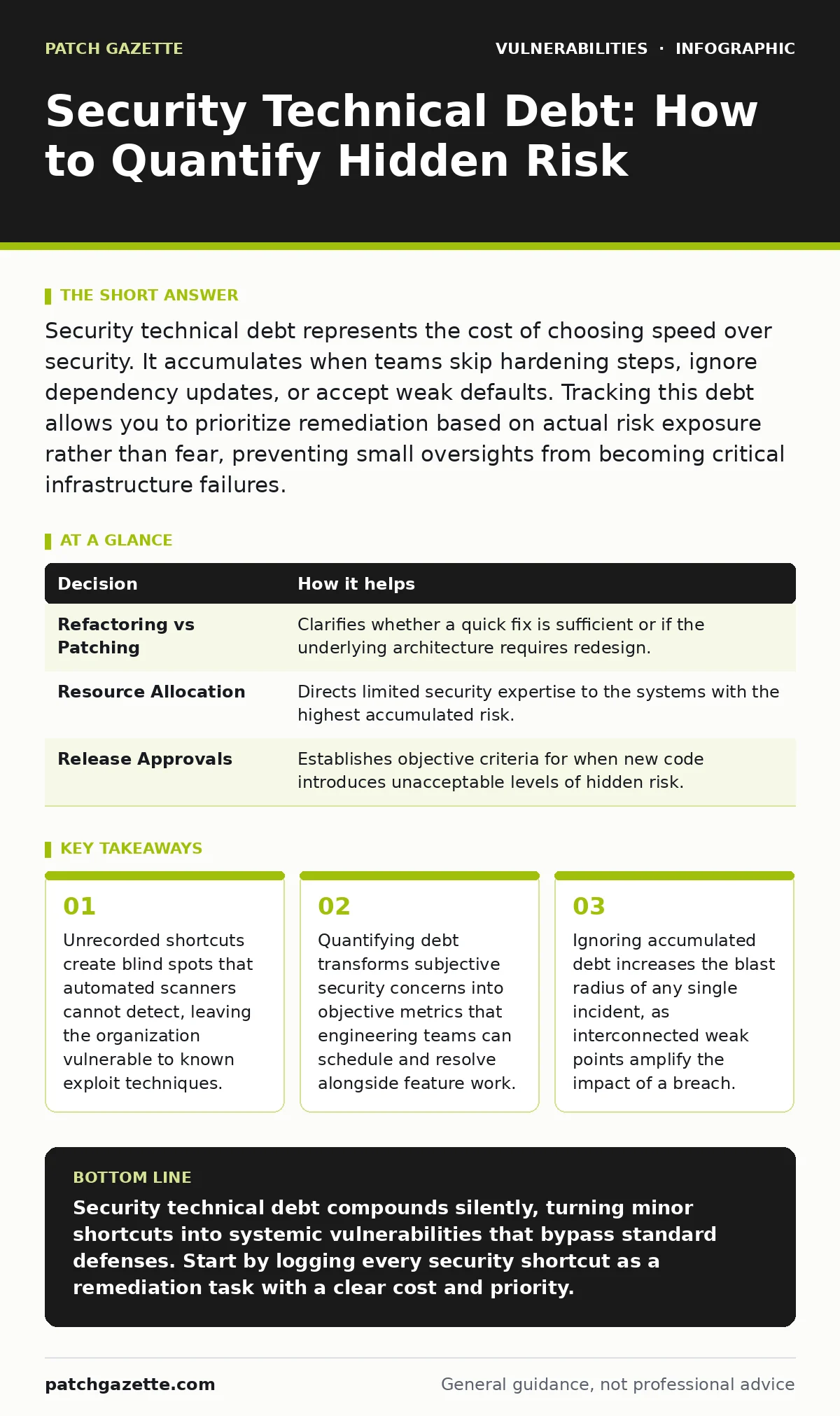
Security technical debt represents the cost of choosing speed over security. It accumulates when teams skip hardening steps, ignore dependency updates, or accept weak defaults. Tracking this debt allows you to prioritize remediation based on actual risk exposure rather than fear, preventing small oversights from becoming critical infrastructure failures.
Defining the Accumulation of Security Shortcuts
Security technical debt is the implied cost of choosing an easy solution now over a better solution that would take longer. Just as financial debt incurs interest, security shortcuts incur risk interest. This interest compounds when new systems depend on old, insecure foundations. You accumulate this debt by accepting default configurations, delaying patch cycles, or bypassing authentication checks to meet a deadline. The debt is not just the missing control. It is the hidden complexity that makes future changes dangerous and unpredictable.
The Cost of Untracked Risk
When you do not track security debt, you operate with incomplete visibility. Automated scanners report on known vulnerabilities, but they miss the architectural compromises you made two years ago. Suppose you disabled a specific integrity check to improve application load times. A scanner sees the application as healthy. You see improved performance. The reality is that you have removed a safety rail. An attacker who discovers this gap can bypass standard defenses without triggering alerts. This hidden cost grows as more developers build features on top of that compromised foundation.
How Teams Measure and Manage Debt
Teams manage security debt by quantifying the effort required to fix each shortcut. You assign a remediation cost to every known deviation from your security baseline. This creates a backlog of technical work that exists alongside your feature backlog. You prioritize items based on their potential impact and the likelihood of exploitation. This approach forces a conversation about trade-offs. It acknowledges that perfect security is impossible, but unmanaged risk is unacceptable. You use this data to negotiate timelines and resources with engineering leadership.
Decisions Informed by Debt Tracking
Tracking security debt informs three critical decisions. First, it determines whether to refactor or patch. If the debt is high and the system is unstable, refactoring may be the only viable path. Second, it guides resource allocation. You direct security engineers to the areas with the highest concentration of unresolved shortcuts. Third, it influences release approvals. You can define a debt threshold that blocks releases if new shortcuts exceed a certain risk level. These decisions shift security from a gatekeeping function to a collaborative engineering discipline.
| Decision | How it helps |
|---|---|
| Refactoring vs Patching | Clarifies whether a quick fix is sufficient or if the underlying architecture requires redesign. |
| Resource Allocation | Directs limited security expertise to the systems with the highest accumulated risk. |
| Release Approvals | Establishes objective criteria for when new code introduces unacceptable levels of hidden risk. |
What Goes Wrong Without Tracking
Without a formal tracking mechanism, security becomes reactive. You only address issues when they cause visible problems. This leads to fire-fighting mode, where teams spend their time putting out fires instead of preventing them. The lack of visibility also erodes trust. Engineering teams view security as a blocker because they do not understand the cumulative risk of their shortcuts. Security teams view engineering as negligent because they do not see the pressure to deliver features. This friction slows down both velocity and security improvements.
See also: Shadow IT: What It Is and How to Reduce the Hidden Risk · Output Encoding Errors: 6 Misconceptions Blocking Secure Code
Integrating Debt into Development Cycles
You integrate debt management by treating security tasks as first-class citizens in your development workflow. When a developer proposes a shortcut, they must log the associated debt. This makes the trade-off explicit. The team then decides whether to accept the debt or spend the time to do it right. Over time, you review the debt backlog regularly. You assign small fixes to regular sprint cycles. This prevents the debt from becoming unmanageable. It also ensures that security is part of the daily work, not a separate, periodic audit.
The Hidden Complexity of Legacy Systems
Legacy systems often hold the highest concentration of security debt. These systems were built with different assumptions about threat models and network boundaries. Modern attackers exploit the gap between old assumptions and current realities. For example, a system that assumes internal traffic is trusted may be vulnerable to dependency confusion attacks if it pulls packages from unverified sources. You must map these legacy dependencies and assess their exposure. This often reveals risks that standard vulnerability scanners miss because they focus on software versions, not architectural trust boundaries.
Mitigating Risk Without Full Refactoring
You cannot always refactor legacy systems immediately. In these cases, you use virtual patching to mitigate risk until a proper fix is possible. Virtual patching places a protective layer between the application and the network, blocking exploit attempts without changing the application code. This buys you time to address the underlying debt. However, it is not a permanent solution. You must still plan for the eventual remediation of the root cause. Relying solely on virtual patching increases operational complexity and can create a false sense of security.
Building a Culture of Accountability
Security technical debt is a team responsibility, not just a security team issue. You build accountability by making debt visible to all stakeholders. Share metrics on debt accumulation and reduction in regular team meetings. Celebrate when teams pay down debt. This reinforces the value of secure coding practices. You also need to adjust incentives. If developers are rewarded only for feature delivery, they will continue to accumulate debt. Reward them for delivering secure, maintainable code. This cultural shift is the most effective way to reduce long-term risk.
Addressing Common Vulnerability Patterns
As you review your debt backlog, you will likely encounter common vulnerability patterns. Many of these fall under CWE weakness categories such as improper input validation or broken access control. Understanding these categories helps you prioritize fixes. For instance, broken access control is often a result of assuming users cannot access certain resources.
This assumption is a form of security debt. You must verify that every endpoint enforces proper authorization checks. Similarly, LDAP injection risks arise when user input is not properly sanitized before being used in directory queries. These are not just code bugs; they are architectural decisions that require careful review.
Managing Third-Party Dependencies
Your security debt includes the code you did not write. Third-party libraries and frameworks introduce their own risks. If a library has a known vulnerability, your application inherits that debt. You must track the versions of all dependencies and assess their security posture. This is particularly important for exposed admin panels that may use outdated authentication mechanisms. Regularly updating dependencies is not enough. You must also evaluate whether you need the dependency at all. Removing unused libraries reduces your attack surface and simplifies maintenance.
The Role of Security Metrics
You need metrics to track progress. Common metrics include the total number of open security debt items, the average time to resolve an item, and the distribution of debt across systems. These metrics help you identify trends and areas of concern. For example, if the average time to resolve is increasing, you may need more resources or better tooling. If debt is concentrated in one system, you may need to prioritize a refactor. These metrics provide objective data to support your security decisions. They also help you communicate the value of security work to non-technical stakeholders.
Balancing Speed and Security
The goal is not to eliminate all security debt. That is impossible. The goal is to manage it effectively. You balance speed and security by making informed trade-offs. Sometimes, accepting a small amount of debt is the right decision to meet a business deadline. Other times, it is better to spend more time to get it right. This balance requires continuous evaluation. You must regularly review your debt backlog and adjust your strategy as needed. This approach ensures that you are always working on the most critical risks.
Conclusion
Security technical debt is a reality of modern software development. Ignoring it leads to systemic risk and operational instability. Tracking and managing it allows you to make informed decisions about where to invest your security efforts. By treating security as a continuous engineering discipline, you can reduce risk while maintaining velocity. This approach builds a more resilient and secure organization.
Key takeaways
- Unrecorded shortcuts create blind spots that automated scanners cannot detect, leaving the organization vulnerable to known exploit techniques.
- Quantifying debt transforms subjective security concerns into objective metrics that engineering teams can schedule and resolve alongside feature work.
- Ignoring accumulated debt increases the blast radius of any single incident, as interconnected weak points amplify the impact of a breach.
Security technical debt compounds silently, turning minor shortcuts into systemic vulnerabilities that bypass standard defenses. Start by logging every security shortcut as a remediation task with a clear cost and priority.
Frequently asked questions
How do I calculate the cost of security technical debt?
Estimate the engineering hours required to fix the shortcut and multiply by the average hourly rate of a developer. Add a risk multiplier based on the potential impact of the vulnerability.
Can automated tools track security technical debt?
Automated tools can identify known vulnerabilities, but they cannot detect architectural compromises or undocumented shortcuts. Human review is necessary to identify and log these items.
Should I prioritize fixing old debt or preventing new debt?
You must do both. Preventing new debt stops the accumulation, while fixing old debt reduces existing risk. A balanced approach ensures long-term security and stability.
How does security debt relate to CVSS scores?
CVSS scores measure the severity of known vulnerabilities. Security debt includes these vulnerabilities but also covers architectural weaknesses and process gaps that do not have a CVSS score.
How this guide was produced: written by the Patch Gazette editorial team with AI assistance, checked against the public references listed below, and reviewed when the facts change. See our editorial policy or report an error.