ISO 27001 Checklist: A Practical Audit of Your Information Security Controls
Most organizations fail ISO 27001 certification not because they lack technology, but because they cannot prove they consistently follow their own written procedures over time.
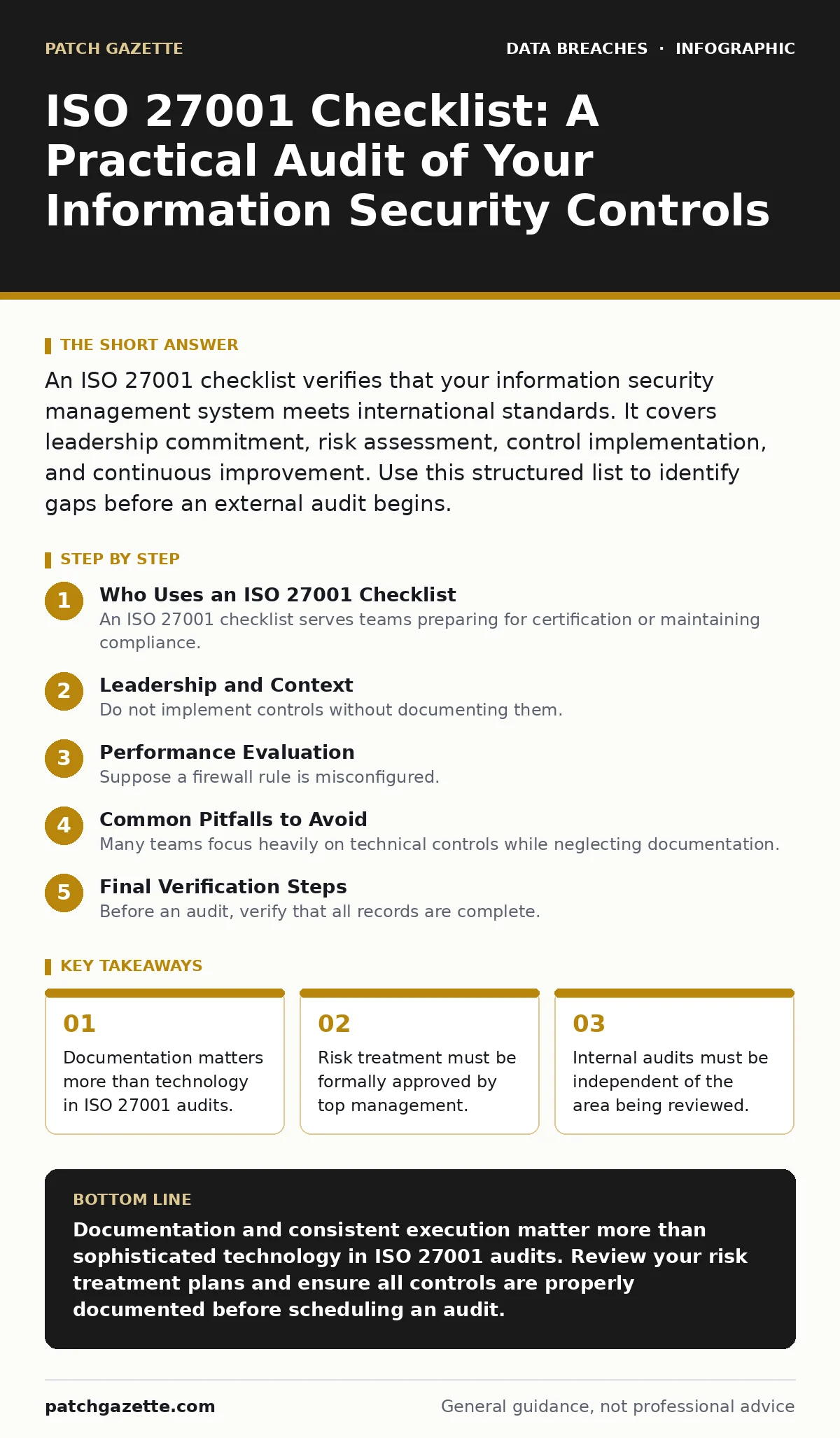
An ISO 27001 checklist verifies that your information security management system meets international standards. It covers leadership commitment, risk assessment, control implementation, and continuous improvement. Use this structured list to identify gaps before an external audit begins.
Who Uses an ISO 27001 Checklist
An ISO 27001 checklist serves teams preparing for certification or maintaining compliance. It translates abstract standard requirements into concrete actions. You use it to verify that your information security management system operates effectively. The checklist helps you spot gaps before an auditor does. It ensures every control is implemented and documented.
Leadership and Context
- Define the scope of the information security management system: Clear boundaries prevent audit confusion and ensure all relevant assets are covered.
- Document information security policy: A signed policy demonstrates top management commitment to protecting data.
- Assign roles and responsibilities: Clear ownership ensures someone is accountable for every security control.
- Identify interested parties and their requirements: Understanding stakeholder needs helps prioritize security investments correctly.
Risk Assessment and Treatment
- Identify information security risks: Listing threats ensures you address actual vulnerabilities rather than hypothetical ones.
- Assess risk likelihood and impact: Quantifying risk helps justify control costs to stakeholders.
- Select risk treatment options: Choosing to accept, mitigate, avoid, or share risk requires formal decision-making.
- Document risk treatment plan: A written plan provides evidence that risks are managed systematically.
- Obtain risk acceptance approval: Senior management must formally accept residual risks after controls are applied.
Control Implementation
- Implement physical security controls: Locking server rooms and offices prevents unauthorized physical access to assets.
- Configure access control systems: Restricting access based on job role reduces the chance of internal data theft.
- Establish secure development practices: Integrating security into coding reduces vulnerabilities before software reaches production.
- Manage supplier security: Vendors with weak security can compromise your own data protection efforts.
- Implement incident management procedures: A clear process ensures rapid response when security events occur.
Performance Evaluation
- Conduct internal audits: Regular checks verify that controls work as intended and documentation is accurate.
- Monitor and measure performance: Metrics show whether security efforts are effective over time.
- Review compliance with legal requirements: Checking against laws like the HIPAA Security Rule or breach notification laws avoids fines.
- Report results to management: Regular reports keep leadership informed about security status and risks.
See also: Password Hygiene Mechanics: How Systems Verify Credentials Behind the Scenes · Stop SIM Swap Fraud: The Technical Controls That Actually Work
Management Review and Improvement
- Hold management review meetings: Leadership must review the system's suitability, adequacy, and effectiveness.
- Address nonconformities: Fixing failures prevents them from becoming systemic issues.
- Implement corrective actions: Root cause analysis stops problems from recurring after initial fixes.
- Continuously improve the system: Regular updates keep security aligned with changing threats and business needs.
Common Pitfalls to Avoid
Many teams focus heavily on technical controls while neglecting documentation. Auditors look for evidence, not just installed software. Another common error is treating risk assessment as a one-time event. Risks change as your business grows and evolves. You must reassess risks regularly.
Related topics such as password hygiene and secure file sharing often appear in control implementations. Ensure your procedures address these areas explicitly. Consider how mobile device management impacts your remote workforce security. Understanding data subject rights helps you meet privacy requirements within the standard.
Final Verification Steps
Before an audit, verify that all records are complete. Check that every risk has a corresponding control. Ensure that internal audit reports are filed and actions are tracked. Review management meeting minutes for evidence of oversight. This final check prevents last-minute surprises.
An ISO 27001 checklist is not just a compliance tool. It is a framework for building a resilient security culture. Using it consistently helps you protect your organization and maintain customer trust.
Key takeaways
- Documentation matters more than technology in ISO 27001 audits.
- Risk treatment must be formally approved by top management.
- Internal audits must be independent of the area being reviewed.
Documentation and consistent execution matter more than sophisticated technology in ISO 27001 audits. Review your risk treatment plans and ensure all controls are properly documented before scheduling an audit.
Frequently asked questions
How often should I update my ISO 27001 checklist?
Update it whenever you change systems, processes, or risk profiles. At minimum, review it annually during your management review.
Can I use this checklist for ISO 27002?
Yes, but ISO 27002 provides detailed guidance on controls. This checklist focuses on the management system requirements of ISO 27001.
Who should perform the internal audit?
Auditors must be independent of the area they are auditing. They should have the competence to evaluate the system objectively.
What happens if I fail an ISO 27001 audit?
You will receive nonconformity reports. You must implement corrective actions and provide evidence of resolution to achieve certification.
How this guide was produced: written by the Patch Gazette editorial team with AI assistance, checked against the public references listed below, and reviewed when the facts change. See our editorial policy or report an error.