CWE Weakness Categories: How Structured Classification Drives Security Decisions
Mapping vulnerabilities to common weakness enumerations transforms chaotic bug reports into predictable engineering workflows that reduce recurring defects.
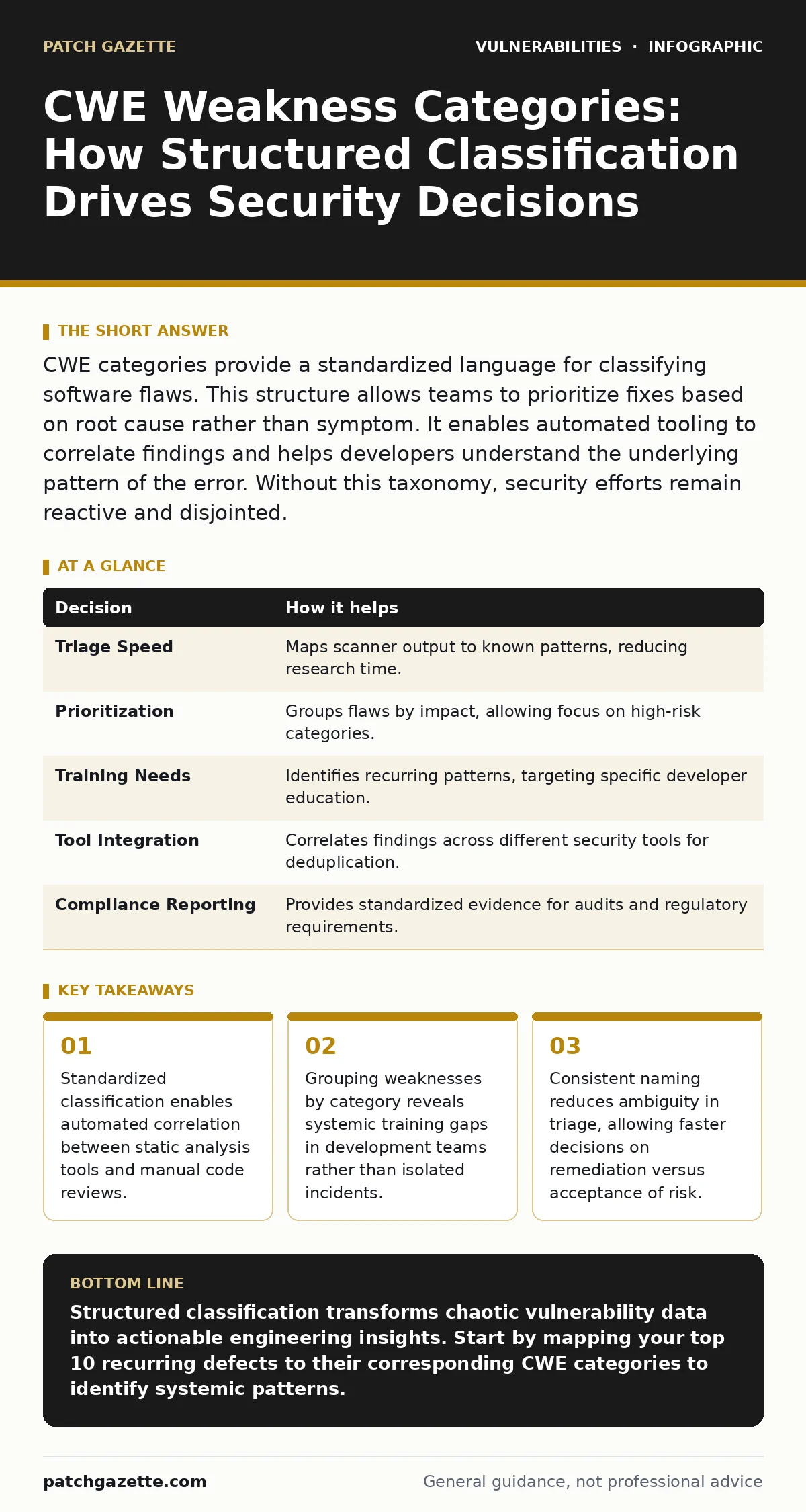
CWE categories provide a standardized language for classifying software flaws. This structure allows teams to prioritize fixes based on root cause rather than symptom. It enables automated tooling to correlate findings and helps developers understand the underlying pattern of the error. Without this taxonomy, security efforts remain reactive and disjointed.
Why Classification Dictates Remediation Speed
Common Weakness Enumeration (CWE) categories provide a hierarchical taxonomy for describing software flaws. The hierarchy allows you to group specific vulnerabilities under broader conceptual umbrellas. This structure matters because it shifts the focus from fixing a single instance to addressing the root pattern. When you treat every bug as unique, you repeat the same mistakes. When you treat bugs as members of a class, you can build defenses against the entire class.
The taxonomy connects specific symptoms to their underlying causes. A buffer overflow is a specific symptom, but memory safety is the broader category. Understanding this distinction changes how you allocate engineering resources. You stop patching individual lines of code and start reviewing memory management practices across the codebase. This approach reduces the volume of future defects significantly.
The Cost of Unstructured Vulnerability Tracking
Without a standardized classification system, security teams struggle with noise. Different scanners use different terminology for the same flaw. One tool might call it an "input validation error" while another calls it "improper neutralization." This ambiguity forces analysts to spend hours reconciling reports instead of fixing code. The result is duplicate work and missed connections between related issues.
Unstructured tracking also hides systemic risks. If you record bugs only by their file location, you miss the pattern that a specific developer consistently mishandles string operations. You cannot identify training needs if the data lacks semantic structure. The team remains reactive, chasing individual alerts without improving the overall security posture. This leads to security technical debt that accumulates silently over time.
How Teams Use CWE for Decision Making
Teams use CWE categories to streamline the triage process. When a scanner reports a finding, the analyst maps it to a CWE ID. This ID provides immediate context about the severity and complexity of the fix. It also links to existing knowledge bases and remediation guidance. This reduces the time spent researching the nature of the vulnerability.
The classification helps in prioritizing remediation efforts. Not all weaknesses carry the same risk. By categorizing flaws, teams can focus on high-impact categories first. For instance, fixing broken access control issues often takes precedence over minor coding style violations that have no security impact. This prioritization ensures that limited engineering resources are spent where they matter most.
| Decision | How it helps |
|---|---|
| Triage Speed | Maps scanner output to known patterns, reducing research time. |
| Prioritization | Groups flaws by impact, allowing focus on high-risk categories. |
| Training Needs | Identifies recurring patterns, targeting specific developer education. |
| Tool Integration | Correlates findings across different security tools for deduplication. |
| Compliance Reporting | Provides standardized evidence for audits and regulatory requirements. |
Automating Correlation Across Security Tools
Security tools generate thousands of alerts daily. Many of these alerts refer to the same underlying issue. CWE categories act as a common denominator for correlation. If a static analysis tool and a dynamic testing tool both report issues mapped to the same CWE, you can deduplicate them. This reduces alert fatigue and gives developers a clearer picture of the actual problem.
Automation relies on consistent naming. If tools use proprietary identifiers, correlation fails. By forcing all tools to output CWE IDs, you create a unified data model. This allows you to build dashboards that track trends over time. You can see if certain categories are increasing or decreasing. This data-driven approach replaces guesswork with measurable progress.
Addressing Root Causes Instead of Symptoms
Fixing a symptom does not prevent recurrence. If you patch a specific SQL injection hole, another developer might create a similar hole elsewhere. CWE categories help you identify the root cause: improper construction of SQL queries. By addressing the root cause, you can implement parameterized queries across the application. This single change prevents hundreds of potential injection flaws.
This shift requires a change in mindset. Developers must understand that security is not about fixing bugs but about writing secure code. CWE categories provide the vocabulary for this conversation. They allow security teams to explain why a specific coding pattern is dangerous. This education is more effective than simply handing over a list of broken lines of code.
See also: Cloud Vulnerability Management Mistakes That Leave Gaps Open
Integrating CWE into the Development Lifecycle
CWE integration should happen early in the development process. Static analysis tools can flag potential weaknesses during coding. By mapping these flags to CWE categories, developers receive immediate feedback. They learn to avoid certain patterns before the code is committed. This proactive approach is cheaper and faster than fixing bugs after deployment.
Code reviews also benefit from CWE awareness. Reviewers can look for known weakness patterns rather than just syntax errors. They can ask targeted questions about input validation or error handling. This makes the review process more efficient and effective. It also builds a culture of security awareness within the team.
Managing Exposure and Administrative Risks
Some CWE categories relate directly to exposure risks. For example, improper configuration can lead to exposed admin panels. These weaknesses are often easy to detect but dangerous if left unpatched. By categorizing these flaws, you can automate the detection of misconfigurations. This ensures that administrative interfaces remain secure and inaccessible to unauthorized users.
Dependency management is another area where CWE categories shine. Supply chain attacks often exploit known weaknesses in third-party libraries. By tracking the CWEs associated with your dependencies, you can identify risky components. This helps you avoid dependency confusion attacks and other supply chain vulnerabilities. You can prioritize updates for libraries with high-severity weaknesses.
Building a Sustainable Security Posture
Sustainable security requires continuous improvement. CWE categories provide the metrics for this improvement. You can track the reduction of specific weakness categories over time. This shows whether your security initiatives are working. It also helps you justify investments in security tools and training.
The taxonomy also aids in communicating risk to leadership. Instead of listing hundreds of bugs, you can report on the reduction of high-risk categories. This provides a clearer picture of the security posture. It demonstrates progress and builds trust with stakeholders. This strategic view is essential for long-term security success.
Key takeaways
- Standardized classification enables automated correlation between static analysis tools and manual code reviews.
- Grouping weaknesses by category reveals systemic training gaps in development teams rather than isolated incidents.
- Consistent naming reduces ambiguity in triage, allowing faster decisions on remediation versus acceptance of risk.
Structured classification transforms chaotic vulnerability data into actionable engineering insights. Start by mapping your top 10 recurring defects to their corresponding CWE categories to identify systemic patterns.
Frequently asked questions
How does CWE differ from CVE?
CVE provides a unique identifier for a specific vulnerability instance, while CWE describes the type of weakness that leads to the vulnerability. CVE is for tracking instances; CWE is for understanding patterns.
Is CWE free to use?
Yes. The Common Weakness Enumeration is a public standard maintained by the MITRE Corporation. It is freely available for use by any organization or individual.
How this guide was produced: written by the Patch Gazette editorial team with AI assistance, checked against the public references listed below, and reviewed when the facts change. See our editorial policy or report an error.