
Heuristic Detection Checklist: Catch Unknown Malware Before It Executes
Heuristic analysis identifies threats by behavior patterns rather than known signatures, allowing detection of zero-day attacks that traditional antivirus software misses entirely.
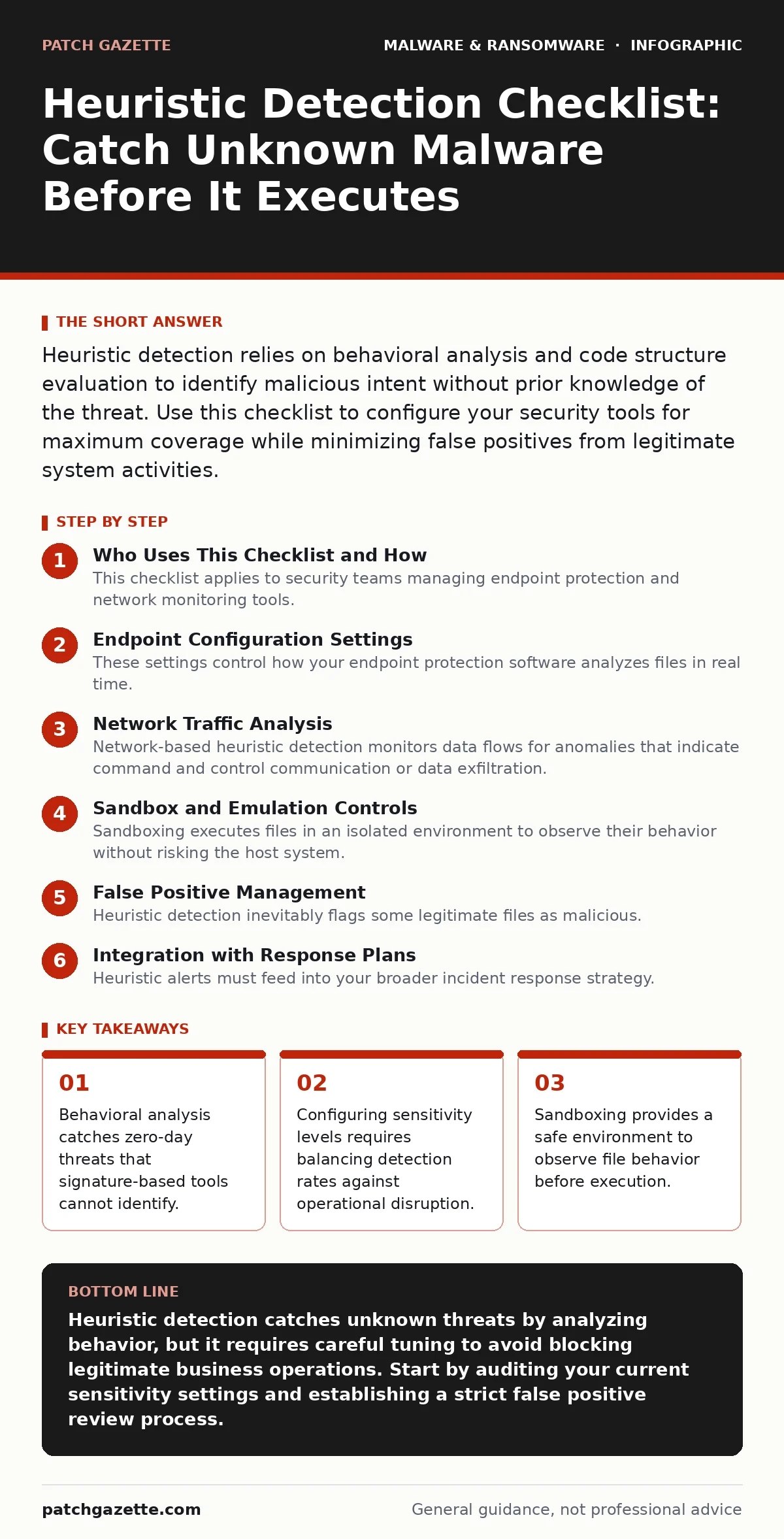
Heuristic detection relies on behavioral analysis and code structure evaluation to identify malicious intent without prior knowledge of the threat. Use this checklist to configure your security tools for maximum coverage while minimizing false positives from legitimate system activities.
Who Uses This Checklist and How
This checklist applies to security teams managing endpoint protection and network monitoring tools. You use it to audit your current configuration and ensure your systems detect novel threats. Heuristic detection examines code behavior and structure rather than matching against a database of known hashes. This approach catches zero-day attacks but introduces the risk of false positives. Review these items quarterly to maintain an effective security posture.
Endpoint Configuration Settings
These settings control how your endpoint protection software analyzes files in real time. Proper configuration ensures that suspicious files are quarantined before they can execute harmful code.
- Enable real-time behavioral monitoring: Detects malicious actions as they occur rather than waiting for a file scan.
- Set heuristic sensitivity to high: Increases detection of novel threats at the cost of potential false positives.
- Exclude trusted application directories: Prevents false alarms from legitimate software installed by your organization.
- Configure automatic quarantine actions: Stops execution of suspicious files immediately without user intervention.
- Enable memory resident scanning: Detects malware that resides only in RAM to avoid disk-based detection.
- Update definition files daily: Ensures the heuristic engine has the latest context for known attack patterns.
- Log all heuristic alerts: Provides audit trails for forensic analysis and trend identification.
- Disable heuristic scanning for large archives: Prevents system slowdowns when processing massive backup files.
Network Traffic Analysis
Network-based heuristic detection monitors data flows for anomalies that indicate command and control communication or data exfiltration. You must configure these rules to distinguish between normal high-volume traffic and malicious activity.
- Monitor for unusual DNS queries: Identifies domains generated by algorithmic malware to contact servers.
- Flag unencrypted outbound connections: Detects data exfiltration attempts that bypass standard encryption protocols.
- Analyze packet size anomalies: Identifies beaconing behavior where malware sends small, regular status updates.
- Inspect HTTPS traffic for certificates: Detects self-signed certificates often used by malicious proxies.
- Rate limit internal scanning: Prevents legitimate administrative tools from triggering heuristic alerts.
- Monitor for protocol violations: Catches malware that misuses standard protocols like SMB or HTTP.
- Log connection attempts to rare ports: Identifies communication on non-standard ports often used by trojanized software.
- Correlate logs with endpoint alerts: Provides context to determine if network anomalies stem from infected hosts.
Sandbox and Emulation Controls
Sandboxing executes files in an isolated environment to observe their behavior without risking the host system. This method reveals actions that static analysis cannot detect, such as registry modifications or file creation.
- Enable dynamic analysis for all downloads: Observes file behavior in a controlled environment before user access.
- Configure timeout limits for emulation: Prevents malware designed to sleep for long periods from evading detection.
- Block sandbox escape attempts: Stops malware that tries to detect and break out of the isolated environment.
- Log all file system changes: Tracks modifications made by the file during emulation for forensic review.
- Monitor network calls from sandbox: Detects attempts to contact external command and control servers.
- Disable user interaction in sandbox: Prevents malware that requires user input to activate from triggering.
- Update sandbox emulation rules: Ensures the environment mimics current operating system versions accurately.
- Archive sandbox results: Retains evidence of malicious behavior for future threat intelligence sharing.
False Positive Management
Heuristic detection inevitably flags some legitimate files as malicious. Managing these false positives is critical to maintaining user trust and system availability. Ignoring them leads to alert fatigue and missed real threats.
- Review quarantined files weekly: Ensures legitimate software is not blocked from critical operations.
- Allowlist verified business applications: Prevents disruption to productivity tools and proprietary software.
- Tune rules based on industry sector: Adjusts sensitivity to match the specific software stack your organization uses.
- Document false positive patterns: Helps identify systemic issues in heuristic rule sets.
- Provide user feedback channels: Allows employees to report blocked files for rapid review.
- Escalate unresolved alerts: Ensures complex cases are reviewed by senior security analysts.
- Test updates in staging: Verifies that new heuristic rules do not break existing workflows.
- Measure mean time to resolution: Tracks efficiency in clearing false positive alerts.
See also: Real-Time Protection: How It Works, What It Misses, and Why It Fails · Antivirus Software Mistakes That Leave Systems Exposed
Integration with Response Plans
Heuristic alerts must feed into your broader incident response strategy. Isolated detection without response capability leaves the organization vulnerable to active threats. Ensure your tools integrate with your existing workflows.
- Connect alerts to SIEM platform: Centralizes log data for correlation and advanced threat hunting.
- Automate containment actions: Isolates infected endpoints automatically upon high-confidence heuristic alerts.
- Define escalation paths for alerts: Ensures human analysts review ambiguous heuristic detections promptly.
- Include heuristic data in ransomware incident response: Provides early warning signs of encryption activity.
- Update disaster recovery plans: Accounts for potential disruption caused by aggressive heuristic blocking.
- Train analysts on heuristic logic: Helps staff distinguish between malicious behavior and benign anomalies.
- Review integration monthly: Ensures APIs and connectors remain functional after software updates.
- Test alert fidelity regularly: Validates that heuristic tools report accurate data to response teams.
Key takeaways
- Behavioral analysis catches zero-day threats that signature-based tools cannot identify.
- Configuring sensitivity levels requires balancing detection rates against operational disruption.
- Sandboxing provides a safe environment to observe file behavior before execution.
Heuristic detection catches unknown threats by analyzing behavior, but it requires careful tuning to avoid blocking legitimate business operations. Start by auditing your current sensitivity settings and establishing a strict false positive review process.
Frequently asked questions
What is the difference between heuristic detection and signature-based detection?
Signature-based detection matches files against a database of known malware hashes, while heuristic detection analyzes code structure and behavior to identify malicious intent without prior knowledge of the threat.
How do I reduce false positives from heuristic scanning?
You reduce false positives by allowlisting trusted applications, tuning sensitivity levels based on your specific software stack, and regularly reviewing quarantined files to identify patterns of legitimate software being blocked.
Can heuristic detection identify fileless malware?
Yes, heuristic detection can identify fileless malware by monitoring for suspicious memory activities, unusual PowerShell commands, and abnormal process creation that deviates from standard system behavior.
Does heuristic detection replace the need for antivirus software?
No, heuristic detection complements traditional antivirus software by catching zero-day threats that signature-based tools miss, but both layers are needed for comprehensive protection against known and unknown malware.
How this guide was produced: written by the Patch Gazette editorial team with AI assistance, checked against the public references listed below, and reviewed when the facts change. See our editorial policy or report an error.