
Why Does Criminal Identity Theft Occur and How to Stop It
Identity theft persists because attackers exploit the economic efficiency of stolen data rather than just the technical weakness of individual accounts.
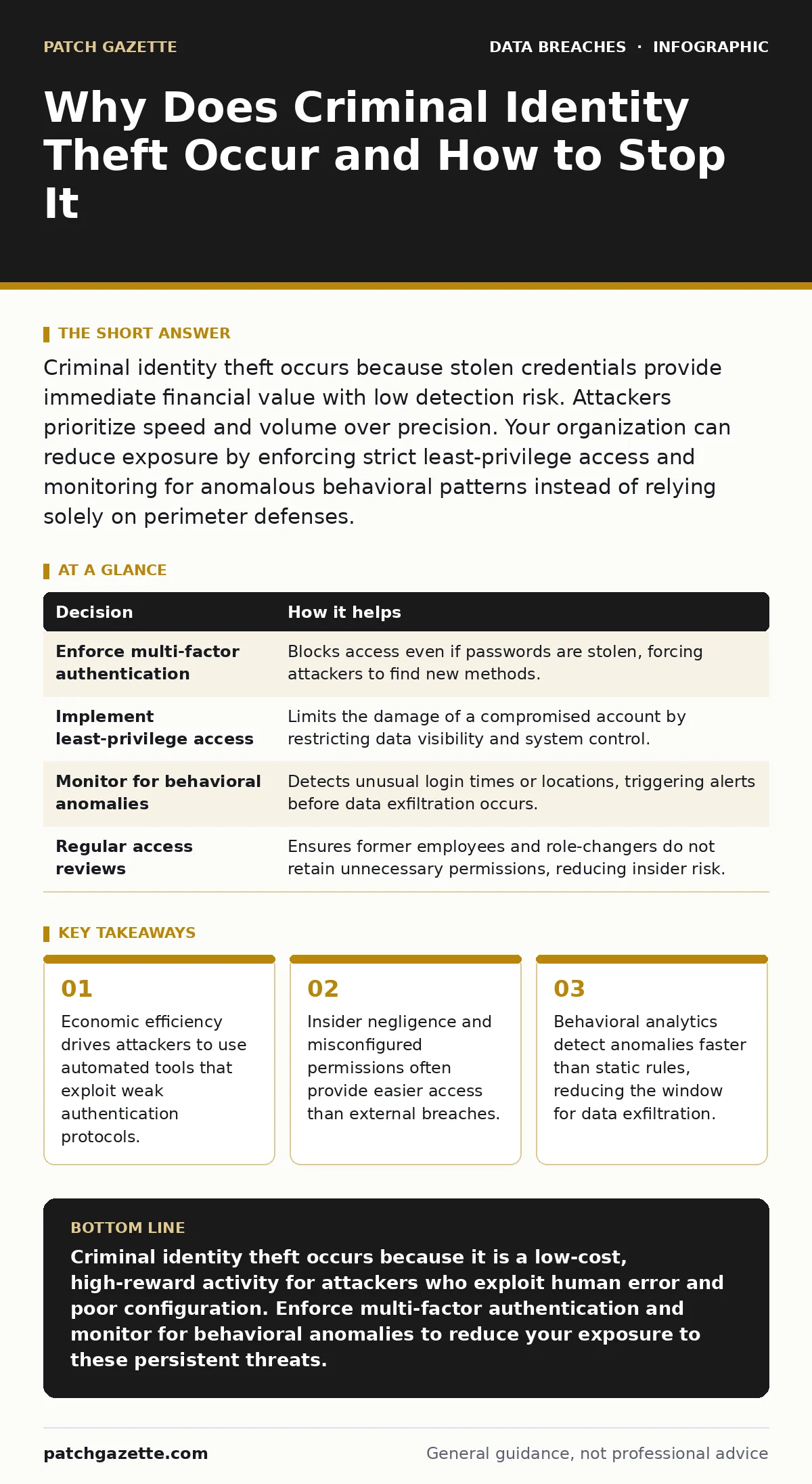
Criminal identity theft occurs because stolen credentials provide immediate financial value with low detection risk. Attackers prioritize speed and volume over precision. Your organization can reduce exposure by enforcing strict least-privilege access and monitoring for anomalous behavioral patterns instead of relying solely on perimeter defenses.
Why Does Criminal Identity Theft Occur
Why does criminal identity theft occur? The primary driver is economic efficiency. Attackers seek the highest return on investment with the lowest operational cost. Stolen credentials allow immediate access to financial assets or sensitive data without the need for complex exploitation of software vulnerabilities. This method scales easily. An attacker can purchase a large batch of credentials on the dark web and test them against thousands of services simultaneously. The cost of acquiring these credentials is often negligible compared to the value extracted.
Secondary drivers include the asymmetry of defense efforts. Defenders must protect every single account and every entry point. Attackers need only find one weak link. This imbalance favors the aggressor. Additionally, the lack of immediate consequences for many low-level offenses encourages persistent attempts. Many organizations fail to detect credential stuffing attacks until significant damage has occurred.
Tertiary factors involve the ease of data aggregation. Publicly available information, combined with data from minor breaches, creates complete profiles. Attackers do not need to hack your database directly if they can assemble enough fragments from other sources to bypass security questions or reset procedures. This approach reduces the technical barrier to entry for criminals.
The Mechanics of Credential Harvesting
Credential harvesting relies on the reuse of passwords. Users often employ the same password across multiple services. When one service suffers a breach, the resulting username-password pairs become valuable commodities. Attackers use bots to test these pairs against other popular services. This is known as credential stuffing. It bypasses traditional intrusion detection systems because the login attempts use valid credentials.
Phishing remains a core collection method. Deceptive emails or websites trick users into entering their login details. These attacks succeed because they mimic trusted interfaces perfectly. Once the attacker has the credentials, they often install malware to capture session tokens. Session tokens allow access even if the user changes their password immediately after the incident. This makes standard password resets ineffective against sophisticated theft.
Organizational Vulnerabilities and Misconfigurations
Organizations frequently expose themselves through poor configuration management. Cloud storage buckets left open to the public are a common source of large-scale data leaks. These misconfigured cloud storage leaks often contain unencrypted personal data. Attackers scan for these open resources automatically. Finding one is often the first step toward broader identity theft within the organization.
Internal processes also create risk. Employees may share accounts to bypass licensing restrictions or to simplify workflows. This practice eliminates accountability. When an account is compromised, it is impossible to determine which individual was responsible. Furthermore, outdated access rights accumulate over time. Employees who change roles rarely have their permissions revoked promptly. This violates the principle of least privilege and expands the attack surface.
The Role of Social Engineering
Social engineering exploits human psychology rather than technical flaws. Attackers research targets to create convincing narratives. They may pose as IT support staff requesting urgent password resets. Or they might pretend to be vendors needing updated billing information. These requests create a sense of urgency that bypasses critical thinking.
Imagine a scenario where an attacker calls an executive, claiming to be from the finance department. They request verification of bank details to process a payment. The executive, wanting to avoid delaying business operations, complies. This interaction requires no technical hacking. It relies entirely on the victim’s willingness to help. Training can reduce this risk, but it cannot eliminate it entirely. Humans will always remain the weakest link in the security chain.
Contrasting Security Postures
The difference in outcome is stark. Team Alpha’s layered defenses stop the initial compromise from becoming a breach. Team Beta’s reliance on perimeter controls fails because the credentials were valid. The attacker moves laterally within the network, accessing sensitive data. Team Beta’s response is reactive. They discover the theft only after the data has been exfiltrated. This contrast highlights the limitations of static security measures.
See also: Single Sign-On Misconceptions That Compromise Cloud Security · What Is Broken Access Control: Mechanisms, Risks, and Fixes
Decision Impact Analysis
| Decision | How it helps |
|---|---|
| Enforce multi-factor authentication | Blocks access even if passwords are stolen, forcing attackers to find new methods. |
| Implement least-privilege access | Limits the damage of a compromised account by restricting data visibility and system control. |
| Monitor for behavioral anomalies | Detects unusual login times or locations, triggering alerts before data exfiltration occurs. |
| Regular access reviews | Ensures former employees and role-changers do not retain unnecessary permissions, reducing insider risk. |
Implementing Effective Countermeasures
Start by enforcing multi-factor authentication everywhere. Use hardware tokens or authenticator apps rather than SMS-based codes. SMS codes are vulnerable to interception via SIM swap fraud. This attack redirects your phone number to a device controlled by the attacker, allowing them to receive verification codes. Hardware tokens are immune to this risk because they generate codes locally.
Next, implement continuous monitoring. Static rules cannot catch every threat. Behavioral analytics establish a baseline for each user. Deviations from this baseline, such as logging in from a new country or downloading large files at odd hours, trigger alerts. This approach adapts to changing conditions. It reduces false positives over time as the system learns normal patterns.
Finally, secure your data sharing processes. Ensure that secure file sharing protocols are in place for external communications. Encrypted channels prevent interception during transit. Additionally, review your mobile device management policies. Mobile devices often store sensitive data and connect to untrusted networks. Proper management ensures these devices are encrypted and can be wiped remotely if lost.
Handling Data and Compliance
Protecting identity data requires adherence to legal and regulatory standards. For organizations handling health information, the HIPAA Security Rule mandates strict controls on access and transmission. Failure to comply can result in significant penalties. Beyond compliance, consider data sovereignty requirements. Data stored in certain jurisdictions may be subject to local laws that allow government access. Understanding these legal landscapes helps you choose appropriate storage locations.
Regular audits of your data lifecycle are necessary. Identify where data resides, who has access, and how long it is retained. Delete data that is no longer needed. Storing unnecessary data increases the risk surface. If that data is stolen, the impact is greater. Minimization is a powerful defense strategy. It reduces the value of your organization as a target.
Adapting to Evolving Threats
Threat actors constantly refine their techniques. They now use artificial intelligence to create more convincing phishing emails. These emails have fewer grammatical errors and better context awareness. Traditional filters may miss them. You must update your detection models regularly. Incorporate threat intelligence feeds to stay ahead of new tactics.
Consider the rise of combo lists. These are large datasets containing username-password pairs from various breaches. Attackers use these lists to automate credential stuffing. Defending against them requires rate limiting and CAPTCHA challenges on login pages. However, these measures can frustrate legitimate users. Find a balance between security and usability. Monitor login failure rates closely. Sudden spikes often indicate an ongoing attack.
Key takeaways
- Economic efficiency drives attackers to use automated tools that exploit weak authentication protocols.
- Insider negligence and misconfigured permissions often provide easier access than external breaches.
- Behavioral analytics detect anomalies faster than static rules, reducing the window for data exfiltration.
Criminal identity theft occurs because it is a low-cost, high-reward activity for attackers who exploit human error and poor configuration. Enforce multi-factor authentication and monitor for behavioral anomalies to reduce your exposure to these persistent threats.
Frequently asked questions
What is the most common cause of identity theft in enterprises?
The most common cause is the reuse of weak passwords combined with a lack of multi-factor authentication, allowing attackers to access accounts easily.
How do I know if my data has been stolen?
Look for unusual account activity, such as password reset requests you did not initiate or unexpected login alerts from unknown locations.
Is multi-factor authentication enough to prevent identity theft?
No, multi-factor authentication significantly reduces risk but does not eliminate it. Attackers may still use social engineering or session hijacking to bypass it.
How long should I keep logs for identity theft investigations?
Retain logs for at least 90 days to allow for thorough forensic analysis and detection of slow-moving threats that may not trigger immediate alerts.
How this guide was produced: written by the Patch Gazette editorial team with AI assistance, checked against the public references listed below, and reviewed when the facts change. See our editorial policy or report an error.