Fraud Alerts: The Real Benefits and Hidden Limits for Account Protection
See how fraud alerts pause new credit accounts to stop identity theft, while learning why they fail against existing account takeover and how to balance security with daily friction.
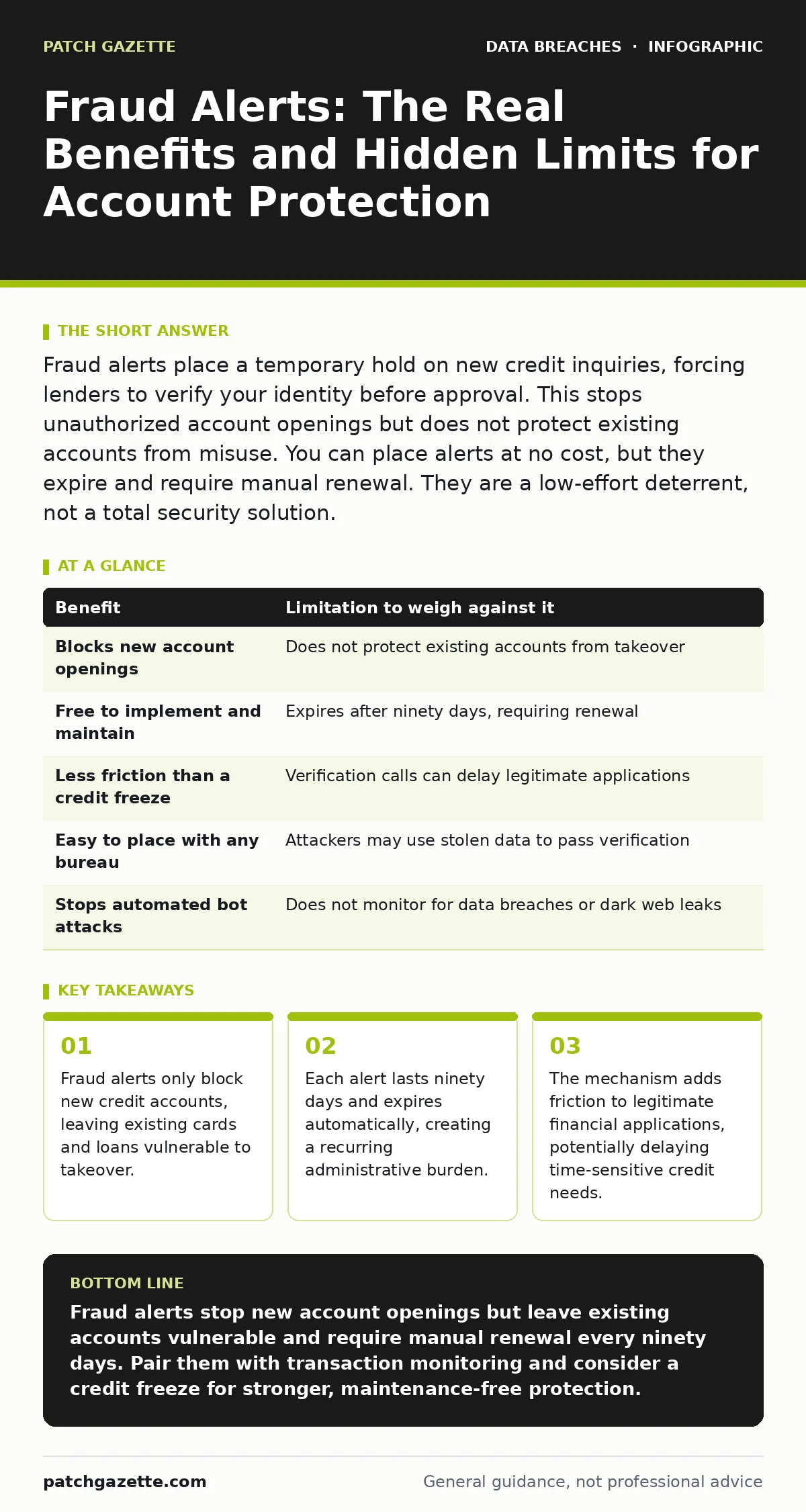
Fraud alerts place a temporary hold on new credit inquiries, forcing lenders to verify your identity before approval. This stops unauthorized account openings but does not protect existing accounts from misuse. You can place alerts at no cost, but they expire and require manual renewal. They are a low-effort deterrent, not a total security solution.
The Mechanics of a Credit Freeze Alternative
A fraud alert is a notice placed on your consumer credit report. It signals to potential creditors that you are actively monitoring for identity theft. When a lender requests your credit file, they see this flag. They must then take additional steps to verify your identity before issuing credit. This usually involves calling a phone number you provide during the setup process.
This mechanism differs significantly from a credit freeze. A freeze locks your report entirely, preventing any access without a PIN. A fraud alert leaves the report accessible but requires verification. You do not need to lift an alert to apply for credit. The lender handles the verification step. This makes alerts less disruptive for frequent credit applicants, but also less restrictive for attackers.
Concrete Benefits for Identity Theft Prevention
The primary benefit is the interruption of unauthorized account openings. Identity thieves often open new credit lines to drain future credit limits. A fraud alert forces a pause in this automated process. The thief cannot rely on instant approval algorithms. They must engage in social engineering to bypass the verification call. This adds time and complexity to their attack chain.
This pause often breaks the momentum of a fraud attempt. Many thieves operate in batches, opening dozens of accounts quickly. A single failed verification or a delayed call causes them to abandon your identity as a target. The effort-to-reward ratio shifts against them. You gain a window of time to detect the attempt and respond.
Another benefit is the lack of cost. Credit bureaus provide fraud alerts for free. This is mandated by federal law in the United States. You do not pay monthly fees or setup charges. This makes it an accessible first line of defense for anyone concerned about their credit health. It requires minimal technical knowledge to implement.
| Benefit | Limitation to weigh against it |
|---|---|
| Blocks new account openings | Does not protect existing accounts from takeover |
| Free to implement and maintain | Expires after ninety days, requiring renewal |
| Less friction than a credit freeze | Verification calls can delay legitimate applications |
| Easy to place with any bureau | Attackers may use stolen data to pass verification |
| Stops automated bot attacks | Does not monitor for data breaches or dark web leaks |
Honest Limitations and Security Gaps
The most significant limitation is the scope of protection. A fraud alert only applies to new credit applications. It does nothing to stop someone from using your existing credit cards. If a thief has your card number, expiration date, and CVV, they can make purchases. The alert provides no friction for transactions on active accounts. You must rely on transaction monitoring and spending limits for that layer.
Another gap is the reliance on phone verification. Lenders typically call the number you provided to confirm your identity. Sophisticated attackers may have intercepted your mail or gained access to your email. They might know answers to security questions. If they can spoof a call or intercept the verification process, the alert fails. The mechanism assumes the attacker cannot answer the phone or provide correct details.
The ninety-day expiration creates a recurring risk. If you forget to renew the alert, your protection vanishes silently. There is no automatic extension. You must remember to place a new alert before the old one expires. This administrative burden is often underestimated. Many users place an alert once and assume it is permanent. This false sense of security leaves them exposed months later.
When It Is Worth It
Imagine you recently had your mail stolen or your email account compromised. You suspect your personal information is in the hands of bad actors. In this scenario, a fraud alert is a sensible immediate step. It raises the barrier for anyone trying to open new accounts with your data. It is quicker to implement than a credit freeze and requires less coordination with lenders.
Suppose you are in the process of applying for a mortgage or auto loan. You need your credit report to be accessible to lenders, but you want extra security. A fraud alert allows lenders to access your report while forcing them to verify your identity. This balances the need for credit access with the desire for protection. It is better than having no alert at all in this high-stakes window.
It is also worth it if you live in a region with high rates of identity theft. The statistical risk of account takeover is higher. Adding a layer of verification can deter opportunistic criminals. It is a low-cost insurance policy against a specific type of attack. You trade a small amount of convenience for a significant reduction in the likelihood of new account fraud.
When It Is Not Worth It
If your primary concern is protecting existing credit cards, a fraud alert is not the right tool. It offers no protection against unauthorized charges on active accounts. You would be better off monitoring your transactions directly and setting up alerts with your card issuers. Some banks offer real-time transaction notifications via push alert. This provides immediate visibility into suspicious activity.
Suppose you rarely apply for new credit. You have a stable financial life with few changes. In this case, a credit freeze is superior. A freeze is permanent until you lift it. You do not need to worry about expiration dates. The effort to place a freeze is similar to placing an alert. The protection is stronger and more reliable. The alert is a weak substitute for a freeze in low-activity scenarios.
It is also not worth it if you are prone to forgetting administrative tasks. The ninety-day renewal cycle requires discipline. If you miss a renewal, you are unprotected. The mental overhead of tracking expiration dates may outweigh the security benefit. For many people, the convenience of a freeze, which requires no maintenance, is preferable. The alert introduces a failure mode based on memory.
See also: Stop Cloud Storage Leaks: Fix Misconfigurations Before Data Escapes · Secure File Sharing: Answers to Your Most Pressing Questions
The Administrative Burden of Maintenance
Placing a fraud alert requires contacting the credit bureaus. You must provide personal identification to prove you are the account holder. This process can take time. You may need to navigate online portals or call customer service lines. Each bureau has its own interface and requirements. This fragmentation adds to the hassle.
Renewing the alert requires repeating this process every ninety days. There is no single dashboard that manages all three alerts simultaneously. You must track the expiration date for each. If one expires and you forget to renew it, that bureau’s report is unprotected. Attackers may target the unprotected bureau specifically. This creates a patchwork of security that is difficult to manage.
The verification process itself can be intrusive. Lenders may call you at unexpected times. You may need to provide additional documentation to prove your identity. This friction can delay legitimate financial transactions. If you are applying for time-sensitive credit, such as a rental application, the delay may cause you to lose the opportunity. The trade-off between security and speed is real and personal.
Balancing Security with Daily Friction
You must decide how much friction you are willing to tolerate. A fraud alert adds a step to every new credit application. This step is designed to stop attackers, but it also slows you down. For most people, this is an acceptable trade-off. The inconvenience is minor compared to the damage of identity theft. However, for frequent credit applicants, the cumulative delay can be significant.
Consider your risk profile. Do you shop online frequently? Do you share your address with many services? High digital exposure increases the likelihood of data leakage. In this case, the alert is a valuable net. It catches attempts that slip past other defenses. For those with low digital exposure, the alert may be unnecessary overhead. A credit freeze provides stronger protection with less ongoing management.
Ultimately, a fraud alert is a tool, not a solution. It addresses a specific vector of attack: new account fraud. It does not solve the broader problem of identity theft. You must combine it with other practices. Monitor your statements regularly. Use unique passwords for financial accounts. Enable multi-factor authentication wherever possible. The alert is one piece of a larger puzzle.
Key takeaways
- Fraud alerts only block new credit accounts, leaving existing cards and loans vulnerable to takeover.
- Each alert lasts ninety days and expires automatically, creating a recurring administrative burden.
- The mechanism adds friction to legitimate financial applications, potentially delaying time-sensitive credit needs.
Fraud alerts stop new account openings but leave existing accounts vulnerable and require manual renewal every ninety days. Pair them with transaction monitoring and consider a credit freeze for stronger, maintenance-free protection.
Frequently asked questions
Does a fraud alert affect my credit score?
No, placing or renewing a fraud alert does not impact your credit score. Lenders see the alert but cannot penalize you for having one. It is a neutral marker on your report.
Can I place a fraud alert on someone else’s account?
No, you can only place an alert on your own credit report. You must verify your identity with the credit bureau. Proxy placement is not allowed to prevent misuse of the system.
How long does a fraud alert last?
A standard fraud alert lasts for ninety days. After that period, it expires automatically. You must place a new alert if you want to continue the protection. Some states offer one-year alerts.
Is a fraud alert the same as a security freeze?
No, they are different mechanisms. A freeze locks your report completely, requiring you to lift it for any access. An alert leaves the report open but requires verification for new credit. Freezes are stronger but more restrictive.
How this guide was produced: written by the Patch Gazette editorial team with AI assistance, checked against the public references listed below, and reviewed when the facts change. See our editorial policy or report an error.