
Data Subject Rights Under GDPR: Access, Erasure, and Portability
Data subject rights under GDPR shift liability from technical storage to procedural accountability, requiring teams to treat personal data as a temporary loan rather than a permanent asset.
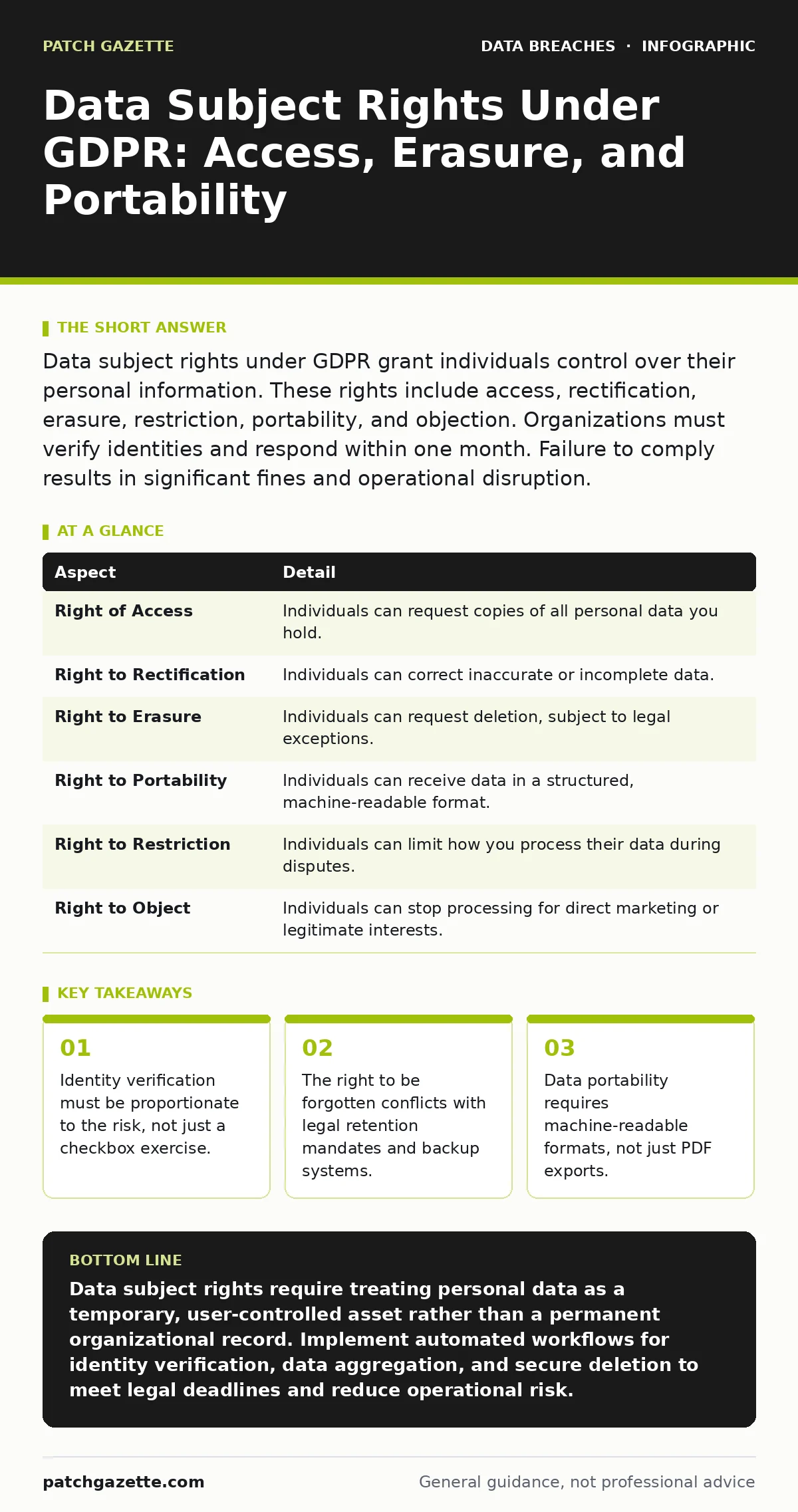
Data subject rights under GDPR grant individuals control over their personal information. These rights include access, rectification, erasure, restriction, portability, and objection. Organizations must verify identities and respond within one month. Failure to comply results in significant fines and operational disruption.
The Library Analogy for Data Rights
Imagine a library where you can demand any book you ever checked out be returned, burned, or rewritten. The library cannot simply say the book sits on a shelf somewhere. It must locate every copy, including those in the archive or lent to other branches. This is the core tension of data subject rights. These rights belong to individuals whose personal data you process. You act as the processor. The individual acts as the controller of their own information.
This dynamic changes how you design systems. You cannot treat data as a static asset. You must treat it as a flowing resource that users can redirect or stop at any time. The burden of proof lies with your organization. You must demonstrate where the data lives and how it moves.
Data Subject Rights Under GDPR: The Core Mechanisms
The General Data Protection Regulation establishes a framework for individual control. It does not grant absolute freedom. It grants specific procedural rights. These rights force organizations to build systems that can identify, isolate, and manipulate specific records on demand.
| Aspect | Detail |
|---|---|
| Right of Access | Individuals can request copies of all personal data you hold. |
| Right to Rectification | Individuals can correct inaccurate or incomplete data. |
| Right to Erasure | Individuals can request deletion, subject to legal exceptions. |
| Right to Portability | Individuals can receive data in a structured, machine-readable format. |
| Right to Restriction | Individuals can limit how you process their data during disputes. |
| Right to Object | Individuals can stop processing for direct marketing or legitimate interests. |
Each right triggers a different technical workflow. Access requires aggregation. Erasure requires sanitization. Portability requires formatting. Your systems must support all these workflows simultaneously.
Who Holds These Rights and Who Must Comply
You hold these rights if you are a natural person in the European Economic Area. Your nationality does not matter. Your location does not matter. The data controller’s location determines jurisdiction. If you process data of EU residents, you comply. This applies to small businesses and global enterprises alike.
The term data subject refers to the living individual. Deceased persons do not hold these rights. Corporate entities do not hold these rights. The rights attach to the person. This definition simplifies scope but complicates identification. You must distinguish between personal data and anonymous data. Anonymous data falls outside these rights. Pseudonymous data falls inside them.
How Identity Verification Prevents Abuse
You cannot fulfill a request without verifying the requester’s identity. Sending data to the wrong person creates a new breach. You must balance security with accessibility. Overly strict verification frustrates users. Overly loose verification exposes data.
Use existing authentication methods where possible. Do not create new hurdles. If a user logs into your portal, that session verifies identity. For external requests, ask for information you already hold. Do not ask for more data than necessary. This principle aligns with password hygiene best practices. You should not collect new credentials just to verify old ones. Store verification records securely. Delete them after the request is complete.
The Erasure Paradox and Legal Retention
The right to erasure, often called the right to be forgotten, is not absolute. You must keep data if a legal obligation requires it. Tax laws often mandate record retention for several years. Contractual disputes may require evidence preservation. You cannot delete data that proves compliance.
This creates a conflict. The user wants deletion. The law wants retention. You must document the legal basis for retention. You must restrict processing while retaining. Restriction means you store the data but do not use it. You isolate it from active systems. You prevent accidental inclusion in analytics. This distinction matters for audits. It shows you respect the right while obeying the law.
Imagine a user requests deletion of a five-year-old contract. You cannot delete the contract. You can delete the user’s marketing preferences. You can redact the user’s phone number from the active CRM. You keep the contract in a restricted archive. This approach satisfies both parties.
See also: Is It Safe to Email Social Security Number? Risks and Secure Alternatives · APIs in Healthcare: Secure Data Exchange Without Breaches
Portability Requires Machine-Readable Formats
The right to data portability allows users to move data to another provider. You cannot send a PDF. You cannot send a screenshot. You must send structured data. Common formats include JSON or CSV. The data must be interoperable. The receiving system must parse it without manual intervention.
This right applies to data provided by the user. It does not apply to data you derived. You do not share your proprietary algorithms. You share the raw inputs. This limitation protects intellectual property. It also reduces scope. You must identify which data points are user-provided. This requires clear data mapping. If you do not know the source of each field, you cannot fulfill portability requests.
What People Usually Get Wrong
Many teams believe anonymization solves the erasure problem. Anonymization removes identifiers. It does not remove the data’s utility. If the data remains in your analytics engine, it still influences decisions. True erasure requires removing the record from all systems. This includes backups.
Backups present the hardest technical challenge. You cannot restore a backup that contains deleted data. You must have a process for purging backups. This process takes time. The law allows one month. It does not require instant deletion from cold storage. You must document the backup retention cycle. You must explain this cycle to the user. Transparency builds trust.
Another common error is ignoring shadow IT data exposure. Developers often store user data in local repositories. These repositories fall under the same rules. You must scan for data across all environments. You cannot limit your search to production databases. This comprehensive view prevents accidental non-compliance.
Integrating Rights Into Daily Operations
You cannot treat these rights as exceptional events. You must build them into daily operations. Design systems with ISO 27001 principles. Focus on data lifecycle management. Tag data with retention periods. Tag data with source types. This metadata enables quick retrieval.
Train staff on the process. Customer service teams receive these requests. They must know how to route them. They must know what information to collect. They must know what not to promise. Do not promise immediate deletion. Promise verification and processing. Set realistic expectations.
Consider misconfigured cloud storage leaks. If data is exposed, rights requests increase. Users become more aware. Your response speed becomes critical. Slow responses signal negligence. Fast responses signal competence. Invest in automation. Automate identity checks. Automate data aggregation. Automate formatting. This reduces human error.
Balancing Security and Accessibility
You must protect data while allowing access. These goals conflict. Open access invites theft. Strict access frustrates users. You find the middle ground. Use role-based access control. Limit who can view sensitive data. Log all access. Monitor for anomalies.
If a request seems suspicious, verify more strictly. Ask for additional proof. Document the reason. This protects you from abuse. It also protects the user. You are their ally. You are not their adversary. Frame interactions around empowerment. Show users their data. Explain how you use it. Offer clear opt-outs.
This approach reduces friction. It improves compliance. It builds brand loyalty. Users respect organizations that respect their rights. They trust organizations that are transparent. Trust is a security asset. It reduces the likelihood of malicious action. It increases the likelihood of cooperation.
Key takeaways
- Identity verification must be proportionate to the risk, not just a checkbox exercise.
- The right to be forgotten conflicts with legal retention mandates and backup systems.
- Data portability requires machine-readable formats, not just PDF exports.
Data subject rights require treating personal data as a temporary, user-controlled asset rather than a permanent organizational record. Implement automated workflows for identity verification, data aggregation, and secure deletion to meet legal deadlines and reduce operational risk.
Frequently asked questions
How long do I have to respond to a data subject request?
You generally have one calendar month to respond. You can extend this by two months for complex requests. You must inform the user of any extension within the first month.
Can I charge a fee for processing these requests?
No. You cannot charge for standard requests. You can charge for manifestly unfounded or excessive requests. You must justify the fee and inform the user in advance.
What if the user cannot verify their identity?
You can refuse the request. You must explain why verification failed. You must give the user a chance to provide better proof. You cannot process the request until identity is confirmed.
Does the right to erasure apply to third-party processors?
Yes. You must ensure your processors delete the data. Your contract with them should include clauses for this. You remain liable if they fail to comply.
How this guide was produced: written by the Patch Gazette editorial team with AI assistance, checked against the public references listed below, and reviewed when the facts change. See our editorial policy or report an error.