
Replay Attacks: How Stolen Data Becomes a Security Threat
Replay attacks succeed not by breaking encryption, but by reusing valid captured data to bypass authentication checks that lack freshness constraints.
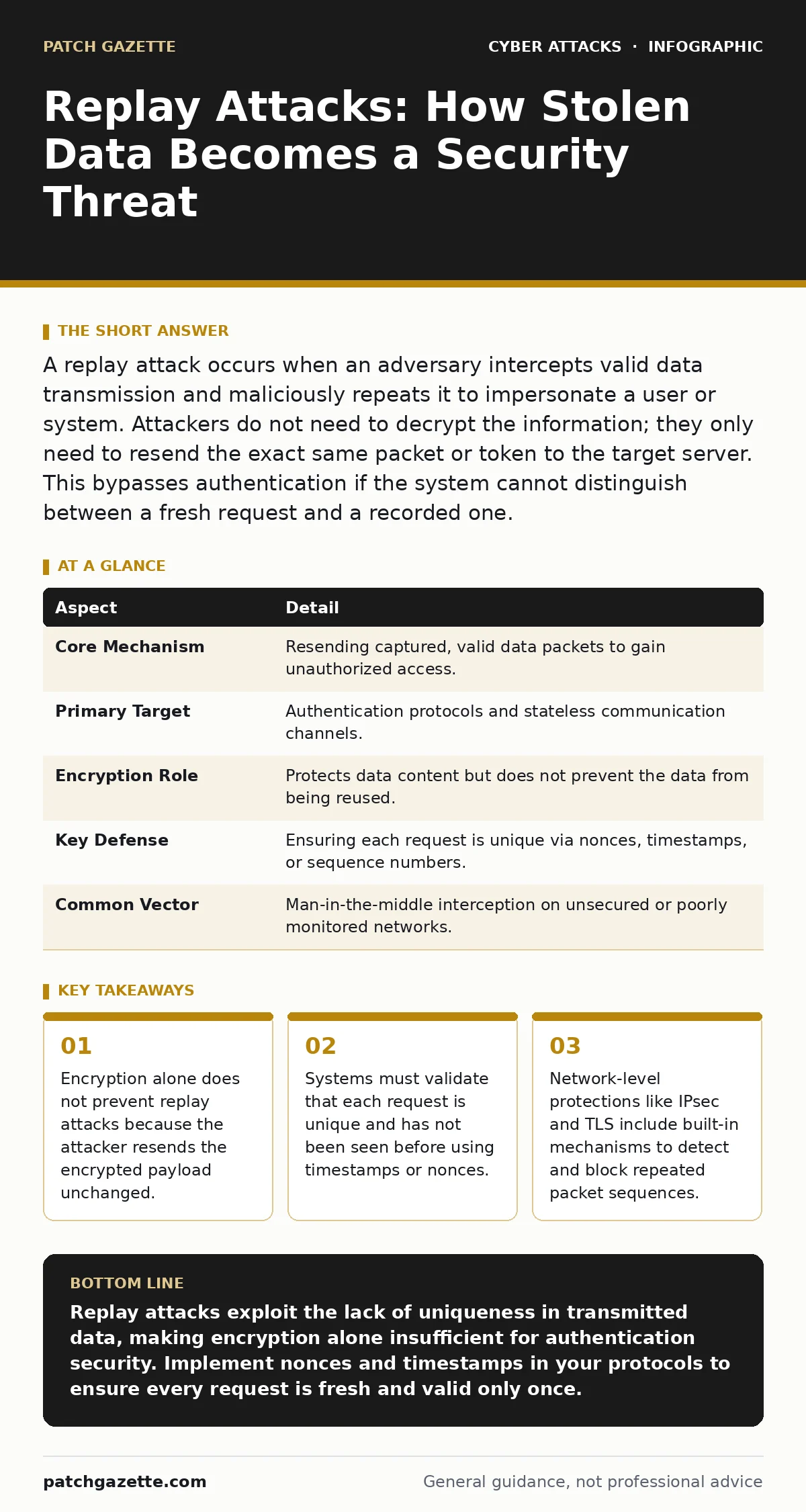
A replay attack occurs when an adversary intercepts valid data transmission and maliciously repeats it to impersonate a user or system. Attackers do not need to decrypt the information; they only need to resend the exact same packet or token to the target server. This bypasses authentication if the system cannot distinguish between a fresh request and a recorded one.
The Parrot in the Data Stream
Imagine a guard at a gate who checks a physical key. If someone films the key being inserted and then plays that video back to the guard, the guard might open the gate if they only look at the shape of the key and not the context of the moment. Replay attacks operate on this same principle. The attacker does not need to know what the key is or how it works. They simply need to capture the successful interaction and repeat it.
In digital communications, this means intercepting a valid stream of data and resending it to the receiver. The receiver sees valid credentials or tokens and processes the request as legitimate. The security failure lies in the receiver’s inability to recognize that the data is stale. It is not a failure of secrecy, but a failure of freshness.
| Aspect | Detail |
|---|---|
| Core Mechanism | Resending captured, valid data packets to gain unauthorized access. |
| Primary Target | Authentication protocols and stateless communication channels. |
| Encryption Role | Protects data content but does not prevent the data from being reused. |
| Key Defense | Ensuring each request is unique via nonces, timestamps, or sequence numbers. |
| Common Vector | Man-in-the-middle interception on unsecured or poorly monitored networks. |
How the Attack Unfolds
The process begins with eavesdropping. The attacker positions themselves on the network path between the client and the server. This might involve being on the same Wi-Fi network, compromising a router, or tapping into a fiber line. They wait for a legitimate user to perform an action that requires authentication, such as logging in or transferring funds.
Once the valid request is sent, the attacker captures the entire packet. This packet contains the encrypted credentials or the authentication token. The attacker does not attempt to decrypt it. Instead, they store it. Later, the attacker resends this exact packet to the server. If the server does not check whether this specific packet has been processed before, it accepts the replayed data as a new, legitimate request.
Why Encryption Is Not Enough
Many organizations assume that using strong encryption, such as TLS or IPsec, makes them immune to replay attacks. This is a dangerous misconception. Encryption ensures that only the intended recipient can read the data. It does not ensure that the data is being sent for the first time.
If the protocol does not include anti-replay measures, the encrypted blob is just as useful to an attacker when replayed as it is when first sent. The attacker acts as a mirror, reflecting valid data back to the source. The security layer that protects the content is blind to the temporal context of the transmission. You must layer anti-replay controls on top of encryption to close this gap.
Common Forms of Replay Exploitation
Replay attacks manifest in several specific technical forms. Understanding these helps in identifying where your infrastructure might be vulnerable.
Session Token Replay
Web applications often use session tokens to maintain user state. If a token is not invalidated after use or does not expire quickly, an attacker can capture it and use it to hijack the session. This is particularly risky if the application relies on stateless tokens without server-side validation of previous usage.
Password Hash Replay
In some older or poorly designed systems, the client sends a hash of the password rather than the password itself. If the server compares this hash against a stored hash, an attacker can capture the hash and replay it. The server sees the correct hash and grants access. This is similar to rainbow table attacks in that it exploits the static nature of the credential representation, though the mechanism differs.
Challenge-Response Replay
Protocols that use challenge-response mechanisms are vulnerable if the challenge is not unique or if the response can be reused. If the server sends the same challenge every time, or if the client’s response does not include a variable element like a timestamp, the attacker can record one successful exchange and reuse it indefinitely.
What People Usually Get Wrong
A common mistake is believing that changing passwords frequently stops replay attacks. It does not. If the attacker captures the login packet before the password is changed, they can replay it until the session expires or the token is invalidated. The vulnerability is in the transmission and validation logic, not the credential itself.
Another misconception is that internal networks are safe. Replay attacks are often internal threats. An attacker who has already breached the perimeter can move laterally by replaying internal authentication packets. This is why conditional access policies that verify device health and user context are more effective than relying solely on network segmentation.
See also: Software Updates Best Practices: Secure Patching Without Downtime · Guest Wi-Fi Explained: Isolate Traffic Without Compromising Security
Reducing the Risk Effectively
To mitigate replay attacks, you must introduce state and time into your authentication protocols. The goal is to make every request unique and valid only for a very short window.
- Use Nonces: A nonce is a number used once. The server generates a unique random number for each session. The client must include this nonce in its response. The server checks that the nonce has not been used before. This prevents an attacker from replaying an old response because the nonce will no longer match the current session requirement.
- Implement Timestamps: Each request should include a timestamp. The server checks that the timestamp is within an acceptable window, such as a few seconds. If the packet is too old, it is rejected. This limits the window of opportunity for an attacker to capture and resend data.
- Sequence Numbers: For continuous data streams, assign a sequence number to each packet. The receiver only accepts packets with the next expected sequence number. Any out-of-order or repeated packets are discarded. This is a standard feature in protocols like IPsec.
- Bind Credentials to Context: Modern authentication methods like passkeys bind the cryptographic proof to the specific device and the specific relying party. This makes it much harder to replay a credential from one device to another or from one service to another.
Integration with Broader Security Strategies
Replay attack mitigation works best when combined with other security measures. For instance, phishing attacks often aim to steal credentials that can then be used in replay scenarios if the underlying protocol is weak. Using multi-factor authentication adds a layer that is difficult to replay because the second factor is often time-sensitive or device-bound.
Similarly, OAuth consent phishing attempts to trick users into granting tokens. If these tokens are long-lived and not bound to specific scopes or devices, they become prime targets for replay. Ensure your OAuth implementation uses short-lived access tokens and refreshes them securely.
While DNS amplification attacks and IP spoofing are different threats, they highlight the importance of validating the source and integrity of incoming traffic. A comprehensive security posture treats data freshness as a core requirement, not an afterthought.
Key takeaways
- Encryption alone does not prevent replay attacks because the attacker resends the encrypted payload unchanged.
- Systems must validate that each request is unique and has not been seen before using timestamps or nonces.
- Network-level protections like IPsec and TLS include built-in mechanisms to detect and block repeated packet sequences.
- Authentication protocols must bind credentials to a specific session or time window to render captured tokens useless after initial use.
Replay attacks exploit the lack of uniqueness in transmitted data, making encryption alone insufficient for authentication security. Implement nonces and timestamps in your protocols to ensure every request is fresh and valid only once.
Frequently asked questions
Can a VPN prevent replay attacks?
Most modern VPN protocols like IPsec and IKEv2 include anti-replay mechanisms by default, using sequence numbers to detect and discard duplicate packets.
Do timestamps solve all replay issues?
Timestamps help, but they require synchronized clocks between client and server. If clocks are out of sync, legitimate requests may be rejected, or the window for replay may be too wide.
How do I know if my system is vulnerable?
Look for authentication protocols that do not use unique session identifiers, nonces, or time-bound tokens. Stateless systems that accept the same credential hash repeatedly are at high risk.
Is HTTPS enough to stop replay?
HTTPS (TLS) includes anti-replay features for the transport layer, but application-layer logic must also ensure that tokens and session data are not reused. Application developers must implement proper session management.
How this guide was produced: written by the Patch Gazette editorial team with AI assistance, checked against the public references listed below, and reviewed when the facts change. See our editorial policy or report an error.