
Rainbow Table Attacks Explained: How Precomputed Lists Steal Passwords
Attackers use precomputed lookup tables to reverse cryptographic hashes instantly, bypassing the need to guess passwords in real time during a breach.
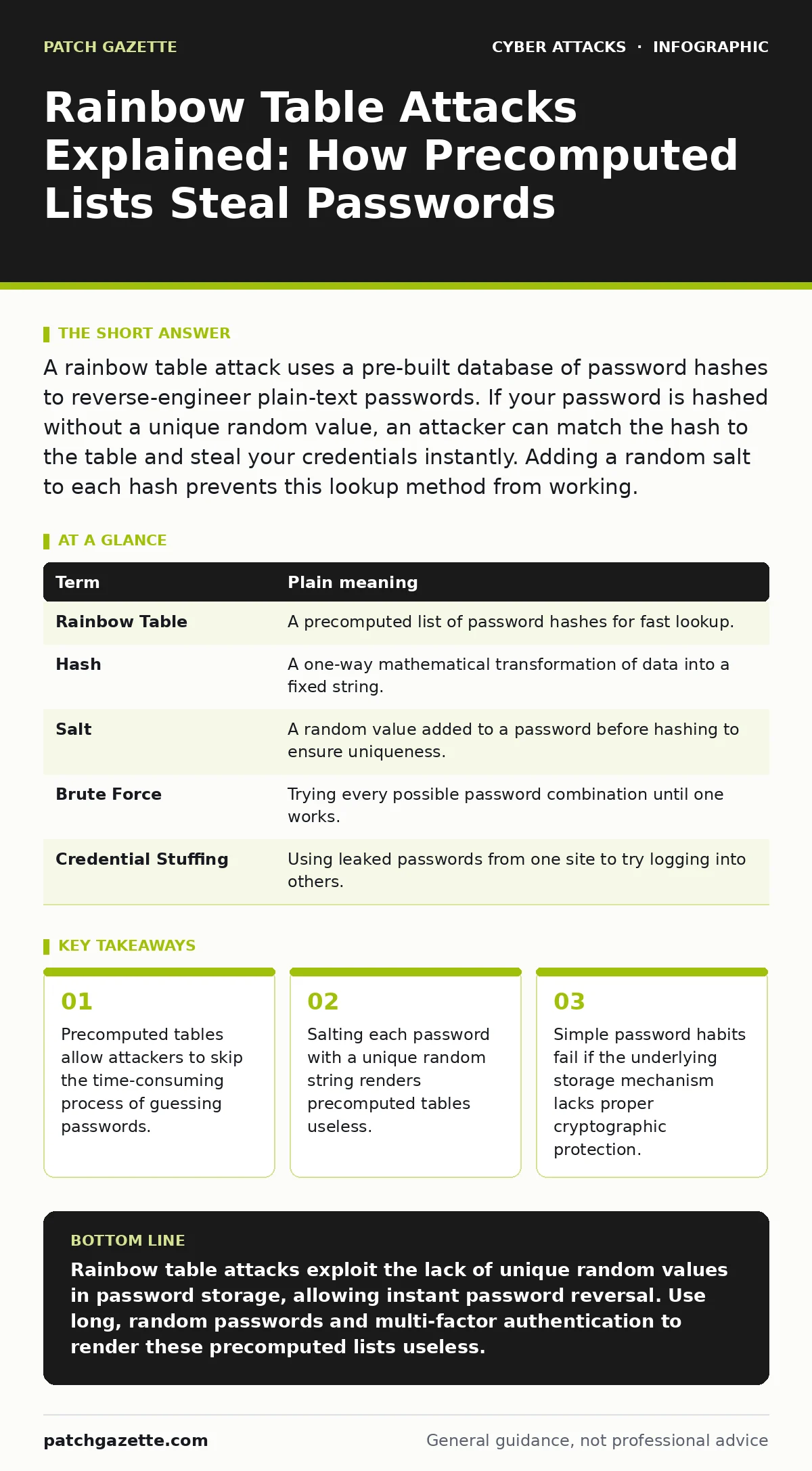
A rainbow table attack uses a pre-built database of password hashes to reverse-engineer plain-text passwords. If your password is hashed without a unique random value, an attacker can match the hash to the table and steal your credentials instantly. Adding a random salt to each hash prevents this lookup method from working.
The Library of Broken Keys
Imagine a massive library where every possible combination of letters and numbers has been written down. Each entry in this library corresponds to a specific lock combination. Instead of trying every key on a door, an intruder simply looks up the lock’s pattern in the library. This is the core concept behind a rainbow table attack. It replaces brute force guessing with instant lookup.
In digital security, this library is a rainbow table. It is a precomputed list of hashes for common passwords. A hash is a mathematical function that turns your password into a fixed-length string of characters. This process is one-way, meaning you cannot easily turn the hash back into the password. However, if the attacker has a table that maps millions of hashes to their original passwords, they can reverse the process by simple lookup.
Why Hashes Are Not Enough
You might assume that storing hashed passwords is safe. It is not, if the hash is unsalted. When a system stores your password, it runs it through a hashing algorithm. If two users have the same password, they will have the same hash. An attacker who steals the database sees identical hashes and knows the passwords are identical.
This uniformity allows the creation of rainbow tables. The attacker generates hashes for every likely password in advance. When they obtain the stolen database, they compare the stolen hashes against their precomputed table. If there is a match, they immediately know the plain-text password. This happens in seconds, not days.
| Term | Plain meaning |
|---|---|
| Rainbow Table | A precomputed list of password hashes for fast lookup. |
| Hash | A one-way mathematical transformation of data into a fixed string. |
| Salt | A random value added to a password before hashing to ensure uniqueness. |
| Brute Force | Trying every possible password combination until one works. |
| Credential Stuffing | Using leaked passwords from one site to try logging into others. |
The Salt Defense
The defense against this library of keys is salting. Salting involves adding a unique, random string of characters to each password before hashing it. This ensures that even if two users have the same password, their resulting hashes will be completely different.
Imagine adding a unique, random page number to every entry in the library. Now, the intruder cannot use a single master list. They would need a separate library for every single user. This makes precomputation impossible at scale. The attacker must go back to slow, expensive brute force guessing for each individual account.
What This Means for You
As a user, you cannot control how a website salts your password. Many legacy systems or poorly configured applications fail to implement salting correctly. This leaves your data exposed to rainbow table attacks if the site is breached.
You can mitigate this risk by using complex, unique passwords. A long password with random characters is unlikely to appear in any precomputed table. These tables are limited in size and typically contain only common or short passwords. If your password is not in the table, the lookup fails.
This connects to the broader issue of phishing. If attackers steal your credentials directly via a deceptive site, they bypass the hash entirely. They get the plain-text password without needing to reverse anything. Protecting against rainbow tables does not protect you from social engineering.
Simple Safety Habits
You can reduce your exposure to these attacks through specific behaviors. First, use a password manager to generate long, random passwords. This ensures your passwords are complex enough to be absent from standard rainbow tables.
Second, enable multi-factor authentication wherever possible. Even if an attacker retrieves your password from a rainbow table lookup, they cannot log in without the second factor. This adds a layer of security that password storage methods cannot address.
Finally, monitor for breaches. If a service you use is compromised, change your password immediately. If that service did not salt passwords, your password may already be in an attacker’s possession.
See also: How Gift Card Scams Work: The Step-by-Step Attack Chain · Phishing Explained: How Attackers Steal Trust and Data
Try This Now
- Audit your most critical accounts. Ensure each uses a unique, long password generated by a manager.
- Enable two-factor authentication on every account that offers it. This prevents access even if passwords are compromised.
- Review your login history. Look for unfamiliar locations or devices that might indicate a breach.
Beyond the Table
Rainbow table attacks are a specific type of threat, but they are part of a larger ecosystem of credential theft. Attackers often combine stolen passwords with other techniques. For instance, they might use OAuth consent phishing to gain access to your accounts without ever needing your password.
They may also engage in dumpster diving for physical documents that reveal security questions or personal data. This personal data can help them reset passwords or guess weak ones. Understanding that password theft is just one vector helps you build a stronger defense.
Key takeaways
- Precomputed tables allow attackers to skip the time-consuming process of guessing passwords.
- Salting each password with a unique random string renders precomputed tables useless.
- Simple password habits fail if the underlying storage mechanism lacks proper cryptographic protection.
Rainbow table attacks exploit the lack of unique random values in password storage, allowing instant password reversal. Use long, random passwords and multi-factor authentication to render these precomputed lists useless.
Frequently asked questions
Can a rainbow table crack my password if it is very long?
No, rainbow tables are limited in size and typically only contain short or common passwords. Long, random passwords are unlikely to be in the table.
Does using a passphrase protect me from rainbow tables?
Only if the passphrase is long and random. Common phrases or simple substitutions may still appear in large precomputed tables.
How do I know if my password was in a rainbow table?
You cannot know for sure unless the service notifies you of a breach. Using unique passwords limits the damage if one service is compromised.
Are rainbow tables still used today?
Yes, they are effective against systems that do not use salting. Many older or poorly configured systems remain vulnerable to this method.
How this guide was produced: written by the Patch Gazette editorial team with AI assistance, checked against the public references listed below, and reviewed when the facts change. See our editorial policy or report an error.