Tenant Isolation: How to Prevent Data Leaks Between Customers
Shared infrastructure creates hidden attack surfaces where a compromised tenant can pivot to others through misconfigured memory or storage layers.
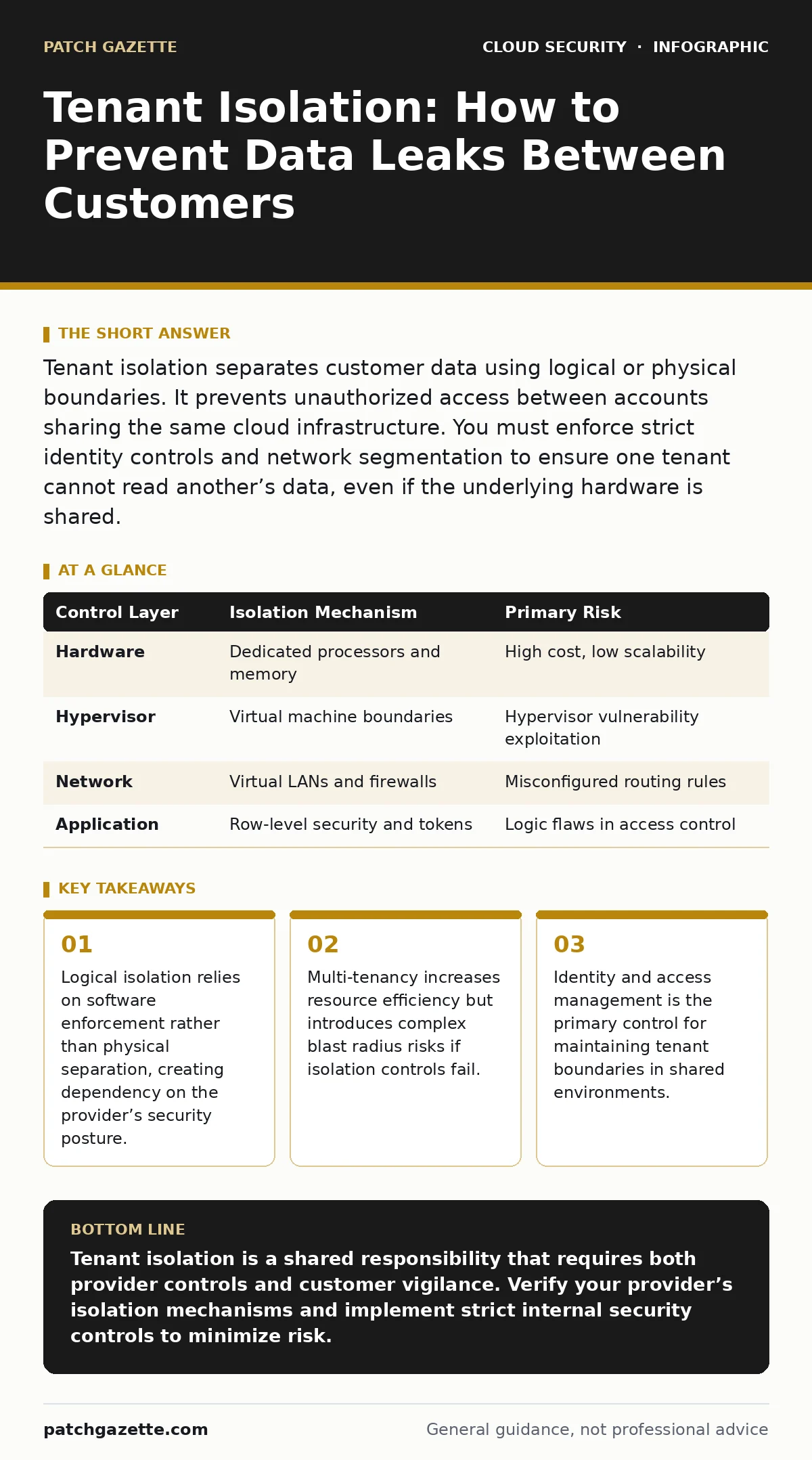
Tenant isolation separates customer data using logical or physical boundaries. It prevents unauthorized access between accounts sharing the same cloud infrastructure. You must enforce strict identity controls and network segmentation to ensure one tenant cannot read another’s data, even if the underlying hardware is shared.
What is tenant isolation in cloud computing?
Tenant isolation is the set of technical controls that prevent one customer from accessing another’s data or resources within a shared environment. It ensures that even though multiple organizations run workloads on the same physical servers, their data remains strictly separated. This separation occurs at the hardware, virtualization, and application layers.
How does logical isolation differ from physical isolation?
Logical isolation uses software-defined boundaries to separate tenants on shared hardware, while physical isolation dedicates specific hardware to a single tenant. Logical isolation is more common because it allows providers to maximize resource utilization and lower costs. Physical isolation offers higher security assurance but comes with significantly higher costs and reduced scalability.
Can a compromised tenant attack another tenant?
Yes, if isolation controls fail or are misconfigured, a malicious tenant can attempt to pivot to neighboring tenants. This is known as a side-channel attack or a breakout attempt. The attacker might exploit vulnerabilities in the hypervisor or shared storage layers to access adjacent memory or disk spaces.
What role does the hypervisor play in isolation?
The hypervisor, or virtual machine monitor, manages the allocation of physical resources to virtual machines. It acts as the gatekeeper that enforces boundaries between virtual environments running on the same host. If the hypervisor is compromised, an attacker can bypass all higher-level security controls and access any tenant’s data on that server.
How do I verify my provider’s isolation controls?
You cannot directly inspect the provider’s internal infrastructure, so you must rely on their compliance certifications and architecture documentation. Review their security whitepapers to understand how they segment network traffic and storage. Ask specifically about their process for detecting and responding to cross-tenant access attempts.
See also: How Cloud Ransomware Works: The Step-by-Step Attack Chain · Shadow IT: What It Is and How to Reduce the Hidden Risk
Does encryption guarantee tenant isolation?
Encryption protects data at rest and in transit, but it does not prevent a tenant from accessing another’s unencrypted memory or processes. If an attacker gains control of a virtual machine, they can potentially read data in RAM before it is encrypted or after it is decrypted. Encryption is a defense-in-depth measure, not a substitute for proper isolation.
What are the risks of shared storage systems?
Shared storage pools present a significant risk if file system boundaries are not strictly enforced. A misconfiguration could allow a tenant to read blocks belonging to another tenant’s virtual disk. Providers must implement strict access control lists and regular integrity checks to ensure storage segregation remains intact.
How does multi-tenancy affect incident response?
Incidents in a multi-tenant environment require careful coordination to avoid impacting other customers. You must isolate the affected tenant’s resources without disrupting the shared infrastructure. This requires pre-defined playbooks that address cross-tenant impact assessments and communication protocols.
| Control Layer | Isolation Mechanism | Primary Risk |
|---|---|---|
| Hardware | Dedicated processors and memory | High cost, low scalability |
| Hypervisor | Virtual machine boundaries | Hypervisor vulnerability exploitation |
| Network | Virtual LANs and firewalls | Misconfigured routing rules |
| Application | Row-level security and tokens | Logic flaws in access control |
How do I secure service accounts across tenants?
Service accounts often hold elevated privileges, making them prime targets for attackers. You must enforce strict credential rotation and limit the scope of permissions granted to these accounts. Never share service accounts between tenants, as this creates a direct bridge for lateral movement.
What is the blast radius of a tenant compromise?
The blast radius refers to the extent of damage caused by a security breach. In a poorly isolated environment, a single compromised tenant can expose data from all other tenants sharing the same infrastructure. Effective isolation limits the blast radius to the specific tenant’s resources and prevents horizontal escalation.
How does this relate to serverless security risks?
Serverless architectures abstract away the infrastructure, making tenant isolation less visible to the user. You must trust the provider to isolate execution environments between different functions and customers. Understanding the provider’s model for state management and temporary storage is critical for maintaining data separation.
Can I use cloud firewalls to enforce isolation?
Cloud firewalls filter network traffic based on rules, but they do not enforce data-level isolation between tenants. They help prevent unauthorized network connections but cannot stop an attacker who has already breached a virtual machine. Use firewalls as part of a layered defense strategy, not as the primary isolation control.
What are the implications for multi-cloud security?
Using multiple cloud providers adds complexity to tenant isolation strategies. Each provider has different mechanisms and certifications for ensuring data separation. You must evaluate each provider’s isolation model independently and ensure your security policies are consistently applied across all environments.
How do CIS Benchmarks help with tenant isolation?
CIS Benchmarks provide specific configuration guidelines for securing cloud environments. They include recommendations for setting up virtual networks, managing access controls, and configuring storage encryption. Following these benchmarks helps ensure that your tenant environment is hardened against common misconfigurations.
What is the role of shadow IT in tenant isolation?
Shadow IT refers to unauthorized applications or services used by employees. These services may not adhere to the organization’s security policies, creating gaps in tenant isolation. You must identify and regulate all cloud services used within your organization to ensure they meet your isolation standards.
How does hybrid cloud security impact tenant isolation?
Hybrid cloud environments extend the attack surface by connecting on-premises resources with cloud services. You must ensure that isolation controls are consistent across both environments. Inconsistent security postures can create weak points that attackers can exploit to move between tenants.
What about cloud ransomware targeting tenants?
Cloud ransomware can encrypt data within a tenant’s environment, disrupting operations. If isolation controls are weak, the ransomware could spread to other tenants sharing the same infrastructure. Implementing immutable backups and strict access controls helps mitigate the impact of such attacks.
Key takeaways
- Logical isolation relies on software enforcement rather than physical separation, creating dependency on the provider’s security posture.
- Multi-tenancy increases resource efficiency but introduces complex blast radius risks if isolation controls fail.
- Identity and access management is the primary control for maintaining tenant boundaries in shared environments.
Tenant isolation is a shared responsibility that requires both provider controls and customer vigilance. Verify your provider’s isolation mechanisms and implement strict internal security controls to minimize risk.
Frequently asked questions
Can I isolate tenants in a public cloud?
Yes, public clouds offer robust logical isolation through software-defined boundaries and strict access controls.
How often should I review tenant isolation controls?
Review controls regularly, especially after major updates or changes to your cloud environment.
What is the biggest risk to tenant isolation?
Misconfigurations by customers or vulnerabilities in the provider’s hypervisor are the biggest risks.
Does encryption replace the need for isolation?
No, encryption protects data but does not prevent unauthorized access to processes or memory.
How this guide was produced: written by the Patch Gazette editorial team with AI assistance, checked against the public references listed below, and reviewed when the facts change. See our editorial policy or report an error.