SAML vs OAuth: Which Protocol Fits Your Cloud Architecture?
SAML handles identity verification for logins, while OAuth manages permissions for app access; conflating the two creates significant security gaps.
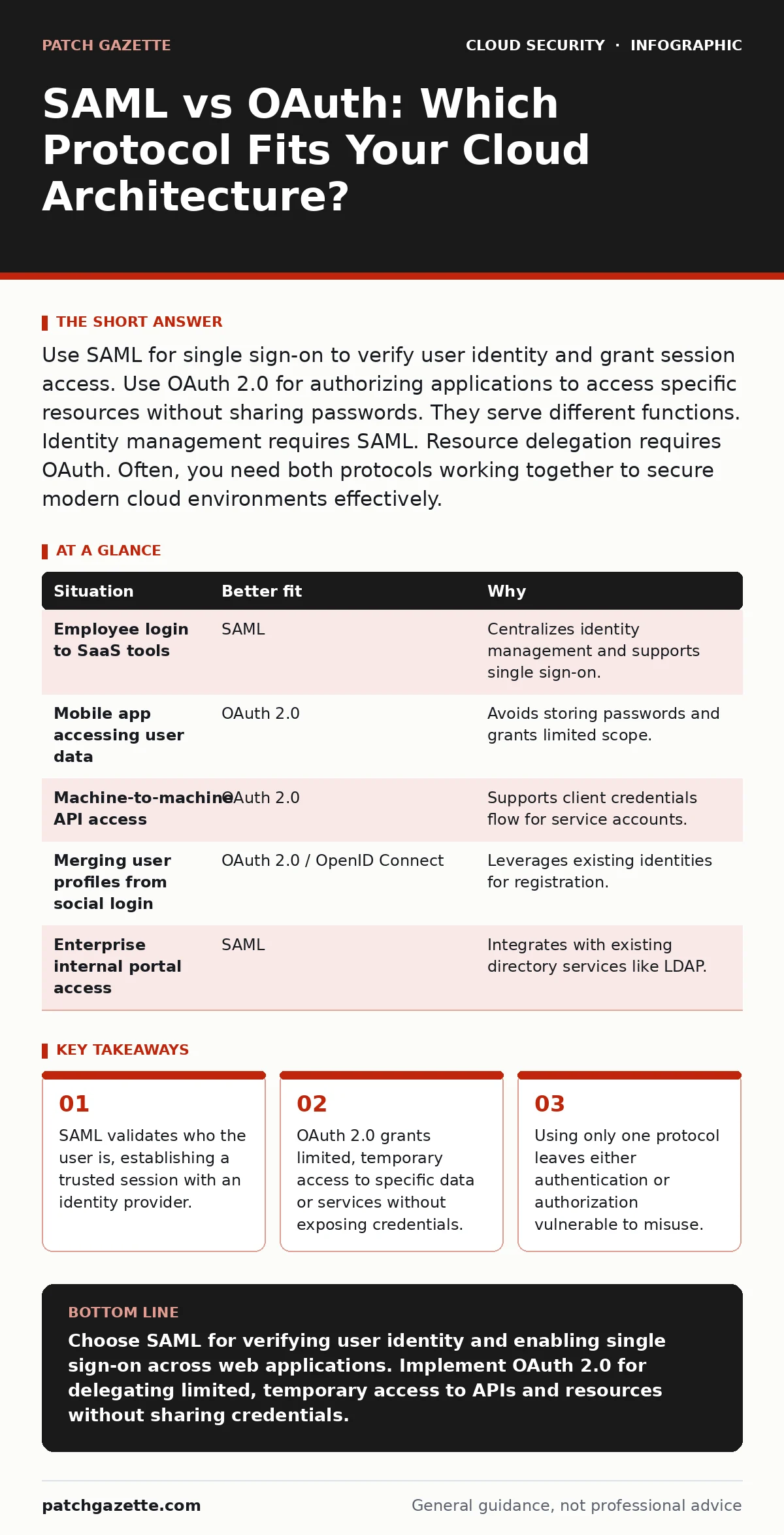
Use SAML for single sign-on to verify user identity and grant session access. Use OAuth 2.0 for authorizing applications to access specific resources without sharing passwords. They serve different functions. Identity management requires SAML. Resource delegation requires OAuth. Often, you need both protocols working together to secure modern cloud environments effectively.
Determining the Core Function
You must first define whether you are solving an identity problem or an access problem. These are distinct challenges in cloud security. SAML (Security Assertion Markup Language) answers the question "Who are you?" It carries assertions about a user’s identity and attributes from an identity provider to a service provider. This mechanism enables single sign-on, allowing users to authenticate once and access multiple applications. The focus is on establishing a trusted session.
OAuth 2.0 (Open Authorization) answers the question "What are you allowed to do?" It is an authorization framework that allows third-party applications to obtain limited access to a user’s resources. It does not verify identity in the same way SAML does. Instead, it issues access tokens that permit specific actions, such as reading a calendar or posting to a social feed. The focus is on permission granularity.
Imagine a user trying to log into a corporate portal. SAML verifies their credentials against a central directory. Now imagine that same user granting a budgeting app permission to read their bank transaction history. OAuth handles that delegation. Confusing these roles leads to architectural errors. You cannot use OAuth to replace SAML for primary login authentication in enterprise environments without significant custom development and increased risk.
Assessing the Integration Scope
Consider where the integration sits in your technology stack. SAML is the standard for enterprise single sign-on. It connects users to web applications, SaaS tools, and internal services. It relies on XML-based assertions that are parsed by the service provider. This makes it ideal for scenarios where you need to transfer rich user attributes, such as department, role, or email address, from the identity provider to the application.
OAuth is the standard for API access. It connects applications to data stores or other services. It uses JSON Web Tokens or opaque tokens to represent access rights. This makes it ideal for mobile apps, single-page applications, and IoT devices that need to interact with backend services. It is lightweight and designed for modern, stateless architectures.
Suppose you are building a mobile field service app. The app needs to read customer records from your CRM. You do not want the app to store CRM passwords. OAuth allows the app to request a token that grants read-only access to specific customer records. SAML would be the wrong choice here because the app is not logging a human user into a web interface; it is a machine-to-machine or user-to-API interaction requiring delegated permissions.
Evaluating the Threat Model
Every protocol introduces specific attack surfaces. SAML assertions can be subject to replay attacks if not properly validated. An attacker who intercepts a valid SAML token can reuse it to impersonate the user. This is why signature validation and timestamp checking are mandatory. The complexity of XML parsing also introduces potential for injection attacks if the service provider is not carefully configured.
OAuth tokens can be leaked or intercepted, especially in mobile or desktop environments. Because OAuth separates authentication from authorization, a compromised access token grants only the permissions defined in the scope. This limits the blast radius of a breach. However, if you define overly broad scopes, a single token leak can expose significant amounts of data. The threat model for OAuth centers on token protection and scope minimization.
You must also consider the impact on shadow IT. Employees often adopt unsanctioned apps that integrate with corporate data. OAuth’s consent screens make it visible when an app requests access. SAML’s backend integration is less visible to the end user. If visibility of third-party access is a priority for your cloud vulnerability management strategy, OAuth provides a clearer audit trail of delegated permissions.
Matching the User Experience
The user experience differs significantly between the two. SAML typically involves a redirect to the identity provider. The user sees a login page, enters credentials, and is redirected back to the application. This flow is familiar for web-based enterprise tools. It supports multi-factor authentication seamlessly at the identity provider layer.
OAuth often involves a consent screen. The user is asked to approve specific permissions for the requesting application. This adds a step to the process but increases user awareness of what data is being shared. For consumer-facing apps, this transparency builds trust. For internal enterprise tools, however, repeated consent prompts can lead to alert fatigue.
Imagine a user accessing a new analytics dashboard. With SAML, they log in once and are granted access based on their group membership. With OAuth, they might be asked to approve "read access to sales data" every time they install the dashboard. For internal tools, SAML’s silent authentication is often preferred. For external partnerships, OAuth’s explicit consent is necessary.
Situations Favoring Each Protocol
Different scenarios demand different approaches. Use SAML when you need to manage user identity across multiple web applications. Use OAuth when you need to grant temporary, limited access to APIs or resources.
| Situation | Better fit | Why |
|---|---|---|
| Employee login to SaaS tools | SAML | Centralizes identity management and supports single sign-on. |
| Mobile app accessing user data | OAuth 2.0 | Avoids storing passwords and grants limited scope. |
| Machine-to-machine API access | OAuth 2.0 | Supports client credentials flow for service accounts. |
| Merging user profiles from social login | OAuth 2.0 / OpenID Connect | Leverages existing identities for registration. |
| Enterprise internal portal access | SAML | Integrates with existing directory services like LDAP. |
See also: How Cloud Ransomware Works: The Step-by-Step Attack Chain · Shadow IT: What It Is and How to Reduce the Hidden Risk
Using Both Protocols Together
In many modern architectures, you need both. This is not a choice between one or the other, but a layering of concerns. SAML handles the initial authentication. The identity provider verifies the user and issues a SAML assertion. The application then uses this identity to initiate an OAuth flow.
Suppose a user logs into a corporate portal via SAML. They then open a connected analytics app. The portal uses the user’s established identity to request an OAuth token from the analytics service. The user is not asked to log in again. The analytics service receives a token that represents the user’s permissions. This combination leverages SAML’s strong identity verification and OAuth’s granular authorization.
This pattern is common in hybrid cloud security setups where on-premises identity directories feed into cloud-based applications. It ensures that identity remains centralized while access rights are distributed and limited. It also simplifies tenant isolation in multi-tenant SaaS environments, as the identity provider can enforce strict boundaries between tenants.
Key takeaways
- SAML validates who the user is, establishing a trusted session with an identity provider.
- OAuth 2.0 grants limited, temporary access to specific data or services without exposing credentials.
- Using only one protocol leaves either authentication or authorization vulnerable to misuse.
- Combining both creates a defense-in-depth strategy that separates identity from access rights.
Choose SAML for verifying user identity and enabling single sign-on across web applications. Implement OAuth 2.0 for delegating limited, temporary access to APIs and resources without sharing credentials.
Frequently asked questions
Can OAuth replace SAML for single sign-on?
OAuth 2.0 is an authorization protocol, not an authentication protocol. While OpenID Connect (built on OAuth) handles authentication, SAML remains the standard for enterprise single sign-on due to its rich attribute support and widespread legacy integration.
Is SAML more secure than OAuth?
Security depends on implementation, not the protocol itself. SAML is vulnerable to assertion replay and XML injection if misconfigured. OAuth is vulnerable to token leakage and scope abuse. Both require strict validation and token handling practices.
Do I need both SAML and OAuth for my SaaS app?
If your app only requires user login, SAML may suffice. If your app allows third-party integrations or API access, you need OAuth. Most modern SaaS apps use both to handle user identity and delegated access separately.
How does this affect cloud ransomware risks?
Proper use of OAuth limits the scope of access tokens, reducing the potential damage if credentials are compromised. SAML centralizes identity, allowing for rapid revocation of access across all services if a user is compromised.
How this guide was produced: written by the Patch Gazette editorial team with AI assistance, checked against the public references listed below, and reviewed when the facts change. See our editorial policy or report an error.