
Is DNSSEC Worth It? The Real Cost of Domain Name Security
DNSSEC prevents data redirection attacks but adds latency and operational complexity that many organizations fail to budget for properly.
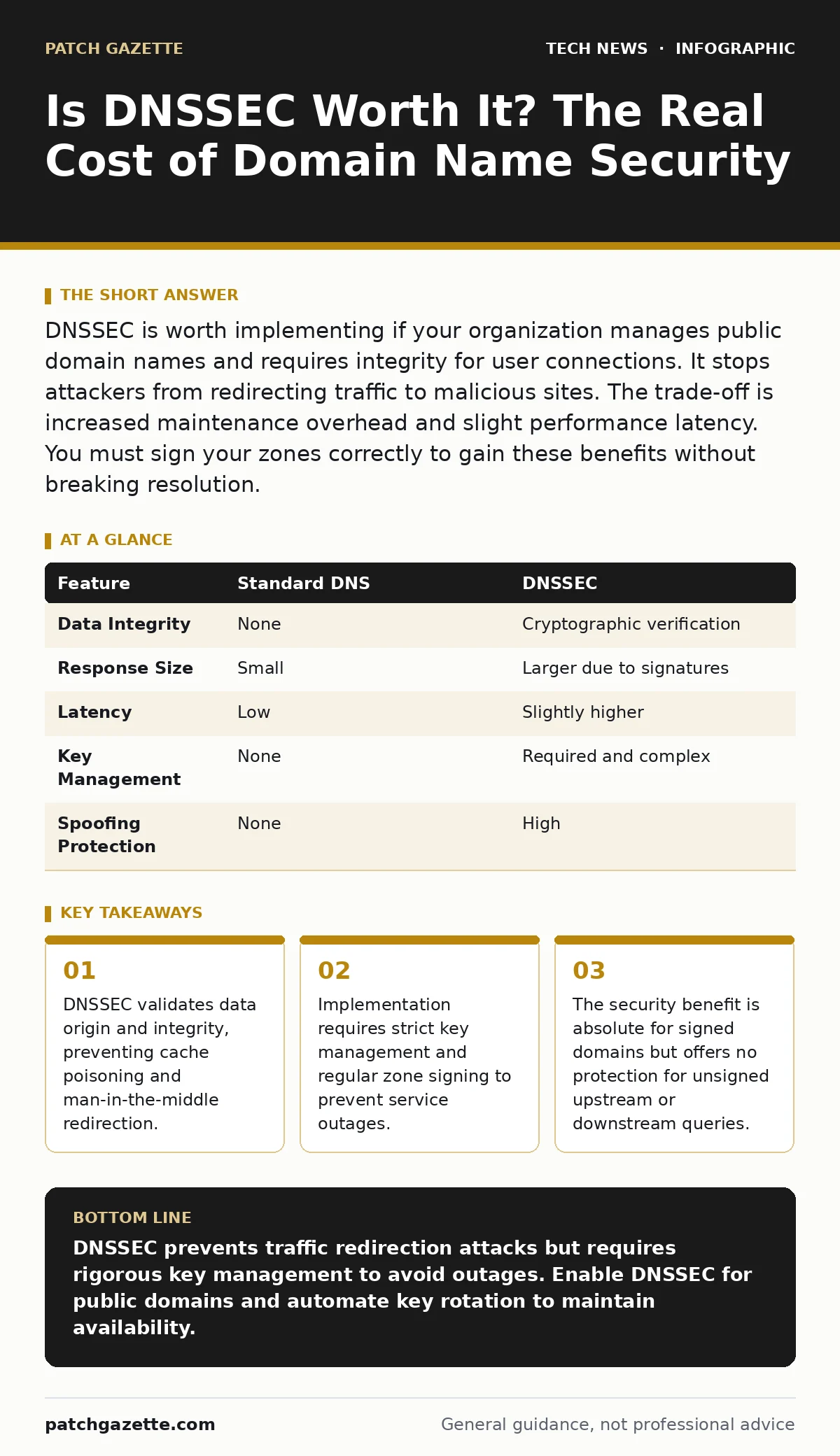
DNSSEC is worth implementing if your organization manages public domain names and requires integrity for user connections. It stops attackers from redirecting traffic to malicious sites. The trade-off is increased maintenance overhead and slight performance latency. You must sign your zones correctly to gain these benefits without breaking resolution.
Is DNSSEC worth it for your organization?
DNSSEC is worth the effort if you control public domain names and need to guarantee that users reach your intended servers. The technology adds cryptographic signatures to DNS records. This prevents attackers from spoofing responses and redirecting traffic. Without DNSSEC, an attacker who compromises a recursive resolver can send users anywhere. With DNSSEC, the resolver rejects forged data. The value depends on your threat model and operational capacity.
What does DNSSEC actually protect?
DNSSEC protects the authenticity and integrity of DNS data, not its confidentiality. It ensures that the IP address you receive for a domain is the one the owner published. It does not encrypt the content of the website or the email. It stops cache poisoning attacks where an attacker injects false records. It also prevents man-in-the-middle attacks that redirect users to phishing sites. It does not hide your browsing habits or protect against malware on the destination server.
How does DNSSEC differ from HTTPS?
DNSSEC and HTTPS protect different layers of the network stack. DNSSEC secures the address lookup process. HTTPS secures the data transmission between the browser and the server. You can have HTTPS without DNSSEC, but an attacker can redirect you to a fake site with its own valid certificate. You can have DNSSEC without HTTPS, but the data remains visible in plain text. Using both provides defense in depth. DNSSEC ensures you connect to the right server. HTTPS ensures the data stays private.
What are the operational costs of DNSSEC?
DNSSEC introduces significant operational complexity and latency. Every DNS record must be signed with a cryptographic key. This increases the size of DNS responses. Larger responses can exceed UDP packet limits, forcing TCP fallback. TCP is slower and more resource-intensive. You must manage key rotation regularly to maintain security. If you forget to rotate keys, signatures expire and your site goes offline. The maintenance burden is higher than standard DNS. You need automated tooling to handle signing and key management.
| Feature | Standard DNS | DNSSEC |
|---|---|---|
| Data Integrity | None | Cryptographic verification |
| Response Size | Small | Larger due to signatures |
| Latency | Low | Slightly higher |
| Key Management | None | Required and complex |
| Spoofing Protection | None | High |
When should you skip DNSSEC?
You might skip DNSSEC if you only manage internal domains that never leave your network. Internal threats require different controls than external spoofing attacks. You should also consider skipping it if you lack the staff to maintain key rotation. Broken DNSSEC is worse than no DNSSEC. A misconfigured zone returns no data, causing total service outage. If your organization cannot guarantee 24/7 monitoring of DNS health, the risk of downtime may outweigh the security benefit. Evaluate your technical capacity before proceeding.
See also: Digital certificates examples: real-world uses and hidden risks · AI Data Center Security: Architecture, Risks, and Mitigation
How do you implement DNSSEC correctly?
Start by generating a Key Signing Key and a Zone Signing Key. The Key Signing Key signs the Zone Signing Key. The Zone Signing Key signs the actual DNS records. Publish the public keys in your DNS zone. Provide the Key Signing Key fingerprint to your registrar. This creates a chain of trust from the root zone down to your domain. Test the configuration thoroughly before enabling it. Use validation tools to check for errors. Ensure your recursive resolvers support DNSSEC. Many do by default, but some legacy systems may block valid responses.
What happens when DNSSEC fails?
DNSSEC failures usually result in a "refused" or "servfail" response. Users cannot reach your site. The failure is often due to expired keys or mismatched signatures. It is rarely due to active attacks. The system is designed to fail securely. It rejects bad data rather than accepting it. This means your site goes offline until you fix the signature. This is a critical trade-off. Availability suffers when integrity checks fail. You must have a rollback plan. Keep unsigned backups of your zone files. Restore them quickly if signing breaks.
How does DNSSEC interact with other security measures?
DNSSEC works best when combined with strong password policies and regular software updates. It secures the connection path but does not protect account credentials. If an attacker steals a password, DNSSEC cannot stop them. It also complements digital certificates by ensuring users reach the correct server before the TLS handshake. This prevents attackers from presenting fake certificates. DNSSEC does not replace OAuth or session management. It is one layer in a broader security strategy. It addresses the specific risk of address spoofing.
What is the long-term outlook for DNSSEC?
DNSSEC adoption is steady but not universal. Root servers and major TLDs support it. Many registrars offer easy setup. The technology is mature and standardized. Future improvements may reduce latency and key size. Quantum computing threats may require new algorithms. DNSSEC is designed to be algorithm-agnostic. You can switch algorithms as needed. The core value proposition remains unchanged. It provides a verifiable link between domain names and IP addresses. This is fundamental to internet trust.
Key takeaways
- DNSSEC validates data origin and integrity, preventing cache poisoning and man-in-the-middle redirection.
- Implementation requires strict key management and regular zone signing to prevent service outages.
- The security benefit is absolute for signed domains but offers no protection for unsigned upstream or downstream queries.
DNSSEC prevents traffic redirection attacks but requires rigorous key management to avoid outages. Enable DNSSEC for public domains and automate key rotation to maintain availability.
Frequently asked questions
Does DNSSEC encrypt DNS queries?
No, DNSSEC only signs records to verify their authenticity. Use DNS over HTTPS or DNS over TLS to encrypt the query itself.
Can DNSSEC stop phishing attacks?
DNSSEC stops attackers from redirecting you to a phishing site via DNS spoofing. It does not protect you if you manually type a wrong URL.
Is DNSSEC compatible with cloud providers?
Yes, most major cloud providers support DNSSEC. You must configure the keys correctly and publish the DS record with your registrar.
How often should I rotate DNSSEC keys?
Rotate Zone Signing Keys frequently, often daily or weekly. Rotate Key Signing Keys less often, typically every few years, to minimize disruption.
How this guide was produced: written by the Patch Gazette editorial team with AI assistance, checked against the public references listed below, and reviewed when the facts change. See our editorial policy or report an error.