AI Data Center Security: Architecture, Risks, and Mitigation
Physical isolation does not prevent logical compromise, while power infrastructure dictates the true attack surface for modern artificial intelligence workloads.
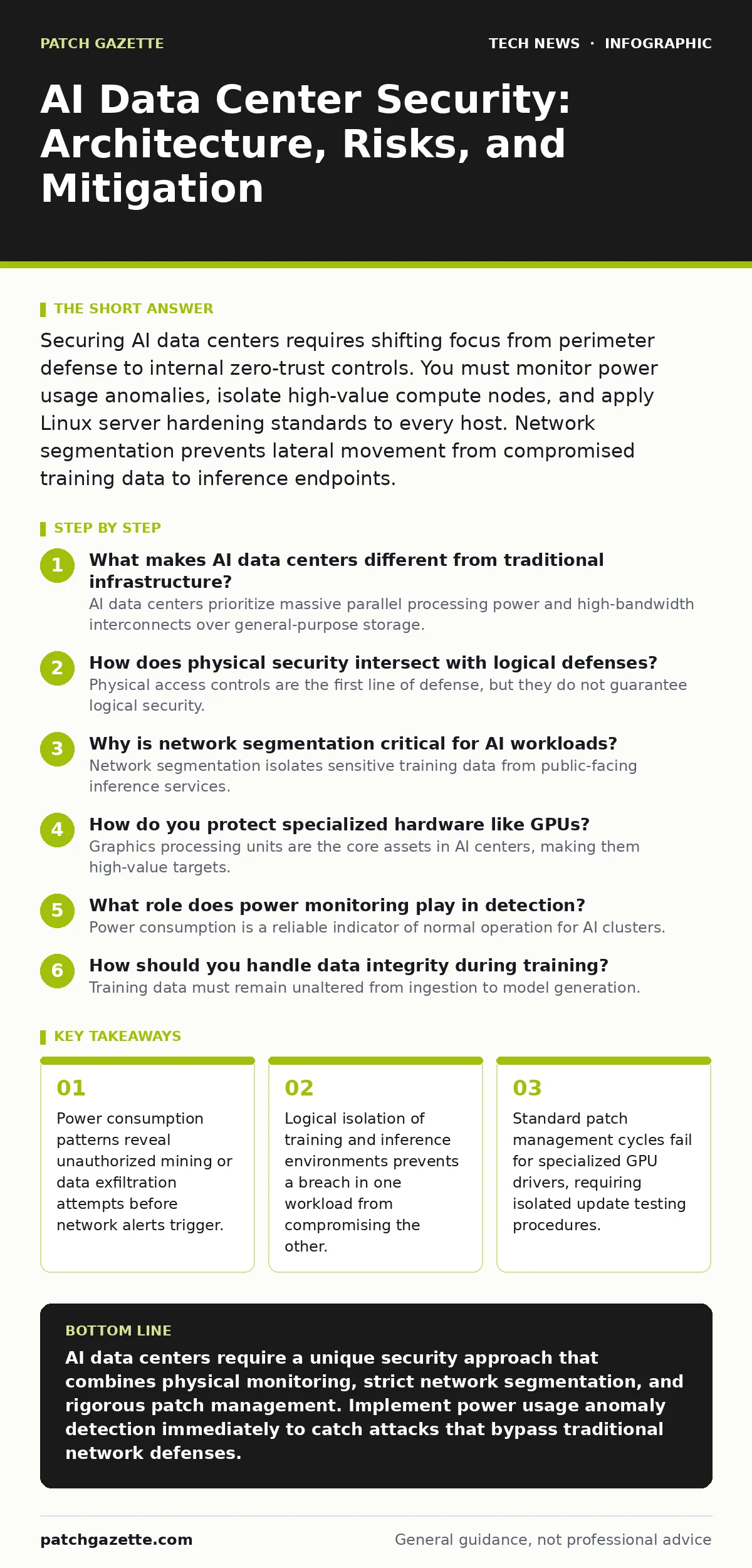
Securing AI data centers requires shifting focus from perimeter defense to internal zero-trust controls. You must monitor power usage anomalies, isolate high-value compute nodes, and apply Linux server hardening standards to every host. Network segmentation prevents lateral movement from compromised training data to inference endpoints.
What makes AI data centers different from traditional infrastructure?
AI data centers prioritize massive parallel processing power and high-bandwidth interconnects over general-purpose storage. Traditional servers handle many small requests, while AI clusters execute few, extremely large computational tasks. This architectural shift changes the security baseline. You cannot apply standard web server defenses to a cluster designed for matrix multiplication. The density of compute nodes creates a unique threat model where a single compromised node can disrupt the entire training pipeline. Network topology matters more than firewall rules in this environment. You must design for internal traffic inspection rather than external perimeter defense.
How does physical security intersect with logical defenses?
Physical access controls are the first line of defense, but they do not guarantee logical security. An attacker with physical access can bypass many software controls using cold boot attacks or direct memory interface exploits. You must assume that physical security will eventually be bypassed or that an insider will have legitimate access. Logical controls must enforce strict separation of duties. Remote management interfaces require multi-factor authentication and out-of-band monitoring. You should treat the physical layer as a convenience, not a control. Digital evidence remains admissible even if physical logs are tampered with.
Why is network segmentation critical for AI workloads?
Network segmentation isolates sensitive training data from public-facing inference services. Without segmentation, a vulnerability in a web-facing API can expose the entire dataset. You must create distinct zones for data ingestion, model training, and model serving. Each zone requires its own security policy and monitoring rules. Use virtual local area networks to separate traffic types. This limits the blast radius of a breach. If one segment is compromised, the attacker cannot easily pivot to adjacent systems. Segmentation also helps you meet compliance requirements for data sovereignty. It provides a clear boundary for audit trails.
| Segment Type | Primary Function | Access Control Model | Monitoring Focus |
|---|---|---|---|
| Data Ingestion | Raw data collection | Identity and Access Management | Input validation anomalies |
| Model Training | Computational processing | Role-Based Access Control | Resource utilization spikes |
| Model Serving | Inference requests | API Gateway Policies | Response latency deviations |
How do you protect specialized hardware like GPUs?
Graphics processing units are the core assets in AI centers, making them high-value targets. Traditional antivirus software often ignores GPU drivers and firmware. You must apply Linux server hardening principles to the host operating system. This includes disabling unused kernel modules and restricting user permissions. Firmware updates should be signed and verified before installation. Unsigned firmware can introduce backdoors at the hardware level. Monitor GPU utilization patterns for anomalies. Sudden drops in efficiency may indicate a side-channel attack or unauthorized mining activity. Hardware security modules help protect cryptographic keys used for data encryption.
What role does power monitoring play in detection?
Power consumption is a reliable indicator of normal operation for AI clusters. Training models requires consistent, high power draw. Deviations from baseline power usage can signal malicious activity. Cryptocurrency mining or data exfiltration tasks have distinct power signatures. You should integrate power usage data into your security information and event management system. This provides an additional layer of detection that does not rely on network traffic analysis. Power anomalies can trigger alerts before data leaves the environment. This method works even if the attacker encrypts all network traffic. It adds a physical dimension to your logical monitoring strategy.
How should you handle data integrity during training?
Training data must remain unaltered from ingestion to model generation. Data poisoning attacks insert malicious samples that bias model outputs. You must implement cryptographic hashing at every stage of the data pipeline. Store hashes in a separate, immutable ledger. Verify data integrity before starting any training job. If the hash does not match, halt the process immediately. Use secure boot mechanisms to ensure the operating system has not been tampered with. This prevents attackers from modifying the environment between data ingestion and training. Regular audits of the data pipeline are necessary to detect slow, incremental poisoning attempts.
What are the risks of using public cloud APIs?
Public cloud services provide scalability but introduce dependency risks. You must carefully review the security posture of any external service. Use OAuth to manage access tokens securely. Ensure that tokens have the minimum necessary permissions. Rotate credentials regularly to limit the impact of a leak. Monitor API usage logs for unusual patterns. Rate limiting helps prevent abuse and denial-of-service attacks. You should have a fallback plan for critical services. If an external API goes down or is compromised, your operations must continue. Diversifying providers reduces the risk of a single point of failure.
How do you manage patching for specialized software?
AI frameworks and libraries update frequently, often breaking compatibility with existing models. You cannot simply apply the latest patch to production systems. Create isolated staging environments that mirror production. Test all patches for compatibility and performance impact. Verify that security fixes do not introduce new vulnerabilities. Automate the deployment process to reduce human error. Maintain a rollback plan for every update. If a patch causes issues, you must revert quickly. This balance between security and stability is difficult to manage. Prioritize patches that address critical vulnerabilities in the core framework.
What is the long-term strategy for AI security?
Security is an ongoing process, not a one-time project. You must continuously monitor and adapt your defenses. Threat actors evolve their techniques to target new vulnerabilities. Regular security assessments help identify gaps in your architecture. Train staff on the latest attack vectors. Encourage a culture of security awareness. Document all security procedures and update them regularly. Review incident response plans to ensure they are effective. Collaboration with other organizations helps share threat intelligence. Staying informed about emerging risks is key to long-term resilience.
How does this relate to other infrastructure components?
AI security does not exist in isolation. It relies on robust email security to prevent phishing attacks that target staff. Guest Wi-Fi networks must be strictly separated from operational networks. Load balancers distribute traffic but can also mask attack patterns. Understanding IP addresses helps in tracking the source of malicious requests. Cookies and sessions manage user state in web interfaces. APIs connect different systems and must be secured individually. Linux server hardening provides the foundation for secure operation. Each component plays a role in the overall security posture.
Key takeaways
- Power consumption patterns reveal unauthorized mining or data exfiltration attempts before network alerts trigger.
- Logical isolation of training and inference environments prevents a breach in one workload from compromising the other.
- Standard patch management cycles fail for specialized GPU drivers, requiring isolated update testing procedures.
AI data centers require a unique security approach that combines physical monitoring, strict network segmentation, and rigorous patch management. Implement power usage anomaly detection immediately to catch attacks that bypass traditional network defenses.
Frequently asked questions
Can AI data centers be fully air-gapped?
Complete air-gapping is impractical for modern AI centers that require regular software updates and data ingestion. Logical isolation and strict access controls are more effective than physical disconnection.
How often should security audits be performed?
Security audits should occur before any major infrastructure change and at least annually. Continuous monitoring provides real-time insights, but formal audits validate the overall control framework.
What is the biggest risk to AI models?
Data poisoning is the most significant risk, as it compromises model accuracy without alerting defenders. Ensuring data integrity through hashing and secure pipelines is critical.
Do standard firewalls protect AI clusters?
Standard firewalls protect the perimeter but do not monitor internal traffic. You need deep packet inspection and micro-segmentation to protect against lateral movement within the cluster.
How this guide was produced: written by the Patch Gazette editorial team with AI assistance, checked against the public references listed below, and reviewed when the facts change. See our editorial policy or report an error.