
Prevent Combo List Attacks: Stop Credential Stuffing Now
Combo lists bypass traditional password strength rules because they rely on valid username and password pairs harvested from previous breaches, not weak guesses.
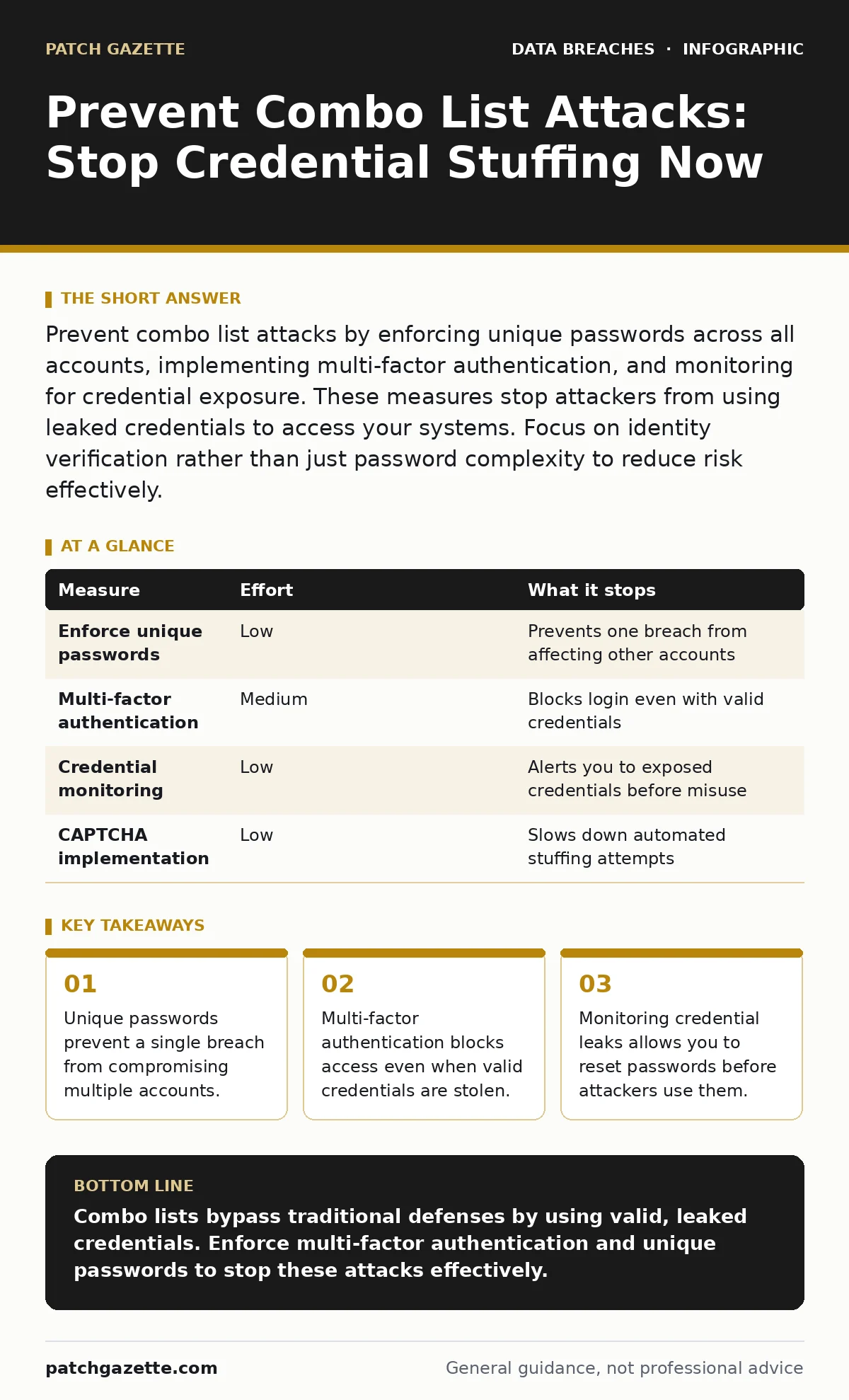
Prevent combo list attacks by enforcing unique passwords across all accounts, implementing multi-factor authentication, and monitoring for credential exposure. These measures stop attackers from using leaked credentials to access your systems. Focus on identity verification rather than just password complexity to reduce risk effectively.
How Combo Lists Bypass Traditional Defenses
Combo lists differ from standard password dictionaries in a fundamental way. Attackers compile these lists by merging usernames and passwords from separate breach databases. They do not guess passwords. They use credentials that a user has already typed and submitted successfully. This means the password is known to be correct for that specific username. Traditional defenses that rely on password complexity rules fail here. A complex password that appears in a combo list is just as vulnerable as a simple one. The attacker does not need to crack the hash. They simply try the pair until it works.
The Hidden Cost of Password Reuse
Password reuse is the primary fuel for combo list attacks. When you use the same password for your email, banking, and work accounts, you create a single point of failure. If one service suffers a breach, the attacker obtains your username and password. They then add that pair to a combo list. Later, automated tools try that pair against thousands of other websites. This process is called credential stuffing. You cannot control whether a vendor secures their data properly. You can only control how you manage your credentials. Reusing passwords assumes every vendor you interact with will never be breached. That assumption is statistically unsafe.
Why Password Complexity Is Not Enough
Many organizations enforce strict password policies requiring uppercase letters, numbers, and symbols. These rules make passwords harder for humans to guess. They do nothing to stop an attacker who already has the password. If your complex password is in a combo list, the attacker knows it is correct. The complexity becomes irrelevant. The attack vector shifts from cracking to stuffing. Focusing solely on complexity gives a false sense of security. It encourages users to write passwords down or use predictable patterns. These behaviors introduce new risks that outweigh the benefits of complexity. You need a defense that works even when the password is known.
| Measure | Effort | What it stops |
|---|---|---|
| Enforce unique passwords | Low | Prevents one breach from affecting other accounts |
| Multi-factor authentication | Medium | Blocks login even with valid credentials |
| Credential monitoring | Low | Alerts you to exposed credentials before misuse |
| CAPTCHA implementation | Low | Slows down automated stuffing attempts |
Multi-Factor Authentication As The Primary Defense
Multi-factor authentication requires a second form of verification beyond the password. This could be a code from an app, a hardware token, or a biometric scan. When an attacker uses a combo list, they have the first factor. They do not have the second. The login attempt fails immediately. This measure stops the attack regardless of password strength or reuse. It is the most effective defense against credential stuffing. Implementing this across all user-facing applications removes the risk of unauthorized access via stolen credentials. It adds friction for legitimate users, but that friction is necessary for security.
Detecting Credential Exposure Early
You can monitor the web for your organization's email addresses appearing in known breaches. Several services aggregate this data and provide alerts. When an alert triggers, you know a credential has been exposed. You can force a password reset for that account immediately. This proactive step prevents the attacker from using the credential before you change it. It turns a passive defense into an active one. You reduce the window of opportunity for the attacker. This approach works best when combined with automated password reset workflows. Manual resets often lag, allowing attackers to succeed.
See also: Stop SIM Swap Fraud: The Technical Controls That Actually Work · Stop Cloud Storage Leaks: Fix Misconfigurations Before Data Escapes
Slowing Down Automated Attacks
Credential stuffing relies on speed. Attackers use bots to try thousands of password pairs per minute. You can disrupt this speed by implementing rate limiting. This restricts the number of login attempts from a single IP address or account. You can also use CAPTCHA challenges after a few failed attempts. This forces a human to intervene, which breaks the automation. These measures do not stop a determined attacker who owns many IP addresses. They raise the cost and time required for the attack. Many attackers will move on to easier targets if the effort increases. This is a defensive layer, not a complete solution.
What Does Not Work Against Combo Lists
Some measures provide little protection against combo lists. Blocking known malicious IP addresses is ineffective. Attackers use residential proxies that mimic normal users. These IPs are not on blocklists. Similarly, relying on password expiration policies does not help. If a password is in a combo list, expiring it does not remove it from the attacker's database. The attacker will simply wait for the next login attempt or use the old password if the system allows it. You must focus on measures that verify identity, not just password age or source IP. Misunderstanding these limitations leads to wasted resources.
Integrating With Broader Security Practices
Preventing combo list attacks fits into a larger security framework. Consider how mobile device management policies affect login security on company phones. Ensure that password hygiene training emphasizes uniqueness over complexity. Review your ISO 27001 controls to see if identity management is adequately covered. These practices reinforce each other. A holistic approach reduces gaps where attackers can exploit. Do not treat credential security as an isolated problem. It connects to data protection, user training, and incident response.
Checklist For Immediate Action
You can reduce your risk today by taking three specific steps. First, audit your current password policies. Remove complexity requirements that do not prevent reuse. Second, enable multi-factor authentication for all privileged accounts. Third, subscribe to a credential monitoring service for your domain. These actions address the root cause and provide immediate protection. They require minimal effort but yield significant risk reduction. Do not delay implementation. The window for exposure grows every day.
- Audit password policies to prioritize uniqueness over complexity.
- Enable multi-factor authentication for all administrative accounts.
- Subscribe to credential monitoring for your organization's email domain.
Key takeaways
- Unique passwords prevent a single breach from compromising multiple accounts.
- Multi-factor authentication blocks access even when valid credentials are stolen.
- Monitoring credential leaks allows you to reset passwords before attackers use them.
Combo lists bypass traditional defenses by using valid, leaked credentials. Enforce multi-factor authentication and unique passwords to stop these attacks effectively.
Frequently asked questions
Do password managers prevent combo list attacks?
Password managers help by generating unique passwords for every site. This prevents a single breach from compromising other accounts. They do not stop an attacker who already has a valid pair.
Is SMS two-factor authentication secure against combo lists?
SMS codes are vulnerable to SIM swapping attacks. Attackers can intercept the code. Use an authenticator app or hardware token instead. These methods are not tied to your phone number.
How do I know if my credentials are in a combo list?
Use a reputable breach notification service. These services scan public databases for your email addresses. They alert you when a match is found. Do not rely on manual searches.
Should I block users who have passwords in known breaches?
Blocking users is disruptive and often inaccurate. Instead, force a password reset and enable multi-factor authentication. This maintains access while improving security.
How this guide was produced: written by the Patch Gazette editorial team with AI assistance, checked against the public references listed below, and reviewed when the facts change. See our editorial policy or report an error.