
Data Subject Rights: Operationalizing Privacy for Small Teams
Small teams fail privacy requests because they treat them as legal hurdles rather than data architecture failures requiring automated retrieval paths.
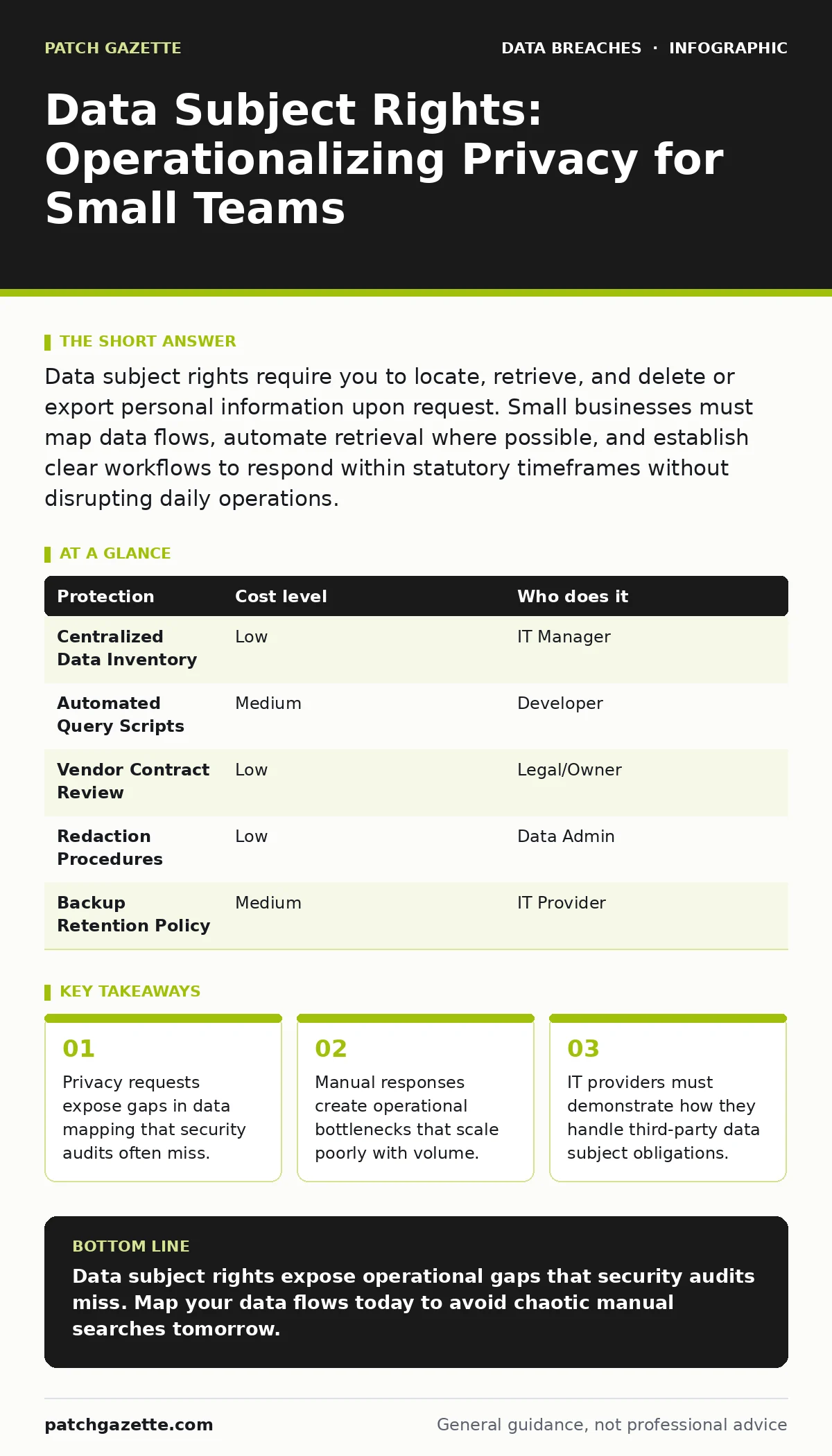
Data subject rights require you to locate, retrieve, and delete or export personal information upon request. Small businesses must map data flows, automate retrieval where possible, and establish clear workflows to respond within statutory timeframes without disrupting daily operations.
The Hidden Surface Area of Small Teams
Small organizations often assume they hold less sensitive data than enterprises. This assumption creates a blind spot. You likely store customer emails, IP addresses, and payment tokens in places that do not appear in your primary database. These fragments constitute personal data under most privacy frameworks. When a data subject exercises their right to erasure or access, you must account for every fragment. Missing one fragment constitutes a compliance failure.
The risk is not just legal fines. The risk is operational chaos. Imagine receiving ten requests in one week. Your staff spends hours searching folders instead of working. This distraction reduces productivity and increases the chance of human error. You may accidentally delete critical business records while trying to remove personal data. Precision matters more than speed.
Mapping Data Before the Request Arrives
You cannot delete what you cannot find. Data mapping is the process of documenting where personal data enters, moves through, and exits your environment. Many small businesses skip this step because it feels tedious. This is a mistake. Without a map, every request becomes a forensic investigation.
Start with your applications. List every tool that collects user input. Include customer relationship management systems, help desk tickets, and analytics platforms. Note where each tool stores data. Is it in a central cloud database? Is it in local backups? Is it cached in a browser plugin? Create a simple inventory. Update it when you add new software. This inventory becomes your single source of truth during a request.
Automating the Retrieval Process
Manual searches are slow and inconsistent. Two employees might search for the same name and find different results. Automation reduces this variance. You do not need expensive enterprise software. Simple scripts or built-in features can help.
Most modern databases allow you to query by unique identifiers. Use email addresses or user IDs as keys. Build a standard query that pulls all records associated with that key. Test this query regularly. Ensure it returns data from active tables and archived tables. If your system does not support this, you must build a manual checklist. A checklist ensures no step is missed, even if it is slower.
The Right to Erasure Versus Business Needs
The right to erasure does not mean you must destroy everything. You may retain data if you have a legal obligation to keep it. Tax laws often require you to keep financial records for several years. These records may contain names and addresses. You must distinguish between personal data you can delete and data you must keep.
Redaction is a common solution. You can remove the name and email from a transaction log while keeping the transaction amount and date. This preserves the business record without exposing the individual. Document your retention policy clearly. Explain why you kept certain data. This transparency protects you during audits. It also builds trust with the data subject.
Handling Third-Party Data Providers
You do not control all your data. Service providers hold data on your behalf. They are data processors. You remain the data controller. This means you are responsible for ensuring they comply with requests. If a customer asks you to delete their data, and your email marketing provider still has it, you are liable.
Check your contracts with vendors. Look for clauses about data subject rights. Does the vendor promise to delete data upon your instruction? How long does it take? Some vendors have automated tools for this. Others require manual intervention. Know the timeline. If a vendor takes thirty days to delete data, you cannot promise a seven-day turnaround to the customer. Align your promises with your vendors' capabilities.
| Protection | Cost level | Who does it |
|---|---|---|
| Centralized Data Inventory | Low | IT Manager |
| Automated Query Scripts | Medium | Developer |
| Vendor Contract Review | Low | Legal/Owner |
| Redaction Procedures | Low | Data Admin |
| Backup Retention Policy | Medium | IT Provider |
See also: Is It Safe to Email Social Security Number? Risks and Secure Alternatives · APIs in Healthcare: Secure Data Exchange Without Breaches
What to Ask Your IT Provider
Your IT provider manages the infrastructure where data lives. They must support your privacy obligations. Do not assume they do. Ask specific questions during your next review.
- How do you handle data deletion requests from clients?
- Can you provide a log showing when and where data was deleted?
- Do you retain backups of deleted data, and for how long?
- How do you ensure data sovereignty compliance for international customers?
- What is the process for redacting data from support tickets?
Integrating Privacy with Security Controls
Privacy and security are complementary but distinct. Security protects data from unauthorized access. Privacy controls how data is used and shared. Strong security does not guarantee privacy compliance. You can have encrypted data that you cannot find or delete.
Consider identity theft prevention. If you store too much personal data, you increase the value of your breach. Minimize data collection. Only collect what you need. This reduces the scope of your privacy obligations. It also reduces the impact of a breach. Review your password hygiene policies. Ensure users can reset credentials without you storing their old passwords. This limits the data you must manage.
The Operational Cost of Non-Compliance
Ignoring data subject rights carries hidden costs. Beyond fines, there is reputational damage. Customers share their experiences. A slow or rude response to a privacy request signals poor data management. This erodes trust. You may lose clients to competitors who handle data more responsibly.
Operational efficiency drops when teams scramble to find data. This time is lost forever. Invest in mapping and automation early. The upfront cost is low. The long-term savings in time and risk are significant. Treat privacy as a product feature, not a legal burden. This mindset shift changes how you design your systems. You build for deletion and access from the start.
Key takeaways
- Privacy requests expose gaps in data mapping that security audits often miss.
- Manual responses create operational bottlenecks that scale poorly with volume.
- IT providers must demonstrate how they handle third-party data subject obligations.
Data subject rights expose operational gaps that security audits miss. Map your data flows today to avoid chaotic manual searches tomorrow.
Frequently asked questions
How long do I have to respond to a data subject request?
Most jurisdictions require a response within one month. Extensions are possible for complex requests, but you must inform the requester. Check local laws for specific deadlines.
Do I need to delete data if the user is anonymous?
No. Data subject rights apply to identifiable individuals. If you cannot identify the person from the data, the rights do not trigger. However, ensure your anonymization is irreversible.
Can I charge a fee for processing requests?
Generally, no. You must process requests free of charge. You may charge a reasonable fee for manifestly unfounded or excessive requests, particularly repeated ones. Verify local regulations for exceptions.
What if the data subject wants to correct inaccurate data?
You must update the data across all systems where it exists. This includes backups if feasible. Document the correction. Notify any third parties who received the inaccurate data, unless it is impossible or involves disproportionate effort.
How this guide was produced: written by the Patch Gazette editorial team with AI assistance, checked against the public references listed below, and reviewed when the facts change. See our editorial policy or report an error.