
HIPAA Privacy Rule Applies to Which of the Following: The Scope and Limits
The HIPAA Privacy Rule governs how covered entities handle protected health information, but it does not directly regulate most technology vendors or individual patients.
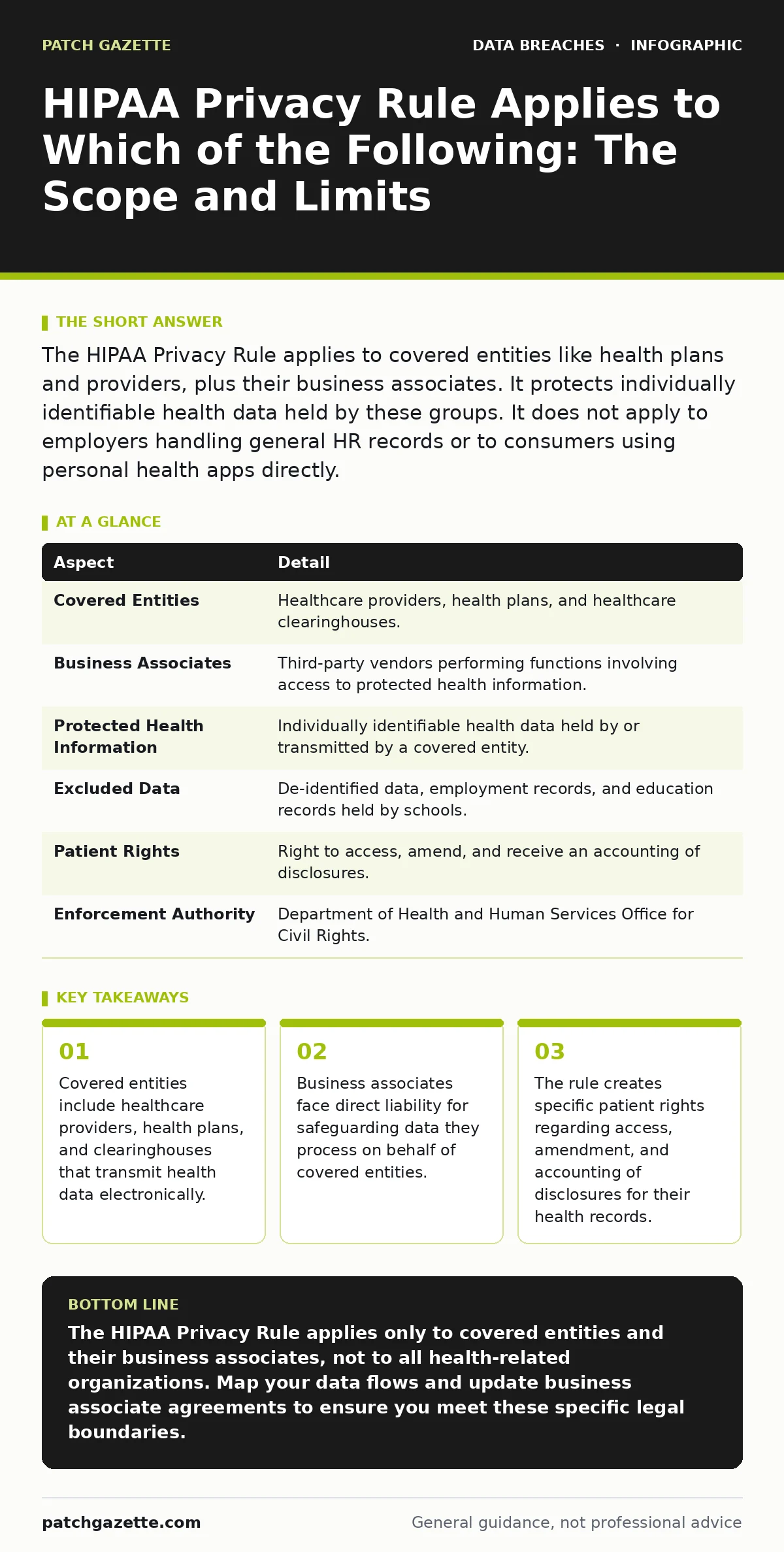
The HIPAA Privacy Rule applies to covered entities like health plans and providers, plus their business associates. It protects individually identifiable health data held by these groups. It does not apply to employers handling general HR records or to consumers using personal health apps directly.
Understanding the HIPAA Privacy Rule scope
The HIPAA Privacy Rule establishes national standards for protecting individuals’ medical records and other personal health information. It applies specifically to covered entities and their business associates who handle this data. Imagine a library that tracks which books you borrow. The HIPAA Privacy Rule is the strict security policy for a hospital’s digital records. It limits who can see your data and requires specific consent for sharing it. This framework balances patient privacy with the need for healthcare operations to function smoothly.
The rule does not apply to every organization that touches health data. It targets specific sectors within the healthcare ecosystem. You must identify whether your organization fits the legal definition of a covered entity or a business associate. This distinction determines your compliance obligations. Misidentifying your status leads to gaps in data protection or unnecessary overhead. Understanding the boundary prevents wasted effort on non-regulated data while securing what matters.
HIPAA Privacy Rule Applies to Which of the Following
The HIPAA Privacy Rule applies to which of the following entities: covered entities and their business associates. This specific phrasing often confuses readers searching for clarity. The rule mandates that covered entities protect protected health information. It also requires them to obtain patient authorization for most disclosures. Business associates must implement safeguards and report breaches. They cannot use the data for their own purposes without permission. This dual responsibility ensures that data remains secure throughout its lifecycle.
| Aspect | Detail |
|---|---|
| Covered Entities | Healthcare providers, health plans, and healthcare clearinghouses. |
| Business Associates | Third-party vendors performing functions involving access to protected health information. |
| Protected Health Information | Individually identifiable health data held by or transmitted by a covered entity. |
| Excluded Data | De-identified data, employment records, and education records held by schools. |
| Patient Rights | Right to access, amend, and receive an accounting of disclosures. |
| Enforcement Authority | Department of Health and Human Services Office for Civil Rights. |
Who is a Covered Entity
A covered entity is a healthcare provider, health plan, or healthcare clearinghouse. Providers include doctors, clinics, and hospitals that transmit health information electronically. Health plans include insurance companies and employer-sponsored plans. Clearinghouses process non-standard health information into standard formats. If you bill insurance companies electronically, you are likely a covered entity. This status triggers mandatory privacy and security protocols. You must train staff on handling sensitive data. You must also establish policies for patient requests. Failure to meet these standards results in significant penalties.
The Business Associate Relationship
Business associates perform services for covered entities that involve accessing protected health information. Examples include billing companies, cloud storage providers, and IT consultants. The HIPAA Privacy Rule extends privacy obligations to these partners. They must sign a business associate agreement. This contract defines how they handle data and report breaches. They cannot use the data for marketing or research without authorization. This layer of accountability ensures that outsourcing does not compromise patient privacy. You must vet your vendors carefully. Understanding shadow IT data exposure helps you identify unvetted tools that might violate these agreements.
Common Misconceptions About Scope
Many organizations misunderstand the scope of the HIPAA Privacy Rule. They assume it applies to all health-related data. This is incorrect. The rule does not cover employment records held by employers. It does not cover education records held by schools. It does not apply to health apps used directly by consumers. If you build a fitness tracker that syncs with a phone, you are not automatically bound by HIPAA. You only become liable if you partner with a covered entity. This distinction saves resources for non-covered organizations. It also prevents false security for covered ones.
People often confuse the Privacy Rule with the Security Rule. The Privacy Rule governs who can see data. The Security Rule governs how data is protected technically. Both apply to covered entities. You need to address both to be compliant. Ignoring one while focusing on the other leaves you vulnerable. For instance, strong encryption helps with security. It does not grant you the right to share data freely. You must still follow privacy consent rules. Reviewing ISO 27001 standards can help you build a broader security framework that supports both rules.
See also: APIs in Healthcare: Secure Data Exchange Without Breaches · Why Does Criminal Identity Theft Occur and How to Stop It
Implementing Privacy Safeguards
You must implement administrative, physical, and technical safeguards. Administrative safeguards include workforce training and policy development. Physical safeguards involve controlling access to facilities and devices. Technical safeguards include access controls and audit logs. You must also establish procedures for patient rights. Patients can request copies of their records. They can ask for corrections. You must respond within specific timeframes. Documenting these processes is critical. Auditors look for evidence of consistent practice. Keep records of training and incident response. This documentation proves your commitment to compliance.
What to Do About Compliance
Start by mapping your data flow. Identify where protected health information enters and leaves your system. Determine which entities are covered and which are business associates. Draft or update business associate agreements. Ensure they include required clauses. Train your staff on privacy principles. Test your incident response plan. Regularly review your policies for changes in law or technology. Compliance is not a one-time project. It is an ongoing process. Stay updated on regulatory guidance. Engage with legal counsel when unsure. This proactive approach reduces risk and builds trust. Monitoring for misconfigured cloud storage leaks is a vital part of this ongoing maintenance.
Handling Patient Rights Requests
Patients have the right to access their health information. You must provide copies within 30 days. You can charge a reasonable fee. Patients can also request amendments to their records. You must evaluate these requests. If you deny an amendment, you must explain why. Patients can request an accounting of disclosures. This list shows who received their data. You must maintain these records for six years. Automating these processes reduces errors. It also ensures timely responses. Respecting these rights builds patient confidence. It also avoids regulatory scrutiny. Addressing data subject rights correctly is a core component of this duty.
Key takeaways
- Covered entities include healthcare providers, health plans, and clearinghouses that transmit health data electronically.
- Business associates face direct liability for safeguarding data they process on behalf of covered entities.
- The rule creates specific patient rights regarding access, amendment, and accounting of disclosures for their health records.
The HIPAA Privacy Rule applies only to covered entities and their business associates, not to all health-related organizations. Map your data flows and update business associate agreements to ensure you meet these specific legal boundaries.
Frequently asked questions
Does HIPAA apply to fitness apps?
No, HIPAA generally does not apply to fitness apps unless they partner with a covered entity or business associate. They are typically governed by other privacy laws.
Can employers share employee health data?
Employers can share health data related to employment, but this data is excluded from HIPAA. It is subject to different privacy regulations.
What is a business associate agreement?
It is a contract between a covered entity and a third party that handles protected health information. It outlines privacy and security responsibilities.
How long must you keep privacy records?
Covered entities must keep privacy policies and documentation for six years from their creation or last effective date.
How this guide was produced: written by the Patch Gazette editorial team with AI assistance, checked against the public references listed below, and reviewed when the facts change. See our editorial policy or report an error.