Data Sovereignty Defined: Legal Borders and Technical Reality
Data sovereignty forces you to treat geographic location as a security control, creating hidden costs for cloud architecture and cross-border legal compliance.
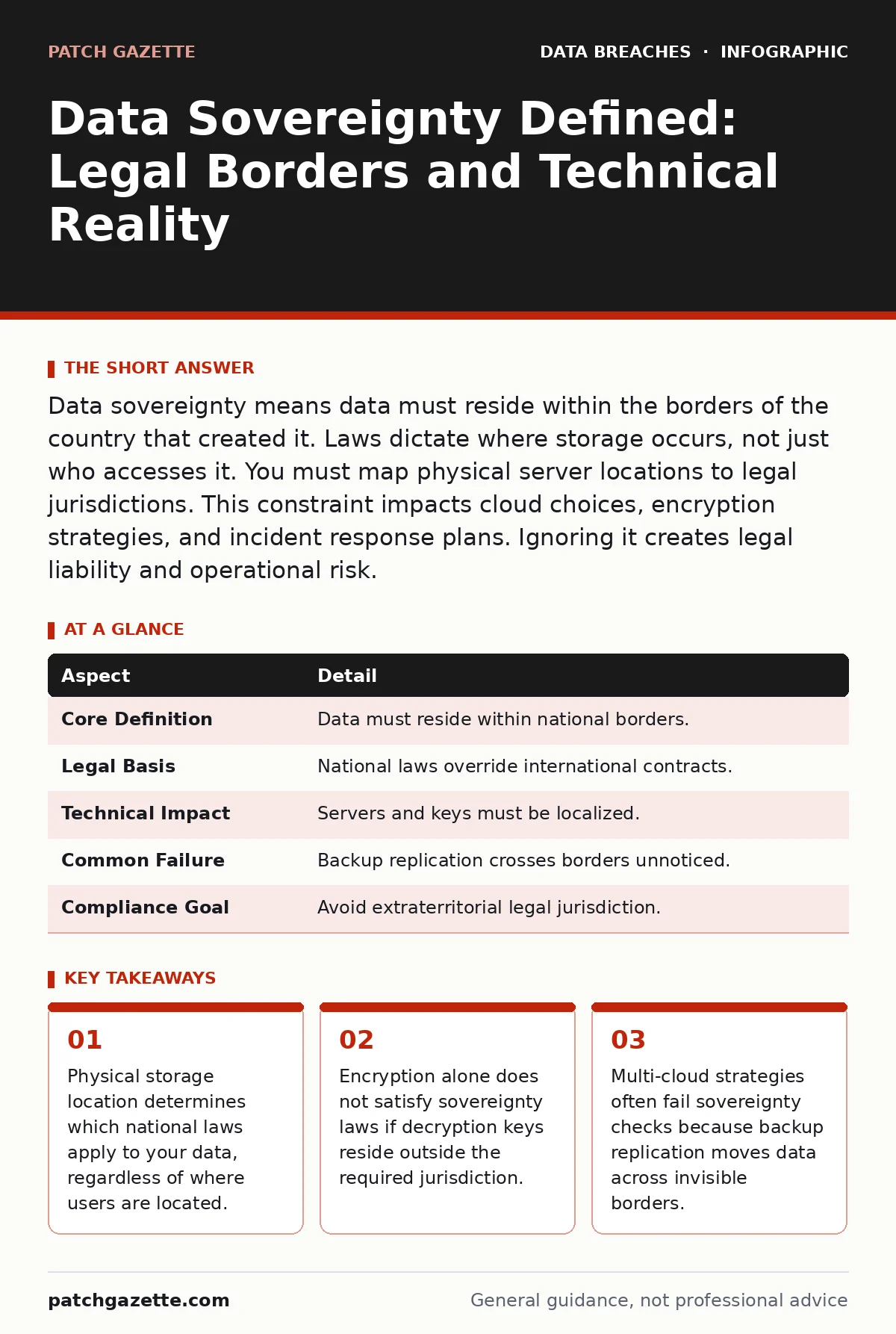
Data sovereignty means data must reside within the borders of the country that created it. Laws dictate where storage occurs, not just who accesses it. You must map physical server locations to legal jurisdictions. This constraint impacts cloud choices, encryption strategies, and incident response plans. Ignoring it creates legal liability and operational risk.
Data Sovereignty Defined and Origin
Data sovereignty defines the legal requirement that digital information remains within the geographic boundaries of its country of origin. The term emerged from the intersection of national security concerns and digital privacy laws. Governments realized that data stored abroad falls under foreign jurisdiction. This creates a gap where local courts cannot compel disclosure.
Local laws cannot protect data held on servers in another nation. You cannot rely on contractual agreements to override national statutes. The concept treats data as an asset subject to territorial rules. It differs from data privacy, which focuses on individual rights. Sovereignty focuses on state control over information flow. You must distinguish between these two concepts to build compliant systems.
| Aspect | Detail |
|---|---|
| Core Definition | Data must reside within national borders. |
| Legal Basis | National laws override international contracts. |
| Technical Impact | Servers and keys must be localized. |
| Common Failure | Backup replication crosses borders unnoticed. |
| Compliance Goal | Avoid extraterritorial legal jurisdiction. |
Practical Application in Cloud Architecture
You apply data sovereignty by mapping data flows to physical locations. Cloud providers offer regions and zones. You must verify the exact physical location of each zone. Some providers obscure this detail for security reasons. You need transparency to prove compliance. Imagine storing customer records in a global cloud platform. The provider replicates data for disaster recovery. That replication might move data to a neighboring country. This action violates sovereignty laws even if no one accessed the data. You must configure replication settings to stay within borders. This reduces redundancy options. It increases hardware costs. You trade resilience for legal safety.
Encryption and Key Management Constraints
Encryption protects data content but does not hide location. Sovereignty laws often target the ability to access data. If you store encrypted data abroad, you might still violate sovereignty. The law may consider the data "present" if you hold the keys. You must store encryption keys in the same jurisdiction as the data. This creates a strict dependency. Losing the key means losing the data permanently. You cannot retrieve it from a foreign backup. Key management systems must be configured for strict locality. You lose the benefit of centralized key management. You gain legal clarity. This constraint complicates multi-region applications.
The Hidden Cost of Compliance
Compliance with data sovereignty carries hidden operational costs. You cannot simply choose the cheapest cloud provider. You must choose the provider with the right physical footprint. This limits your vendor options. You may need to build on-premises infrastructure for certain data types. This increases maintenance burden. You must audit storage locations regularly. Cloud providers change hardware and locations. You must monitor these changes. Failure to detect a move creates liability. You need tools that track data residency in real time. This adds complexity to your monitoring stack. You pay for visibility to avoid fines.
Common Misconceptions About Sovereignty
People often confuse data sovereignty with data privacy. Privacy laws protect individuals. Sovereignty laws protect state interests. You can have strong privacy without sovereignty. You can have sovereignty without strong privacy. Another mistake is assuming encryption solves everything. If the decryption key is abroad, the data is legally accessible abroad. Some believe contractual clauses override local law. They do not. A court in the data's location can seize it. You cannot contract away national jurisdiction. This misunderstanding leads to failed audits. You must treat location as a legal fact.
See also: RSA Encryption: Why Your Security Architecture Depends on It · Prevent Combo List Attacks: Stop Credential Stuffing Now
Impact on Incident Response Planning
Data sovereignty changes how you respond to breaches. If data is stored in multiple jurisdictions, multiple laws apply. You must notify regulators in each country. This creates a complex reporting timeline. You cannot use a single response plan. You need jurisdiction-specific procedures. Imagine a ransomware attack encrypts data in three countries. You must coordinate with three different law enforcement agencies. Each has different requirements for evidence handling. You risk violating one law while obeying another. Your response plan must account for these legal borders. You must pre-identify the legal owner of each dataset.
Integration with Security Frameworks
You integrate sovereignty into existing frameworks like ISO 27001. The standard requires asset management and legal compliance. You must document where each asset resides. This becomes a control objective. You should also review secure file sharing protocols. Shared files often bypass storage controls. They create shadow copies in foreign servers. You must enforce restrictions on these tools. Similarly, consider data subject rights requests. These requests often require data retrieval from specific locations. You must ensure retrieval paths respect borders. This integration requires continuous effort. It is not a one-time configuration.
Managing Third-Party Vendor Risk
Third-party vendors complicate sovereignty compliance. You must verify their storage practices. Many vendors use global infrastructure by default. You must demand regional isolation. This requires detailed contracts. You need right-to-audit clauses. You must verify claims with technical evidence. Do not trust marketing materials. You need proof of physical location. This due diligence takes time. It slows down vendor onboarding. You must prioritize vendors who understand these constraints. This reduces the risk of accidental violations. You shift some responsibility to the vendor. You do not shift liability.
Key takeaways
- Physical storage location determines which national laws apply to your data, regardless of where users are located.
- Encryption alone does not satisfy sovereignty laws if decryption keys reside outside the required jurisdiction.
- Multi-cloud strategies often fail sovereignty checks because backup replication moves data across invisible borders.
Frequently asked questions
Does data sovereignty apply to cloud backups?
Yes, backups are copies of data and must reside in the same jurisdiction as the original. Cross-border replication violates sovereignty laws.
Can encryption allow data storage outside borders?
No, if decryption keys are accessible from outside the border, the data is considered legally present there. Keys must also be localized.
How does this differ from GDPR?
GDPR focuses on individual privacy rights and consent. Data sovereignty focuses on geographic location and national jurisdiction over data.
What happens if a cloud provider moves servers?
You must be notified and have the right to withdraw data. Failure to move data creates legal liability for storage in the wrong jurisdiction. BOTTOM LINE: Treat geographic location as a hard security constraint, not a soft preference. Audit your cloud replication settings and encryption key storage locations immediately to ensure they align with legal borders.
How this guide was produced: written by the Patch Gazette editorial team with AI assistance, checked against the public references listed below, and reviewed when the facts change. See our editorial policy or report an error.