RSA Encryption: Why Your Security Architecture Depends on It
RSA encryption enables secure data exchange without prior key sharing, but its performance limits require careful architectural choices for modern systems.
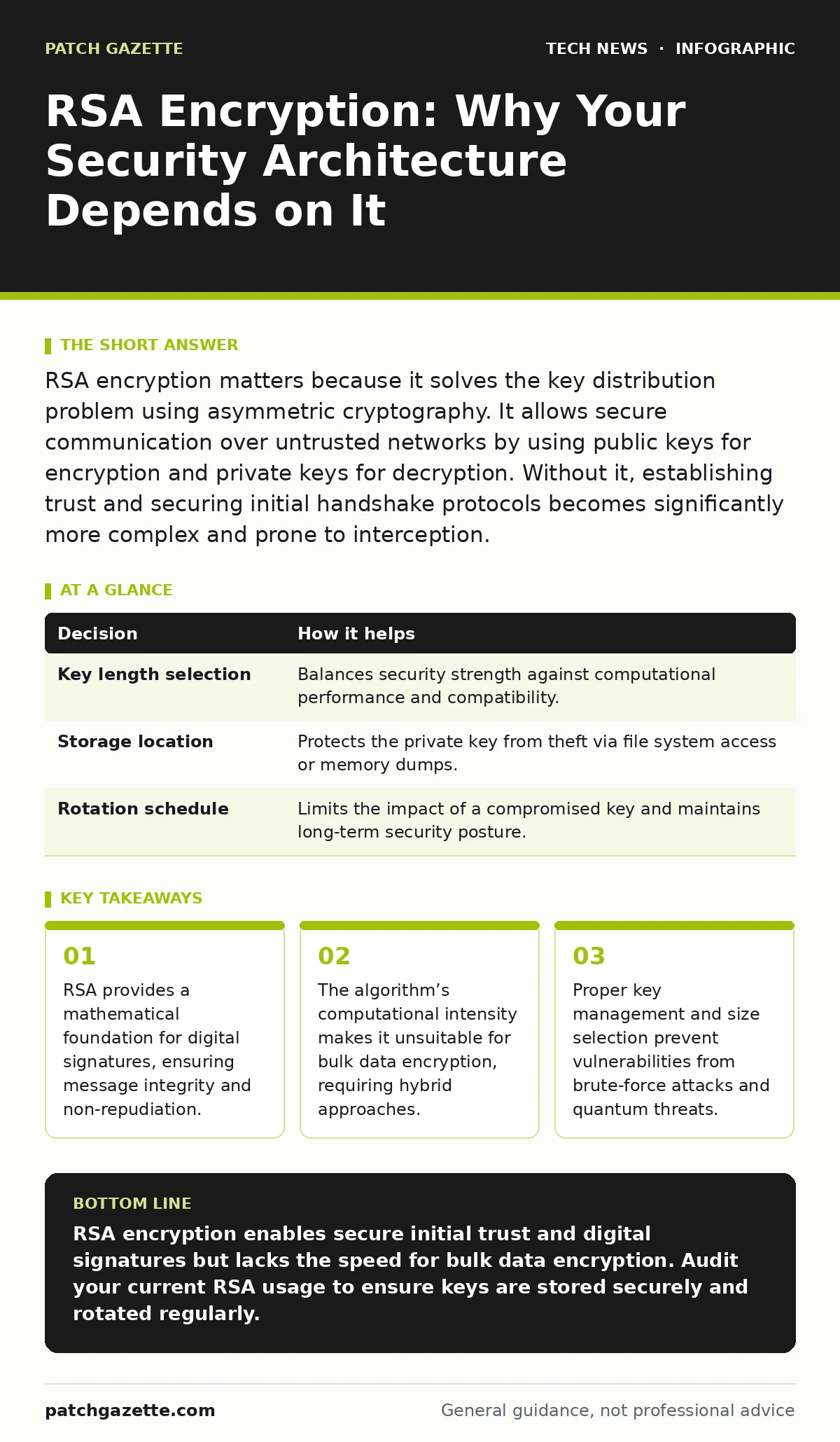
RSA encryption matters because it solves the key distribution problem using asymmetric cryptography. It allows secure communication over untrusted networks by using public keys for encryption and private keys for decryption. Without it, establishing trust and securing initial handshake protocols becomes significantly more complex and prone to interception.
The Asymmetric Advantage
RSA encryption matters because it resolves the fundamental challenge of secure key exchange. Traditional symmetric encryption requires both parties to share a secret key before communication begins. Sharing that key over an insecure network creates a vulnerability. RSA uses asymmetric cryptography, which relies on a pair of mathematically linked keys. One key is public, and the other is private. This structure allows anyone to encrypt data with the public key, but only the holder of the private key can decrypt it.
This mechanism eliminates the need to transmit sensitive secrets over the wire. You can publish your public key openly without compromising security. The private key remains on your server or device. This separation of concerns is the cornerstone of modern secure communication protocols. It enables trust in environments where participants have never met and have no prior shared secrets.
What Fails Without RSA
Imagine a team that relies solely on symmetric encryption for all external communications. They must establish a secure channel to exchange the initial symmetric key. If they use a pre-shared secret, they must manage that secret across every device and user. Scaling this approach is operationally difficult. If one device is compromised, the shared secret is exposed, requiring a full rotation of keys for every other participant.
Without RSA, digital signatures become nearly impossible to implement at scale. Symmetric keys cannot provide non-repudiation because both parties hold the same key. If a dispute arises, either party could have created the message. RSA allows a sender to sign data with their private key. Anyone with the public key can verify the signature. This proves the message originated from the sender and was not altered. Removing this capability breaks trust in software updates, legal documents, and financial transactions.
Key Management Decisions
The security of RSA depends entirely on how you manage the key pair. Generating keys is straightforward, but protecting the private key is complex. You must decide where to store the private key. Storing it in plain text on a disk is risky. If an attacker gains file system access, they can extract the key. Using a hardware security module or a trusted platform module provides physical protection. These devices never expose the private key in plaintext, even to the operating system.
Key length is another critical decision. Older systems used 1024-bit keys, which are now considered insecure. Modern standards require at least 2048-bit keys. Larger keys provide better security but increase computational overhead. You must balance security needs with performance constraints. For most general-purpose applications, 2048-bit keys offer a strong security margin. High-security environments may opt for 4096-bit keys, accepting the performance cost.
| Decision | How it helps |
|---|---|
| Key length selection | Balances security strength against computational performance and compatibility. |
| Storage location | Protects the private key from theft via file system access or memory dumps. |
| Rotation schedule | Limits the impact of a compromised key and maintains long-term security posture. |
Performance Trade-offs
RSA is computationally expensive. The mathematical operations required for encryption and decryption are intensive compared to symmetric algorithms. This makes RSA unsuitable for encrypting large volumes of data. Encrypting a large file with RSA would consume significant CPU resources and slow down operations. This limitation dictates how teams use the algorithm in practice.
Teams use RSA for key exchange and digital signatures, not for bulk data. In a typical secure connection, RSA encrypts a symmetric session key. The symmetric key is then used to encrypt the actual data. This hybrid approach combines the security of asymmetric key exchange with the speed of symmetric encryption. Understanding this distinction prevents architectural mistakes. You should never use RSA to encrypt database contents or large file transfers directly.
Integration with Other Security Controls
RSA does not operate in isolation. It works alongside other security measures to create a layered defense. For instance, when deploying software updates, RSA signatures verify that the code has not been tampered with. This ensures users install only authentic versions. Without this verification, attackers could inject malicious code into update packages.
In the context of DevOps security, RSA keys sign container images and artifacts. This ensures that only trusted code reaches production environments. It prevents supply chain attacks where compromised builds are deployed. Similarly, when configuring guest Wi-Fi networks, RSA-based certificates secure the captive portal. This prevents attackers from spoofing the login page and stealing credentials.
Common Misconfigurations
Even with RSA implemented, misconfigurations can undermine security. One common error is using weak random number generators to create keys. If the randomness is predictable, attackers can derive the private key. You must ensure your cryptographic libraries use high-quality entropy sources. Another mistake is reusing keys across different services. If one service is compromised, the attacker gains access to all services using that key.
Key expiration is often overlooked. Keys should have a defined lifespan. Long-lived keys increase the risk of compromise over time. Regular rotation limits the window of exposure. However, rotation introduces operational complexity. You must ensure all systems have the new public key before the old one expires. Failure to coordinate this can cause service outages.
Future-Proofing Your Architecture
The rise of quantum computing poses a theoretical threat to RSA. Quantum algorithms could potentially break the mathematical problems that RSA relies on. While practical quantum computers capable of breaking RSA do not yet exist, organizations should prepare. This involves planning for post-quantum cryptography migration.
Start by inventorying where RSA is used. Identify systems that are long-lived and critical. These will be the hardest to update later. Monitor standards for post-quantum algorithms. When standardized solutions become available, you will need to update your cryptographic libraries. This transition will require significant effort. Planning now reduces future risk.
Practical Implementation Steps
Implementing RSA correctly requires a structured approach. First, generate keys using a trusted cryptographic library. Do not attempt to write your own key generation logic. Second, store the private key securely. Use hardware-backed storage if available. Third, implement proper access controls. Only authorized services should be able to use the private key.
Regularly audit your key usage. Ensure that keys are not being used for purposes they were not designed for. Verify that certificates are valid and not expired. Test your systems with new keys before deploying them. This ensures that key rotation does not break existing functionality. Documentation is key. Record key IDs, expiration dates, and storage locations. This simplifies incident response if a key is compromised.
Key takeaways
- RSA provides a mathematical foundation for digital signatures, ensuring message integrity and non-repudiation.
- The algorithm’s computational intensity makes it unsuitable for bulk data encryption, requiring hybrid approaches.
- Proper key management and size selection prevent vulnerabilities from brute-force attacks and quantum threats.
RSA encryption enables secure initial trust and digital signatures but lacks the speed for bulk data encryption. Audit your current RSA usage to ensure keys are stored securely and rotated regularly.
Frequently asked questions
Can RSA encrypt large files?
No, RSA is too slow for large files. Use RSA to encrypt a symmetric key, then use that symmetric key to encrypt the file.
How often should I rotate RSA keys?
Rotate keys annually or when a compromise is suspected. Critical systems may require more frequent rotation.
Is RSA secure against quantum computers?
No, RSA is vulnerable to quantum attacks. Plan for migration to post-quantum cryptography standards as they become available.
What is the difference between RSA and ECC?
RSA relies on integer factorization, while ECC relies on elliptic curve mathematics. ECC offers similar security with smaller key sizes.
How this guide was produced: written by the Patch Gazette editorial team with AI assistance, checked against the public references listed below, and reviewed when the facts change. See our editorial policy or report an error.