
Adversary in the Middle Phishing: How Invisible Proxies Steal Credentials
Adversary in the middle phishing hides behind legitimate-looking login pages, making standard URL checks and visual inspections useless against sophisticated credential theft.
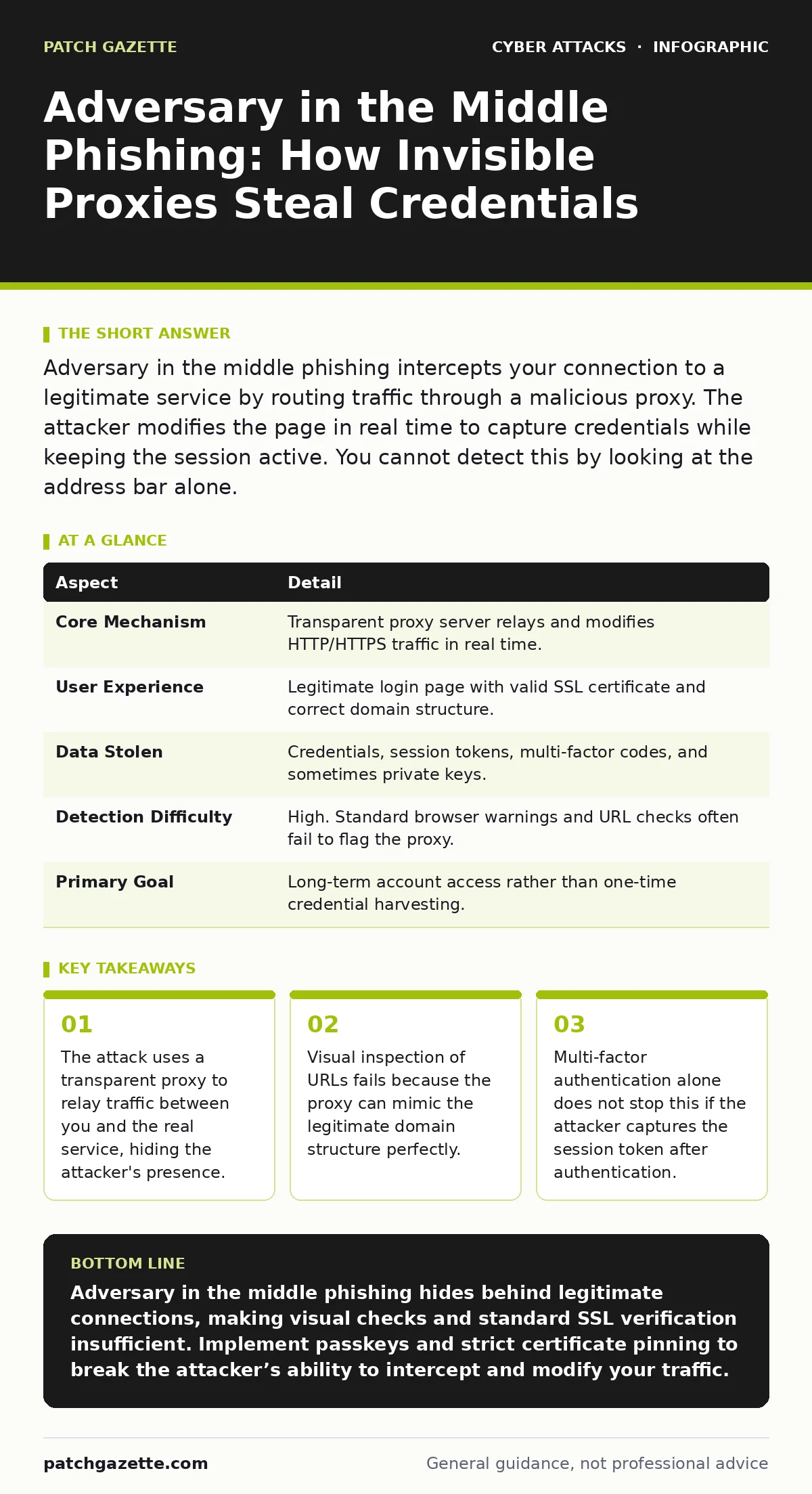
Adversary in the middle phishing intercepts your connection to a legitimate service by routing traffic through a malicious proxy. The attacker modifies the page in real time to capture credentials while keeping the session active. You cannot detect this by looking at the address bar alone.
Everyday Analogy: The Silent Interpreter
Imagine you are negotiating a contract with a vendor. You hire an interpreter to translate your words. The interpreter listens to your offer, translates it for the vendor, and then translates the vendor’s response back to you. If the interpreter is dishonest, they can subtly change your terms to benefit themselves. You believe you are speaking directly to the vendor. The vendor believes they are speaking to you. The interpreter controls the entire flow of information without either party knowing.
Adversary in the middle phishing operates on this exact principle. Instead of a person, a malicious server sits between your browser and the legitimate website. You see the real site. The real site sees valid traffic. The attacker sees everything and can modify it on the fly. This differs from simple phishing, where you land on a fake site that looks like the real one. Here, you are technically connected to the real infrastructure, but the attacker controls the pipe.
At a Glance: Attack Mechanics
| Aspect | Detail |
|---|---|
| Core Mechanism | Transparent proxy server relays and modifies HTTP/HTTPS traffic in real time. |
| User Experience | Legitimate login page with valid SSL certificate and correct domain structure. |
| Data Stolen | Credentials, session tokens, multi-factor codes, and sometimes private keys. |
| Detection Difficulty | High. Standard browser warnings and URL checks often fail to flag the proxy. |
| Primary Goal | Long-term account access rather than one-time credential harvesting. |
How Adversary in the Middle Phishing Works
The attack begins with a standard lure, often found in phishing emails or QR code phishing links. You click a link that appears to lead to your corporate portal or banking site. The link directs your browser to the attacker’s server. This server acts as a man-in-the-middle. It establishes a connection to the real destination server and another connection to your browser.
The attacker’s server decrypts your traffic, reads it, and re-encrypts it before sending it to the real server. It does the same in reverse. To your browser, the connection looks secure. The certificate may even be valid if the attacker uses a technique to mimic the real certificate’s appearance or if they have compromised a legitimate certificate authority. The critical difference is that the attacker can inject JavaScript or modify HTML forms. When you type your password, the attacker captures it. They then forward the correct password to the real server. You log in successfully. The attacker now has your credentials and may also capture your session cookie.
This method bypasses many automated security checks. Security tools often trust the destination domain because the final hop is legitimate. The proxy hides the malicious intermediate step. This makes it distinct from replay attacks, where an attacker simply resends captured data. Here, the attacker actively participates in the live session.
Who It Affects and Why It Succeeds
Any organization using web-based authentication is vulnerable. The attack targets users who trust visual cues. You might check for the padlock icon. You might verify the domain name. Adversary in the middle phishing exploits the complexity of modern web infrastructure. Subdomains and complex URL structures make it hard for humans to spot the difference between login.company.com and company.login.attacker-proxy.com.
High-value accounts are prime targets. Attackers use this method to maintain persistence. Stealing a password is useful, but stealing a session token is better. With a session token, the attacker can access the account without needing the password again. This bypasses password managers and even some forms of multi-factor authentication. If the attacker captures the token after you authenticate, they are already inside. The system thinks you are logged in.
This technique also affects organizations relying on third-party identity providers. If the proxy intercepts traffic to an OAuth provider, the attacker can steal authorization codes. These codes grant access to linked services. One compromised session can lead to access across multiple platforms. The ripple effect is significant. A single click can compromise an entire ecosystem of connected accounts.
What People Usually Get Wrong
Many users believe that seeing a valid SSL certificate means the connection is safe. This is a dangerous misconception. A certificate proves the identity of the server you are connected to. It does not prove that the server is not a proxy. If the attacker controls the server you connect to, the certificate is valid for that server. The security gap lies in trusting the endpoint without verifying the path.
Another common error is assuming that multi-factor authentication (MFA) stops this attack. MFA adds a layer of verification, but it does not prevent credential theft. If the attacker captures your password and your MFA code in the same session, they can log in. Some advanced MFA methods, like passkeys, are resistant to this because they bind the authentication to the specific origin. However, SMS-based or app-based codes can be captured by the proxy. The attacker simply asks for the code and passes it along.
Users often overlook the behavior of the page. A proxy might introduce slight delays or minor rendering errors. These are subtle clues. Most users do not notice them. They focus on the content, not the performance. This oversight allows the attack to proceed undetected. The assumption that "it works, so it is safe" is the core vulnerability.
See also: Parameterized Queries Best Practices: Stop Injection Attacks · QR Code Phishing: Risks and Protection for Small Businesses
Detection and Mitigation Strategies
Defending against adversary in the middle phishing requires a shift in verification methods. You cannot rely on visual checks alone. Implement certificate pinning in your internal applications. This ensures that your app only trusts a specific certificate, not just any valid certificate. This breaks the proxy’s ability to mimic the real server.
Monitor for anomalous login patterns. Look for logins from unexpected geographic locations or at unusual times. While proxies can mask IP addresses, they cannot always hide all metadata. Behavioral analytics can flag sessions that deviate from the norm. If a user logs in from a new device and immediately accesses sensitive data, trigger a step-up authentication challenge.
Educate users to verify the context of the request. Did you expect to log in right now? Did you click a link in a trusted email? Contextual awareness is a powerful defense. If the timing feels wrong, do not proceed. This simple check can stop many attacks before they start.
Advanced Defenses for IT Managers
For organizations, network-level controls are critical. Use DNS filtering to block known malicious domains. This stops the initial redirect. However, attackers use fast-flux domains and newly registered domains. DNS filtering must be updated continuously.
Implement strict Content Security Policy (CSP) headers. CSP restricts which sources your web applications can load scripts from. If the proxy tries to inject malicious JavaScript, a strong CSP will block it. This limits the attacker’s ability to modify the page or capture keystrokes.
Consider using end-to-end encryption for sensitive communications. If the data is encrypted before it leaves your device, the proxy cannot read it. This is difficult to implement for standard web browsing but feasible for specific high-risk applications.
Regularly audit your external-facing services. Ensure that all public endpoints use the latest security standards. Disable outdated protocols that are easier to intercept. The more secure your infrastructure, the harder it is for an attacker to set up a functional proxy.
The Role of Modern Authentication
Traditional password-based authentication is vulnerable to this attack. Passwords are static secrets that can be captured and reused. Moving to phishing-resistant authentication methods is the most effective long-term defense. Passkeys, for example, use public-key cryptography. They bind the authentication request to the specific origin of the website. A proxy cannot mimic the origin. If the user tries to authenticate via a proxy, the passkey will fail because the origin does not match.
This shift reduces the attack surface significantly. Even if the attacker intercepts the traffic, they cannot generate a valid authentication response. The cryptographic proof is tied to the real domain. This eliminates the possibility of credential theft via proxy.
Organizations should prioritize migrating to these standards. While the transition takes time, the security benefits are substantial. Reduce reliance on password managers for high-risk accounts. Use them for low-risk sites, but reserve passkeys or hardware tokens for critical infrastructure.
Key takeaways
- The attack uses a transparent proxy to relay traffic between you and the real service, hiding the attacker's presence.
- Visual inspection of URLs fails because the proxy can mimic the legitimate domain structure perfectly.
- Multi-factor authentication alone does not stop this if the attacker captures the session token after authentication.
Adversary in the middle phishing hides behind legitimate connections, making visual checks and standard SSL verification insufficient. Implement passkeys and strict certificate pinning to break the attacker’s ability to intercept and modify your traffic.
Frequently asked questions
Can antivirus software detect adversary in the middle phishing?
Antivirus software typically scans for known malware signatures. It does not inspect live web traffic for proxy interception. You need specialized network monitoring or endpoint detection and response tools for this threat.
How is this different from DNS amplification attacks?
DNS amplification attacks flood a target with traffic to cause a denial of service. Adversary in the middle phishing is a stealthy interception technique designed to steal data, not disrupt service. They have opposite goals.
Does using a VPN protect me from this attack?
A VPN encrypts traffic between your device and the VPN server. If the attacker is between you and the VPN, you are safe. If the attacker is between the VPN and the destination, or if you connect to a malicious proxy after the VPN, you are still vulnerable.
Can rainbow table attacks help an attacker who uses this method?
No. Rainbow tables are used to crack password hashes. Adversary in the middle phishing captures plaintext passwords or session tokens directly. The attacker does not need to crack hashes because they already have the usable credentials.
How this guide was produced: written by the Patch Gazette editorial team with AI assistance, checked against the public references listed below, and reviewed when the facts change. See our editorial policy or report an error.