
Data Residency Rules: What Small Teams Must Verify Now
Cloud providers often move data across borders without explicit consent, creating legal exposure that small teams miss during onboarding.
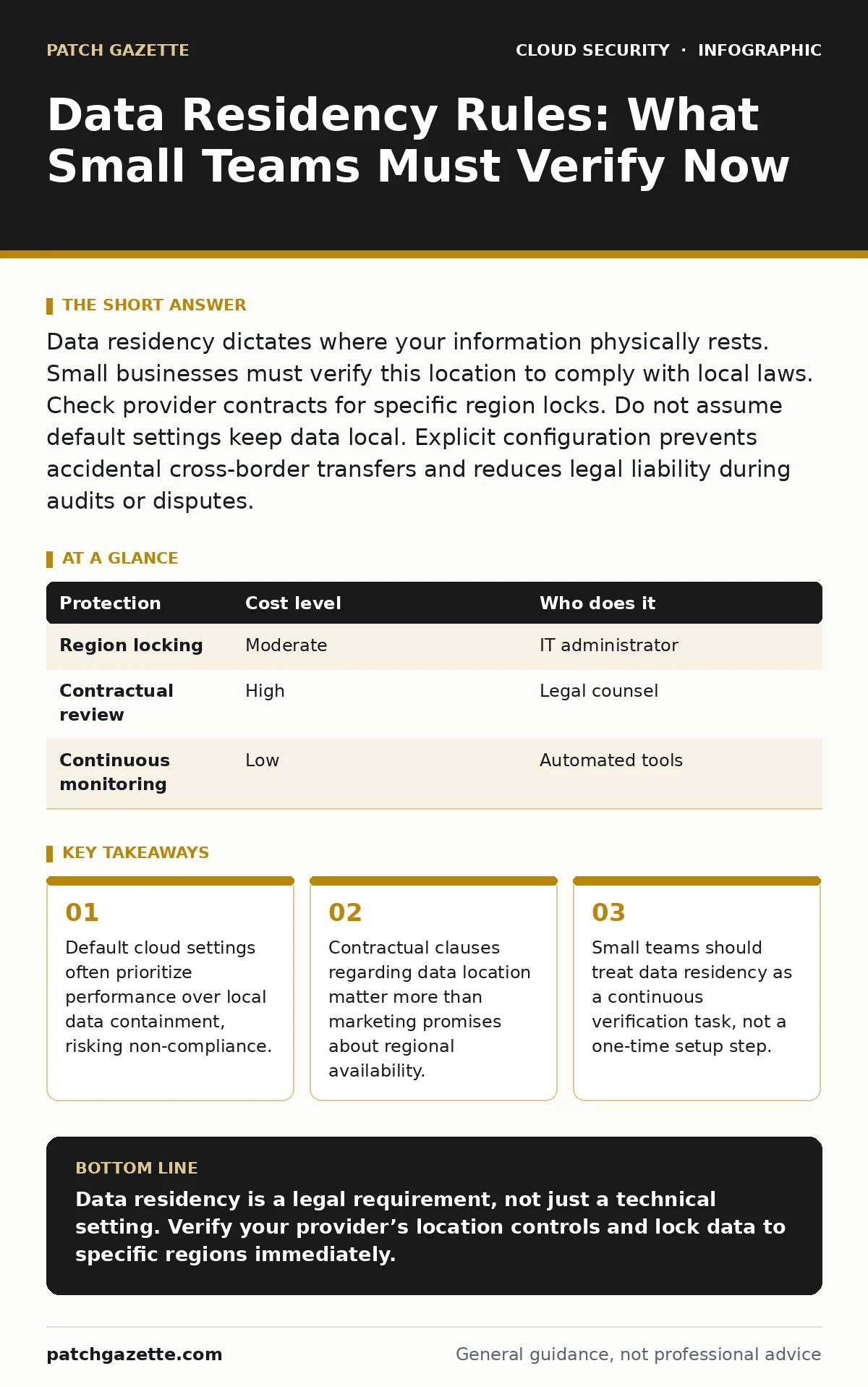
Data residency dictates where your information physically rests. Small businesses must verify this location to comply with local laws. Check provider contracts for specific region locks. Do not assume default settings keep data local. Explicit configuration prevents accidental cross-border transfers and reduces legal liability during audits or disputes.
The Hidden Border Crossing
This scenario illustrates why data residency matters at small scale. Data residency refers to the physical location where digital information is stored and processed. Many small organizations assume their data stays within their national borders because they select a local entry point. This assumption is frequently incorrect. Cloud infrastructure operates on a global mesh. Providers optimize for speed and cost, not necessarily for legal boundaries. When latency spikes or hardware fails, data may migrate automatically to a secondary region.
Small teams often lack the legal resources to track these movements. A single misconfigured storage bucket can expose sensitive records to foreign surveillance laws. The risk is not just about theft. It is about jurisdiction. If your data rests in a country with broad government access laws, you may be compelled to hand over information that your home country protects. This creates a compliance gap that is difficult to close retroactively.
Why It Matters for Small Teams
Small businesses face unique pressures regarding data location. Large enterprises have dedicated legal teams to negotiate data processing agreements. Small teams usually rely on standard terms of service. These standard terms often include broad language allowing data movement across multiple jurisdictions. You must read these terms carefully. Look for clauses that permit the provider to move data for maintenance or disaster recovery.
Regulatory requirements vary significantly by region. Some laws require specific types of data, such as health records or financial details, to remain within national borders. Others restrict data flow to countries with equivalent protection standards. Ignoring these rules can result in fines or loss of customer trust. For a small company, a single compliance breach can be existential. The cost of remediation often exceeds the budget for the entire IT department.
Data residency also impacts performance. Storing data far from your users increases latency. This slows down applications and degrades the user experience. Balancing legal compliance with technical performance requires deliberate choices. You cannot simply pick the cheapest option. You must choose a location that satisfies both legal constraints and speed requirements.
Practical Steps for Implementation
Implementing data residency controls requires a structured approach. Start by mapping your data. Identify which datasets are subject to residency requirements. Not all data needs the same level of restriction. Public marketing materials can live anywhere. Customer payment details may need to stay local. This classification drives your configuration choices.
Next, configure your cloud services to lock data to specific regions. Most major platforms allow you to set region constraints. Ensure these constraints apply to all storage services, including backups and logs. Backups are often overlooked. If your primary data stays local but your backups replicate to a distant region, you have failed the residency requirement.
Monitor your environment for changes. Configuration drift occurs when settings deviate from the intended state. An employee might accidentally change a storage location to improve performance. Automated tools can detect these changes. Alert your team immediately when a resource moves outside the approved region. This proactive monitoring prevents long-term exposure.
| Protection | Cost level | Who does it |
|---|---|---|
| Region locking | Moderate | IT administrator |
| Contractual review | High | Legal counsel |
| Continuous monitoring | Low | Automated tools |
What to Ask Your IT Provider
Your IT provider or cloud partner plays a critical role in maintaining data residency. You must verify their capabilities and processes. Do not accept vague assurances. Ask specific questions about their infrastructure and policies.
- Which physical regions do you support for data storage?
- Can you guarantee that data will not leave a specified region?
- How do you handle disaster recovery and backup replication?
- What happens to data if you go out of business?
- Do you share data with third-party vendors in other countries?
These questions reveal the provider’s commitment to data sovereignty. A provider that cannot answer these questions clearly may not be suitable for regulated industries. Review their service level agreements. Look for specific clauses regarding data location and transfer. Ensure the contract includes penalties for unauthorized data movement.
Common Pitfalls to Avoid
Many small teams make mistakes when setting up data residency. One common error is assuming that choosing a local entry point ensures local storage. The entry point is just the door. The data may travel through multiple servers before reaching its final resting place. Verify the actual storage location, not just the access point.
Another pitfall is neglecting metadata. Metadata describes your data. It often contains sensitive information about users or systems. If metadata is stored in a different region than the primary data, you may violate residency rules. Configure metadata storage to follow the same location constraints as the data itself.
Teams also forget about analytics and processing. Data may be stored locally but processed remotely for analysis. This processing step can trigger residency violations. Ensure that any data transformation or analysis occurs within the approved region. This requires careful architecture design. It may mean running analytics engines locally rather than using centralized global services.
See also: Serverless Security Risks: Protecting Small Teams from Hidden Cloud Threats · Data Subject Rights: Operationalizing Privacy for Small Teams
Integrating with Security Practices
Data residency is not an isolated concern. It intersects with other security practices. For instance, see our guide on cloud misconfigurations to understand how default settings can expose data. Misconfigured permissions can allow unauthorized access, regardless of location. Combine residency controls with strict access management.
Encryption adds another layer of protection. Even if data moves to an unauthorized region, encryption keeps it unreadable. Use customer-managed keys. This gives you control over the encryption keys. If you hold the keys, the provider cannot access the data even if they move it. This strategy reduces the risk of unauthorized disclosure.
Consider the implications of hybrid cloud security. If you use both on-premises and cloud resources, data may move between them. Ensure that the transfer mechanisms are secure and compliant. Define clear policies for data movement between environments. This prevents accidental leaks during migration or synchronization.
Long-Term Management Strategies
Data residency requires ongoing attention. Regulations change. Providers update their infrastructure. Your business needs evolve. Revisit your data residency strategy regularly. Conduct annual audits to verify compliance. Check that all resources are still in the approved regions.
Train your staff on data handling procedures. Employees should understand the importance of data location. They should know how to configure services correctly. Include data residency in your onboarding process. This builds a culture of compliance.
Stay informed about regulatory changes. New laws may impose stricter requirements. Adapt your strategy accordingly. Flexibility is key. A rigid approach may fail when new rules emerge. Build a framework that can adjust to changing legal landscapes. This ensures long-term compliance and protection.
Key takeaways
- Default cloud settings often prioritize performance over local data containment, risking non-compliance.
- Contractual clauses regarding data location matter more than marketing promises about regional availability.
- Small teams should treat data residency as a continuous verification task, not a one-time setup step.
Data residency is a legal requirement, not just a technical setting. Verify your provider’s location controls and lock data to specific regions immediately.
Frequently asked questions
Does encryption solve data residency issues?
Encryption protects data confidentiality but does not change its physical location. Residency laws often require specific storage locations regardless of encryption status.
Can I use global CDNs for compliant data?
Content delivery networks cache data globally. This may violate residency rules for sensitive information. Use regional CDNs or restrict caching for compliant data.
What if my provider moves data without notice?
Review your contract for notification clauses. Ensure you have the right to audit and terminate service for unauthorized data movement.
How do backups affect residency?
Backups must follow the same residency rules as primary data. Configure backup replication to stay within approved regions to maintain compliance.
How this guide was produced: written by the Patch Gazette editorial team with AI assistance, checked against the public references listed below, and reviewed when the facts change. See our editorial policy or report an error.