
What is blockchain security and how cryptographic ledgers fail
Cryptographic ledgers prevent tampering with historical data, yet they remain deeply vulnerable to faulty application logic and human error.
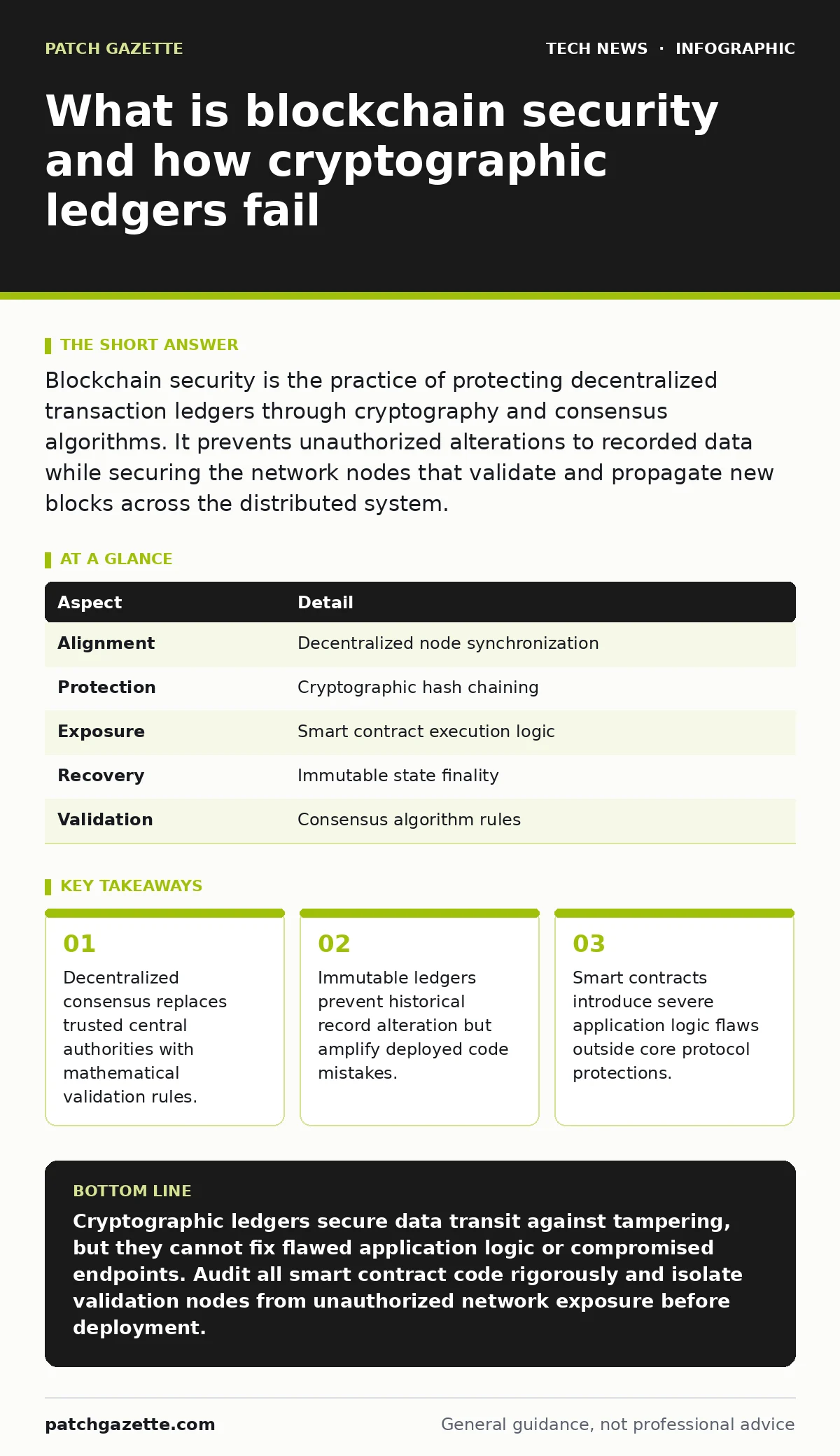
Blockchain security is the practice of protecting decentralized transaction ledgers through cryptography and consensus algorithms. It prevents unauthorized alterations to recorded data while securing the network nodes that validate and propagate new blocks across the distributed system.
The Shared Notebook Analogy of Decentralized Trust
Blockchain security operates much like a neighborhood where every resident keeps an identical notebook recording financial trades. No single neighbor can erase a past entry because the other residents will instantly spot the mismatch against their own copies. Shared validation prevents fraudulent history rewrites without requiring a central bank or a trusted intermediary to oversee the ledger.
Distributed bookkeeping trades administrative convenience for massive replication overhead. Every node must process every transaction independently, creating bottlenecks that limit processing speed compared to traditional centralized databases. Maintaining this distributed state requires careful alignment between network topology and hardware capacity, much like managing physical devices through strict IT asset management practices.
| Aspect | Detail |
|---|---|
| Alignment | Decentralized node synchronization |
| Protection | Cryptographic hash chaining |
| Exposure | Smart contract execution logic |
| Recovery | Immutable state finality |
| Validation | Consensus algorithm rules |
What is Blockchain Security at the Protocol Layer
Blockchain security is the defense of distributed ledger architectures against unauthorized state changes, node takeovers, and consensus disruptions. Core network layers rely on asymmetric cryptography to sign transactions and link blocks together in a strict chronological sequence. Each new block contains a mathematical reference to the previous block, creating a tamper-evident chain that breaks if anyone alters historical data.
Protocol rules dictate how nodes agree on the valid state of the ledger without trusting one another. Malicious actors face high economic costs if they attempt to rewrite history, because doing so requires controlling a majority of the network validation power. Protocol designers build these economic incentives to make attacks mathematically or financially prohibitive rather than strictly impossible.
How Consensus Protocols Validate Transactions
Consensus mechanisms require network nodes to solve complex cryptographic puzzles or stake native assets before they can append new blocks. Proof-of-work protocols force validators to expend computational energy to earn the right to write the next ledger entry. Proof-of-stake protocols instead demand financial collateral, slashing the staked funds of any validator attempting to approve fraudulent transactions.
Consensus security depends heavily on network connectivity and node distribution across independent jurisdictions. If a single entity acquires control over a majority of validation power, the underlying consensus guarantees collapse immediately. Partitioned networks can temporarily fork into separate conflicting histories, requiring deterministic reconciliation rules once normal communication channels resume.
Who Is Affected by Decentralized Ledger Vulnerabilities
Organizations building decentralized applications face direct financial losses and reputational damage when platform vulnerabilities are exploited in production environments. Enterprise consortia sharing private ledgers risk exposing proprietary supply chain data if access controls fail at the perimeter. Individual users suffer immediate asset theft when private keys are compromised through phishing or endpoint malware.
System administrators managing validating nodes must maintain rigorous hygiene across their infrastructure. Neglecting routine software updates on underlying operating systems creates direct entry points for attackers seeking to compromise node keys. Compromised nodes disrupt consensus participation and threaten the operational integrity of the entire connected network architecture.
What People Usually Get Wrong About Immutable Records
Observers frequently assume that immutability guarantees absolute safety against all forms of digital fraud and theft. Immutable ledgers only ensure that once data is written, it cannot be altered without detection. Data recorded inaccurately at the origin remains permanently flawed, meaning bad inputs produce permanent bad history regardless of cryptographic strength.
Another common misconception assumes that decentralization eliminates single points of failure entirely. Centralized application programming interfaces often bridge users to decentralized networks, creating obvious targets for interception. Compromising these access gateways allows attackers to trick users into signing malicious transactions while the underlying ledger functions exactly as designed.
See also: Mobile device security best practices for locking down hardware · Difference between OSI model and tcp model explained for networks
What to Do About Application Logic Flaws
Developers must treat smart contracts as immutable software binaries that cannot be easily patched after deployment. Comprehensive test suites must simulate edge cases, including reentrancy attacks where recursive calls drain contract balances before state variables update.
Network operators should implement strict egress filtering and isolate validation nodes behind secure firewalls to prevent unauthorized peer connections. Monitoring memory pools for suspicious transaction patterns provides early warning signs before malicious payloads are finalized into blocks. Defending these distributed systems requires treating smart contract security as a distinct discipline separate from traditional network hardening.
Key takeaways
- Decentralized consensus replaces trusted central authorities with mathematical validation rules.
- Immutable ledgers prevent historical record alteration but amplify deployed code mistakes.
- Smart contracts introduce severe application logic flaws outside core protocol protections.
Cryptographic ledgers secure data transit against tampering, but they cannot fix flawed application logic or compromised endpoints. Audit all smart contract code rigorously and isolate validation nodes from unauthorized network exposure before deployment.
Frequently asked questions
Can a blockchain be hacked after data is written?
Historical data cannot be altered without controlling a majority of the network validation power, but application layers remain vulnerable to logic exploits.
Why are smart contracts vulnerable if the underlying ledger is secure?
Smart contracts are self-executing programs that contain human coding errors, and the ledger faithfully records whatever execution results the code produces.
How do private blockchains differ in security from public ones?
Private ledgers restrict participation to known entities, reducing the risk of anonymous malicious validators while introducing centralized governance vulnerabilities.
What happens when a private key is lost on a blockchain network?
Lost private keys mean permanent loss of access to associated assets, because no central administrator possesses password reset capabilities.
How this guide was produced: written by the Patch Gazette editorial team with AI assistance, checked against the public references listed below, and reviewed when the facts change. See our editorial policy or report an error.