
Should I enable DNSSEC on my domain for cryptographic validation?
Cryptographic signing protects lookup paths from malicious tampering, but silently drops traffic when keys expire or configurations drift.
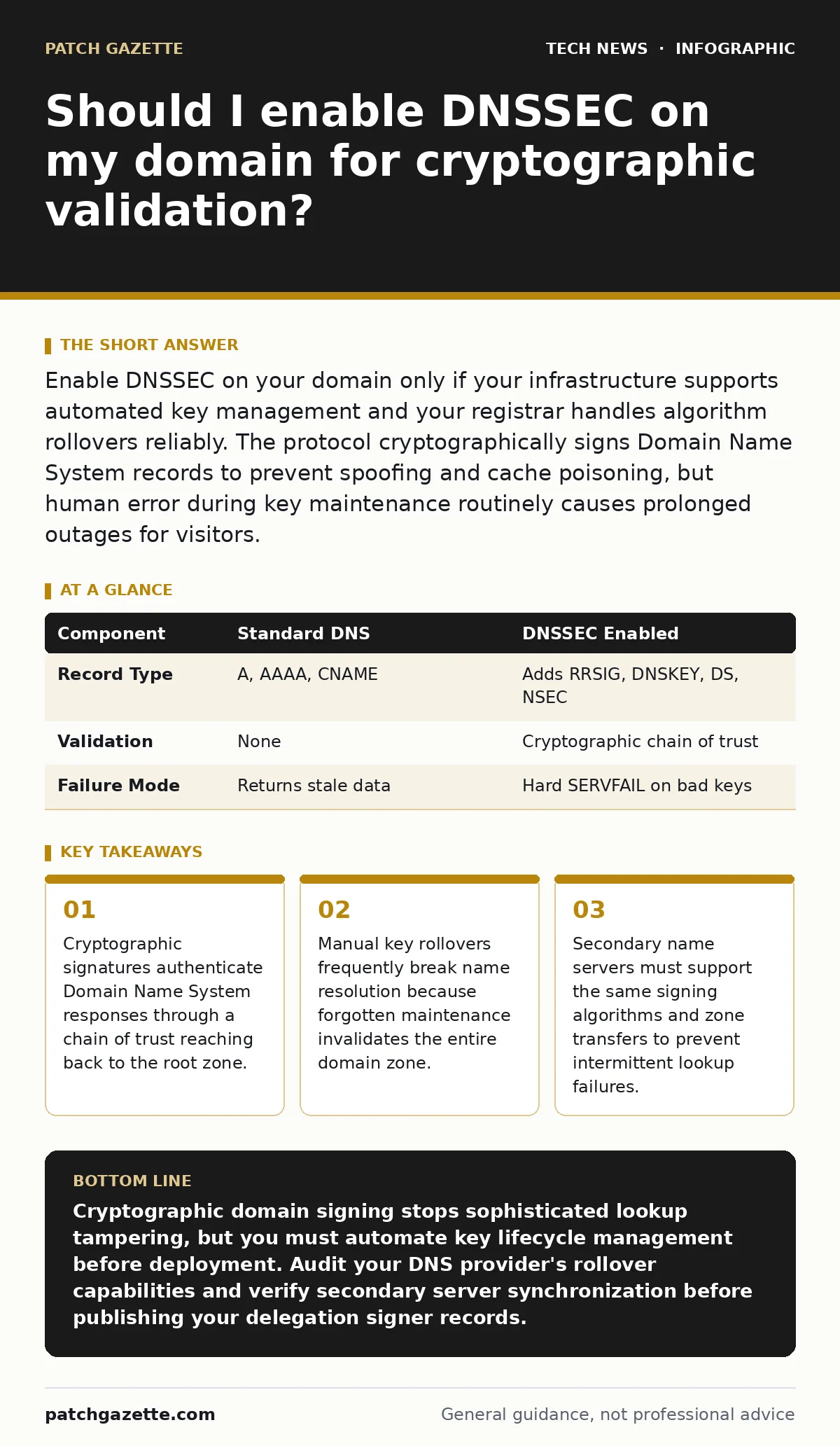
Enable DNSSEC on your domain only if your infrastructure supports automated key management and your registrar handles algorithm rollovers reliably. The protocol cryptographically signs Domain Name System records to prevent spoofing and cache poisoning, but human error during key maintenance routinely causes prolonged outages for visitors.
Should I enable DNSSEC on my domain right now?
Enabling DNSSEC on your domain requires a careful audit of your DNS hosting provider's automated key management capabilities before you touch any settings. The Domain Name System Security Extensions protocol adds cryptographic signatures to standard lookup records, proving that the answers your visitors receive actually originated from your authoritative servers. Without this layer, attackers can easily forge responses on local networks or compromise recursive resolvers to redirect your web traffic and mail delivery.
| Component | Standard DNS | DNSSEC Enabled |
|---|---|---|
| Record Type | A, AAAA, CNAME | Adds RRSIG, DNSKEY, DS, NSEC |
| Validation | None | Cryptographic chain of trust |
| Failure Mode | Returns stale data | Hard SERVFAIL on bad keys |
What actually breaks when you turn on DNSSEC?
Turning on DNSSEC breaks name resolution immediately if your secondary name servers fail to sync signed zone files or if your registrar loses your DS record. The protocol introduces new record types that inflate packet sizes, frequently pushing standard UDP queries over traditional size limits and forcing messy TCP fallbacks. Furthermore, incorrect time synchronization across your authoritative name servers causes signature validation failures that are notoriously difficult to diagnose from the outside.
How does the chain of trust protect your lookups?
The chain of trust protects your lookups by anchoring your domain's public keys directly into the parent zone through a cryptographic delegation signer record. Recursive resolvers evaluate these signatures step by step, starting from the root servers down through the top-level domain and finally to your specific hostname. Any mismatch in this hierarchy causes validating resolvers to reject the response entirely, replacing your content with a hard resolution error rather than serving forged data.
When does the standard advice to enable DNSSEC fail?
The standard advice to enable DNSSEC fails when organizations manage their cryptographic keys manually without rigorous monitoring dashboards or expiration alerts. Imagine a busy engineering team updating zone records while forgetting to rotate their key-signing keys on schedule, leaving the domain completely invisible to strict validating resolvers worldwide. Effective IT asset management practices must track cryptographic material with the same urgency as SSL certificates to prevent self-inflicted outages.
Why do secondary name servers cause silent failures?
Secondary name servers cause silent failures when zone transfers drop the cryptographic signature records due to outdated server software or misconfigured access controls. Primary and secondary providers must coordinate algorithm rollovers precisely, ensuring that new public keys propagate everywhere before old ones expire or get revoked. Neglecting this synchronization creates a split-brain condition where half the global resolvers trust your domain and the other half treat your records as hostile forgeries.
See also: Quantum cryptography example and how mathematical traps protect data · Difference between cyber security and devops explained clearly
Can automated management prevent human errors?
Automated management prevents human errors by letting modern DNS providers handle key generation, scheduled rollovers, and parent zone updates through integrated application programming interfaces. Relying on scripts or vendor dashboards removes the danger of mistyping complex cryptographic fingerprints during manual DS record submissions at your registrar. Proper open port management ensures that necessary network paths remain open for these automated systems to communicate without triggering firewall drops.
What should you check before flipping the switch?
Checking your infrastructure compatibility before flipping the switch requires verifying that your current provider supports modern cryptographic algorithms like elliptic-curve cryptography rather than aging standards. You must confirm that your team has documented recovery procedures for emergency key rollovers if a private key ever becomes compromised or suspected. Neglecting this preparation turns a routine security upgrade into an unmitigated disaster that blindsides your users and support desks alike.
Key takeaways
- Cryptographic signatures authenticate Domain Name System responses through a chain of trust reaching back to the root zone.
- Manual key rollovers frequently break name resolution because forgotten maintenance invalidates the entire domain zone.
- Secondary name servers must support the same signing algorithms and zone transfers to prevent intermittent lookup failures.
Cryptographic domain signing stops sophisticated lookup tampering, but you must automate key lifecycle management before deployment. Audit your DNS provider's rollover capabilities and verify secondary server synchronization before publishing your delegation signer records.
Frequently asked questions
Does DNSSEC encrypt my DNS traffic?
DNSSEC does not encrypt lookup queries or responses, meaning anyone can still read the domain names your users request. The protocol only provides authenticity and integrity by digitally signing records to prove they were not modified in transit.
Will enabling DNSSEC slow down my website load times?
Enabling DNSSEC adds a minor processing overhead to resolvers and slightly increases packet sizes due to cryptographic signatures. Most visitors will not notice any performance difference, though rare TCP fallbacks can occur on constrained networks.
What happens if my DNSSEC keys expire?
Expired keys cause validating resolvers worldwide to reject your domain records, resulting in complete service outages for legitimate visitors. Resolvers treat expired signatures as potential attack indicators and refuse to resolve the affected hostnames.
Do all domain registrars support DNSSEC configuration?
Most modern registrars support DNSSEC, but older or discount providers may lack proper interfaces for submitting delegation signer records. You should verify registrar compatibility before transferring domains or attempting zone activations.
How this guide was produced: written by the Patch Gazette editorial team with AI assistance, checked against the public references listed below, and reviewed when the facts change. See our editorial policy or report an error.