
Difference between OSI model and tcp model explained for networks
Abstract layers hide physical network reality, causing administrators to debug imaginary boundaries instead of actual protocol traffic.
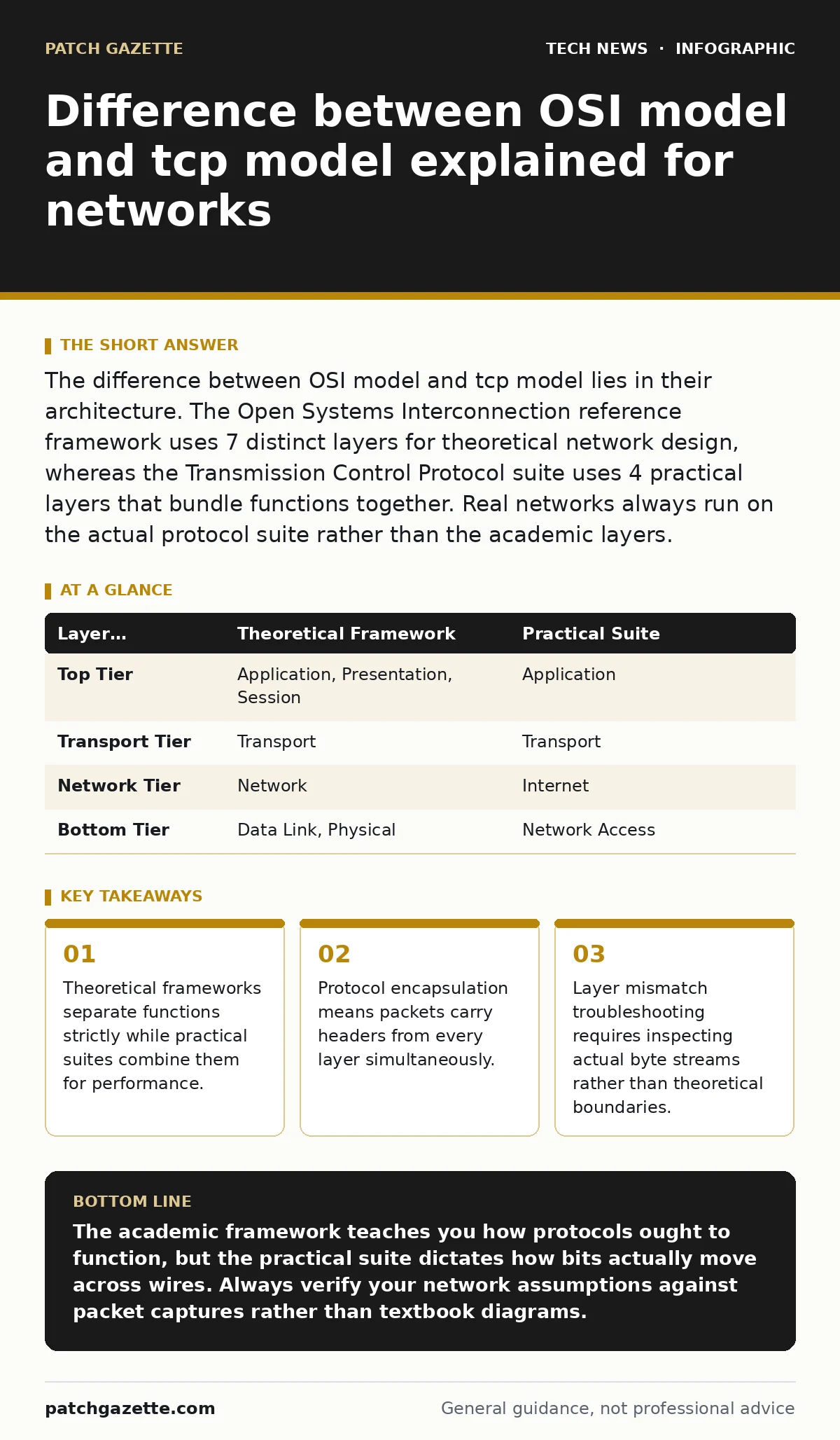
The difference between OSI model and tcp model lies in their architecture. The Open Systems Interconnection reference framework uses 7 distinct layers for theoretical network design, whereas the Transmission Control Protocol suite uses 4 practical layers that bundle functions together. Real networks always run on the actual protocol suite rather than the academic layers.
What is the actual difference between OSI model and tcp model?
The difference between OSI model and tcp model is that the former serves as a 7-layer theoretical blueprint, while the latter functions as a 4-layer operational reality. You build networks using the practical suite, yet engineers reference the academic framework during design discussions. This structural gap creates confusion when diagnostic tools show behavior that does not fit neatly into separate protocol categories.
Network architecture relies on packet encapsulation, where data descending through layers receives successive headers. Encapsulation wraps application payloads inside transport segments, network packets, and link frames before wire transmission. The theoretical framework splits session and presentation tasks into standalone tiers, but the practical suite leaves those responsibilities entirely to the application layer.
| Layer Comparison | Theoretical Framework | Practical Suite |
|---|---|---|
| Top Tier | Application, Presentation, Session | Application |
| Transport Tier | Transport | Transport |
| Network Tier | Network | Internet |
| Bottom Tier | Data Link, Physical | Network Access |
Why do network engineers still use the theoretical framework?
Network engineers still use the theoretical framework because its rigid separation of duties provides a common vocabulary for troubleshooting complex hardware failures. You isolate routing anomalies by mapping physical switches, cabling paths, and logical addressing to distinct hierarchical tiers.
Hidden costs emerge when you assume network hardware respects the clean boundaries drawn in textbooks. Modern load balancers inspect application payloads while operating at transport speeds, violating strict hierarchy rules. Hardware offloading moves packet processing directly onto interface cards, blurring the line between software layers and physical silicon.
How do encapsulation and decapsulation cross these boundaries?
Encapsulation and decapsulation cross these boundaries by continuously wrapping and unwrapping data as it traverses protocol tiers. Decapsulation strips outer headers sequentially as frames ascend from the physical medium toward the software application. Each removed header reveals instructions for the adjacent upper tier, transforming raw electrical signals back into readable data streams.
Imagine a malformed packet arriving at an interface, forcing the operating system kernel to drop the frame before upper tiers ever inspect the payload. Security analysts often audit traffic patterns by reviewing Domain Name System queries to spot unauthorized data exfiltration channels before traditional firewalls trigger alerts. You might secure remote access sessions by auditing laptop security configurations to ensure endpoint devices do not leak encapsulated credentials.
When does the 4-layer practical suite diverge from textbook theory?
The 4-layer practical suite diverges from textbook theory whenever protocols span multiple functional boundaries simultaneously. Transport protocols such as Transmission Control Protocol manage flow control and error recovery while interacting directly with application sockets, bypassing intermediate session management layers entirely.
- Application software formats data directly for transport sockets without separate presentation formatting.
- Transport mechanisms handle reliability functions that theoretical models assign to higher tiers.
- Internet protocols route packets globally without depending on strict data link layer standardization.
Routing failures often require deeper inspection of underlying mechanisms, especially when resolving IP addresses across complex subnets without centralized directory services.
What happens when applications violate protocol layering rules?
Applications violate protocol layering rules when software developers embed lower-level routing logic directly into user-space programs. Tunneling encapsulates entire packets inside unrelated application payloads, hiding traffic characteristics from standard intermediate inspection devices. This practice bypasses perimeter controls, rendering traditional port-based security policies ineffective against modern software architectures.
Edge cases multiply when virtualized network overlays create synthetic topologies on top of physical hardware switches. You must monitor guest Wi-Fi networks carefully to prevent rogue virtual interfaces from bridging isolated segments and exposing core infrastructure.
See also: Mobile device security best practices for locking down hardware · What is blockchain security and how cryptographic ledgers fail
How should you troubleshoot layer mismatches in production?
Troubleshooting layer mismatches in production requires inspecting raw byte streams using packet capture utilities rather than guessing which protocol tier failed. Packet analysis reveals the exact sequence of headers traversing the wire, exposing discrepancies between expected behavior and actual network implementation.
- Capture live traffic at the interface nearest the failing endpoint.
- Inspect the innermost protocol headers for unexpected flags or mismatched sequence numbers.
- Verify that intermediate security appliances permit the specific encapsulation methods in use.
Key takeaways
- Theoretical frameworks separate functions strictly while practical suites combine them for performance.
- Protocol encapsulation means packets carry headers from every layer simultaneously.
- Layer mismatch troubleshooting requires inspecting actual byte streams rather than theoretical boundaries.
The academic framework teaches you how protocols ought to function, but the practical suite dictates how bits actually move across wires. Always verify your network assumptions against packet captures rather than textbook diagrams.
Frequently asked questions
Can a network run without the theoretical 7-layer framework?
Networks run entirely on practical protocol suites and do not require the academic framework to function.
Why do application developers need to understand protocol layering?
Developers must understand layering to prevent custom software from breaking transport reliability and routing efficiency.
How do firewalls interact with different protocol layers?
Firewalls inspect headers at specific tiers, dropping malicious packets based on rules written for transport or network layers.
What is the main disadvantage of strict protocol layering?
Strict layering introduces processing overhead and complicates troubleshooting when modern applications span multiple tiers simultaneously.
How this guide was produced: written by the Patch Gazette editorial team with AI assistance, checked against the public references listed below, and reviewed when the facts change. See our editorial policy or report an error.