Quantum cryptography example and how mathematical traps protect data
Mathematical locks securing modern networks will fail once advanced physics outpaces the underlying algorithms.
A quantum cryptography example demonstrates how new cryptographic systems rely on hard mathematical problems that even subatomic processors cannot easily solve. These algorithms replace older standards like RSA encryption to keep encrypted traffic secure against future hardware breakthroughs.
Understanding the Subatomic Threat to Secret Keys
Post-quantum cryptography refers to mathematical algorithms designed to resist decryption by subatomic processors. Traditional public-key algorithms rely on the extreme difficulty of factoring large numbers or computing discrete logarithms. Standard processors require thousands of years to solve these puzzles. Subatomic hardware uses superposition to evaluate multiple possibilities simultaneously, dissolving those mathematical barriers in moments.
Imagine a massive warehouse filled with millions of locked boxes, where standard keys take a lifetime to find the right match. Subatomic processing acts like a master key that opens every box simultaneously. Securing digital infrastructure requires replacing those vulnerable mathematical foundations before hardware capabilities mature. Network administrators must review digital certificates across all internal and external services to locate legacy algorithms.
How Mathematical Traps Replace Traditional Locks
Mathematical complexity forms the core of post-quantum security by building puzzles based on lattice structures and multidimensional geometry. Lattice-based cryptography forces an attacker to find the shortest vector in a multidimensional grid. Adding more dimensions increases the computational burden exponentially for both standard and subatomic hardware. This geometric approach ensures that guessing the private key remains computationally impossible regardless of processing power.
Hash-based signatures provide another protective mechanism by relying on the one-way nature of specific mathematical functions. These functions transform input data into a fixed string that cannot be reversed to reveal the original message. Modern systems integrate these new primitives alongside traditional methods during a transitional hybrid phase. Systems engineers often pair these cryptographic updates with proper open port management to minimize overall attack surfaces.
At a Glance Comparison of Cryptographic Generations
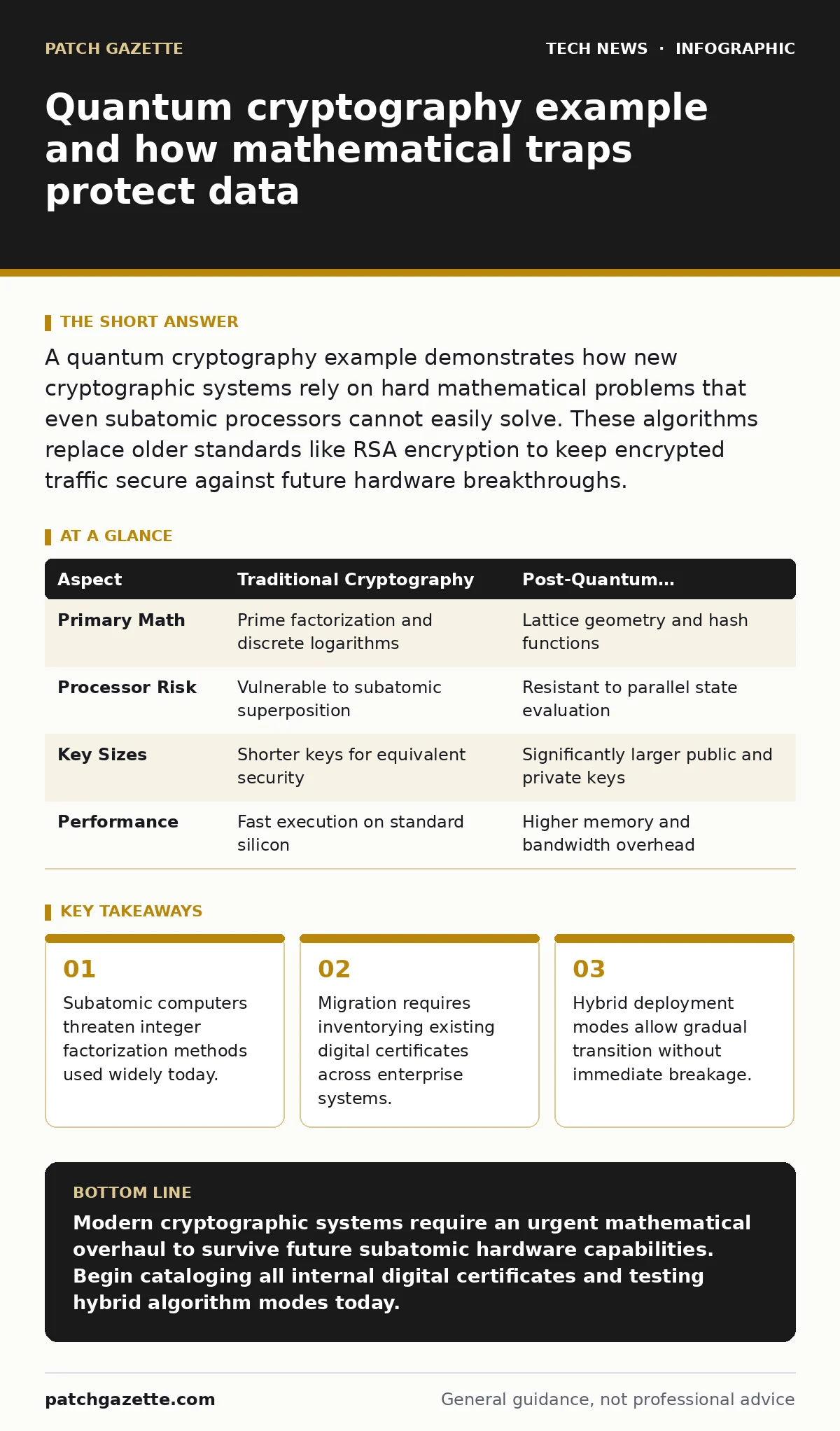
| Aspect | Traditional Cryptography | Post-Quantum Cryptography |
|---|---|---|
| Primary Math | Prime factorization and discrete logarithms | Lattice geometry and hash functions |
| Processor Risk | Vulnerable to subatomic superposition | Resistant to parallel state evaluation |
| Key Sizes | Shorter keys for equivalent security | Significantly larger public and private keys |
| Performance | Fast execution on standard silicon | Higher memory and bandwidth overhead |
A Concrete Quantum Cryptography Example in Practice
Practical implementations of post-quantum algorithms alter how servers and clients exchange initial connection parameters. Suppose a financial institution wants to secure customer sessions against future decryption by archived data harvesters. The server and client exchange public keys derived from multidimensional lattice geometry rather than standard prime number equations. Both endpoints compute the shared secret using the complex vector math, completing the handshake successfully.
Adversaries routinely capture encrypted network traffic today with the intent to decrypt it years later when better hardware becomes available. This harvest-now-decrypt-later strategy means sensitive data transmitted right now remains at risk even if current systems appear secure. Upgrading transport layer security protocols prevents historical surveillance from yielding intelligence once hardware capabilities advance.
Who Is Affected by the Coming Algorithmic Shift
Every organization relying on public-key infrastructure must eventually update its cryptographic inventory. Long-lived data assets such as government records, intellectual property, and medical histories face the highest exposure levels. Financial institutions and telecommunications providers also carry immense liability because their encrypted sessions protect critical societal infrastructure. Software vendors face monumental tasks rewriting libraries, updating firmware, and managing dependent software packages.
Embedded systems and Internet of Things devices experience severe operational friction due to resource constraints. New post-quantum algorithms demand larger public keys and more memory than older standards can support comfortably. Developers must optimize memory footprints without sacrificing cryptographic strength on constrained microcontrollers. Hardware security modules require physical replacements or firmware overhauls to process the new mathematical primitives efficiently.
See also: Should I enable DNSSEC on my domain for cryptographic validation?
What People Usually Get Wrong About Transitioning
Many engineers assume that simply doubling current key lengths neutralizes the subatomic threat completely. Doubling the size of a standard prime-based key offers negligible resistance against subatomic processors due to the underlying mechanics of search algorithms. True defense requires adopting entirely new mathematical families rather than merely scaling up legacy parameters.
Another common misconception involves waiting for international standardization bodies to finish every specification before taking action. Waiting for absolute finality leaves organizations with an unmanageable engineering crunch at the end of the decade. Proactive IT managers test preliminary algorithm implementations in non-production environments to identify performance bottlenecks early.
What to Do About the Impending Cryptographic Deadline
Building an effective migration strategy starts with discovering every instance of public-key cryptography active within your network environment. Cataloging algorithms, key lengths, and certificate expiration dates highlights hidden dependencies across legacy applications. Prioritize high-risk assets that require long-term confidentiality exceeding the anticipated timeline of hardware advancements.
Establish a vendor risk management framework to ensure third-party software and cloud services support upcoming standards. Test hybrid deployment modes where traditional and new algorithms operate simultaneously to maintain backward compatibility. Gradual deployment minimizes operational disruptions while building internal familiarity with larger key sizes and altered handshake timings.
Key takeaways
- Subatomic computers threaten integer factorization methods used widely today.
- Migration requires inventorying existing digital certificates across enterprise systems.
- Hybrid deployment modes allow gradual transition without immediate breakage.
Modern cryptographic systems require an urgent mathematical overhaul to survive future subatomic hardware capabilities. Begin cataloging all internal digital certificates and testing hybrid algorithm modes today.
Frequently asked questions
What makes post-quantum algorithms different from older encryption methods?
They rely on complex geometric lattices and hash functions instead of prime number factorization, resisting parallel processing threats.
Why do organizations capture encrypted traffic before new algorithms arrive?
Attackers store intercepted ciphertext today to decrypt it later once advanced computational hardware becomes widely available.
How do larger key sizes impact network performance?
Larger keys consume more memory, increase bandwidth overhead, and require hardware optimizations during connection handshakes.
Can a system use both traditional and new algorithms at the same time?
Hybrid deployment modes allow systems to combine old and new cryptographic methods for a smoother transitional phase.
How this guide was produced: written by the Patch Gazette editorial team with AI assistance, checked against the public references listed below, and reviewed when the facts change. See our editorial policy or report an error.