
Difference between cyber security and devops explained clearly
Cyber security guards static perimeters while devops engineering embeds controls directly into fast-moving software delivery pipelines.
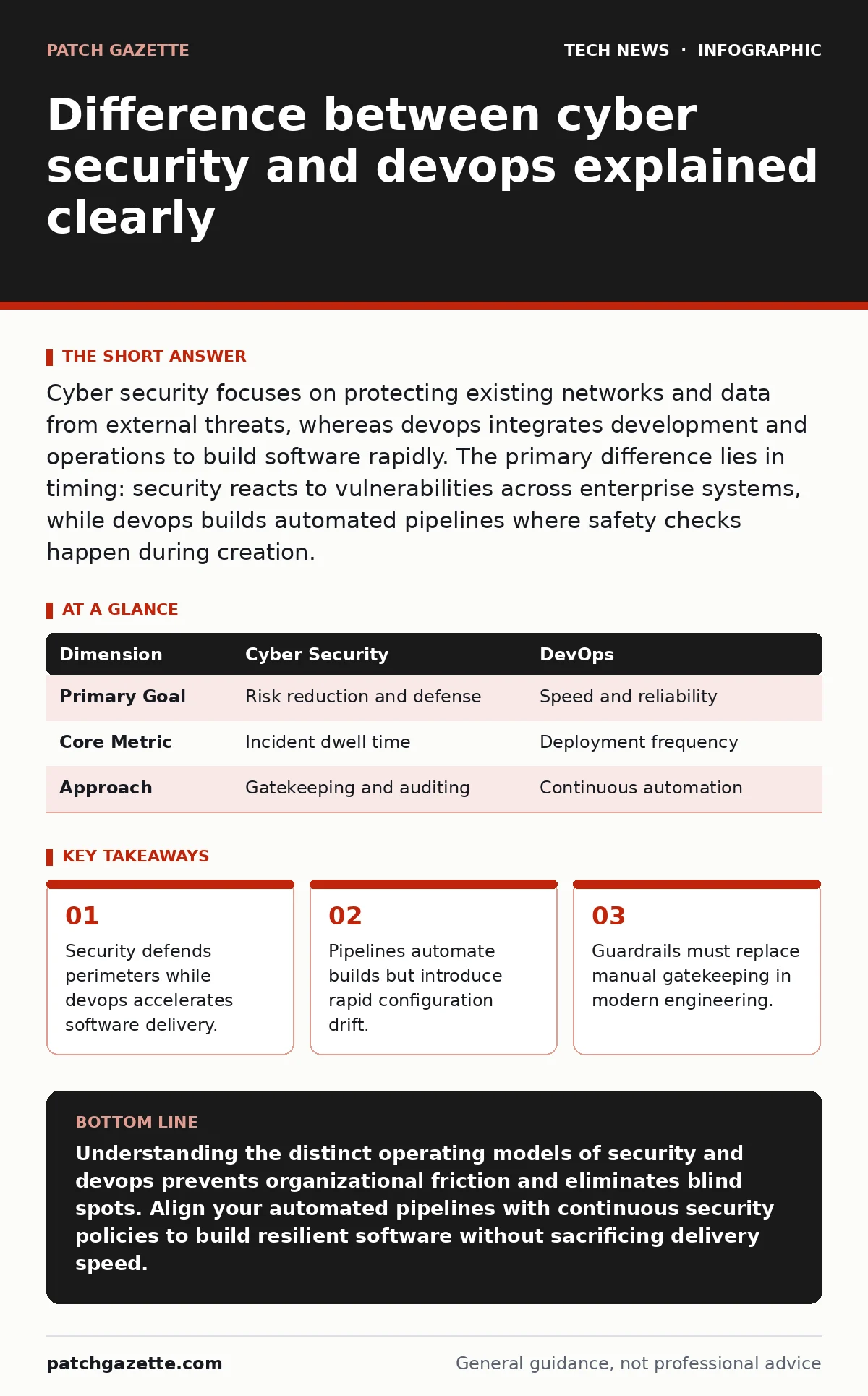
Cyber security focuses on protecting existing networks and data from external threats, whereas devops integrates development and operations to build software rapidly. The primary difference lies in timing: security reacts to vulnerabilities across enterprise systems, while devops builds automated pipelines where safety checks happen during creation.
Is there a fundamental difference between cyber security and devops?
Cyber security and devops represent two distinct organizational philosophies with diverging priorities, methods, and operational cadences. Security teams prioritize confidentiality, integrity, and availability of digital assets by enforcing strict boundaries and monitoring for malicious intrusions. Development and operations teams prioritize speed, feature velocity, and system reliability through continuous integration and automated deployment workflows.
What does cyber security protect that devops ignores?
Cyber security protects the broader enterprise environment, including end-user endpoints, legacy infrastructure, and administrative access controls that fall entirely outside application build pipelines. Protection mechanisms must address user behaviors, physical server locations, and network segmentation across corporate offices. Engineers working solely on application deployment pipelines rarely evaluate how third-party services interact with corporate identity providers or how employees secure their workstation environments against sophisticated phishing campaigns.
How does devops change the traditional perimeter model?
Devops dismantles the traditional network perimeter by treating infrastructure as transient code that deploys across multiple cloud regions within minutes. Traditional firewalls and perimeter defenses struggle to keep pace with microservices that spin up and terminate automatically based on traffic demand. Security practitioners must adapt by shifting their focus from static network boundaries to identity-based access controls and runtime application self-protection mechanisms.
Where do cyber security and devops overlap in practice?
Security and devops converge heavily when organizations implement automated vulnerability scanning inside continuous integration pipelines before code reaches production environments. Teams must secure underlying infrastructure components just as thoroughly as they protect web applications communicating through modern APIs. Developers write the deployment scripts, but security architects define the compliance policies that those scripts must automatically enforce without human intervention.
| Dimension | Cyber Security | DevOps |
|---|---|---|
| Primary Goal | Risk reduction and defense | Speed and reliability |
| Core Metric | Incident dwell time | Deployment frequency |
| Approach | Gatekeeping and auditing | Continuous automation |
Why do traditional security audits fail in fast deployment environments?
Traditional security audits fail because they rely on point-in-time assessments that become obsolete the moment developers push new code changes to production servers. Manual penetration testing schedules cannot match systems that deploy updates dozens of times per day. Organizations must replace manual sign-offs with automated test suites that validate security configurations continuously during every single build cycle.
See also: Quantum cryptography example and how mathematical traps protect data · Difference Between Domain Name System and Domain Name Server
How should you manage credentials across automated pipelines?
Pipeline credentials require dedicated vault systems that inject secrets dynamically at runtime rather than storing plain-text API tokens inside source code repositories. Developers often commit sensitive keys accidentally, creating massive exposures if unauthorized actors gain read access to the code management platform. Centralized secrets management tools ensure that credentials rotate frequently and leave comprehensive audit trails for every automated deployment.
What hidden costs emerge when merging these two disciplines?
Merging these disciplines introduces severe alert fatigue because automated scanners generate thousands of low-priority findings that overwhelm engineering teams who are already racing against tight product deadlines. Developers frequently bypass security controls when false positives block urgent bug fixes, creating shadow deployment pathways that lack any oversight. Training engineers to triage security alerts requires substantial time investments that slow down immediate feature delivery targets.
How do you measure success in a combined security and devops model?
Success requires tracking mean time to remediation for discovered vulnerabilities alongside traditional metrics like deployment frequency and change failure rates. Security posture improves when automated guardrails catch configuration errors before code reaches production, reducing the total volume of critical incidents requiring emergency response. Teams must balance speed metrics with compliance adherence to ensure that velocity never supersedes fundamental system safety. Proper management of open port management and strict adherence to secure cookies and sessions help maintain this balance across complex web environments.
Key takeaways
- Security defends perimeters while devops accelerates software delivery.
- Pipelines automate builds but introduce rapid configuration drift.
- Guardrails must replace manual gatekeeping in modern engineering.
Understanding the distinct operating models of security and devops prevents organizational friction and eliminates blind spots. Align your automated pipelines with continuous security policies to build resilient software without sacrificing delivery speed.
Frequently asked questions
Can a single engineer handle both security and devops responsibilities?
1 person can handle both domains only in very small organizations, but split focus usually leads to missed vulnerabilities or delayed software releases. Dedicated specialization becomes necessary as infrastructure scales.
Do automated security scanners replace human penetration testers entirely?
Automated tools catch known vulnerability patterns quickly, but human testers remain essential for discovering complex logical flaws and multi-step attack chains that scripts cannot anticipate.
What is shift-left security in a modern pipeline?
Shift-left security moves vulnerability testing and policy checks to the earliest possible stages of software development rather than waiting until final production deployment.
How do microservices complicate the difference between these fields?
Microservices multiply the number of network pathways and dependencies, requiring both automated deployment pipelines and continuous security monitoring to maintain visibility.
How this guide was produced: written by the Patch Gazette editorial team with AI assistance, checked against the public references listed below, and reviewed when the facts change. See our editorial policy or report an error.