
Difference Between Domain Name System and Domain Name Server
The Domain Name System is a global database protocol, while a domain name server is just one physical machine storing a tiny fraction of its records.
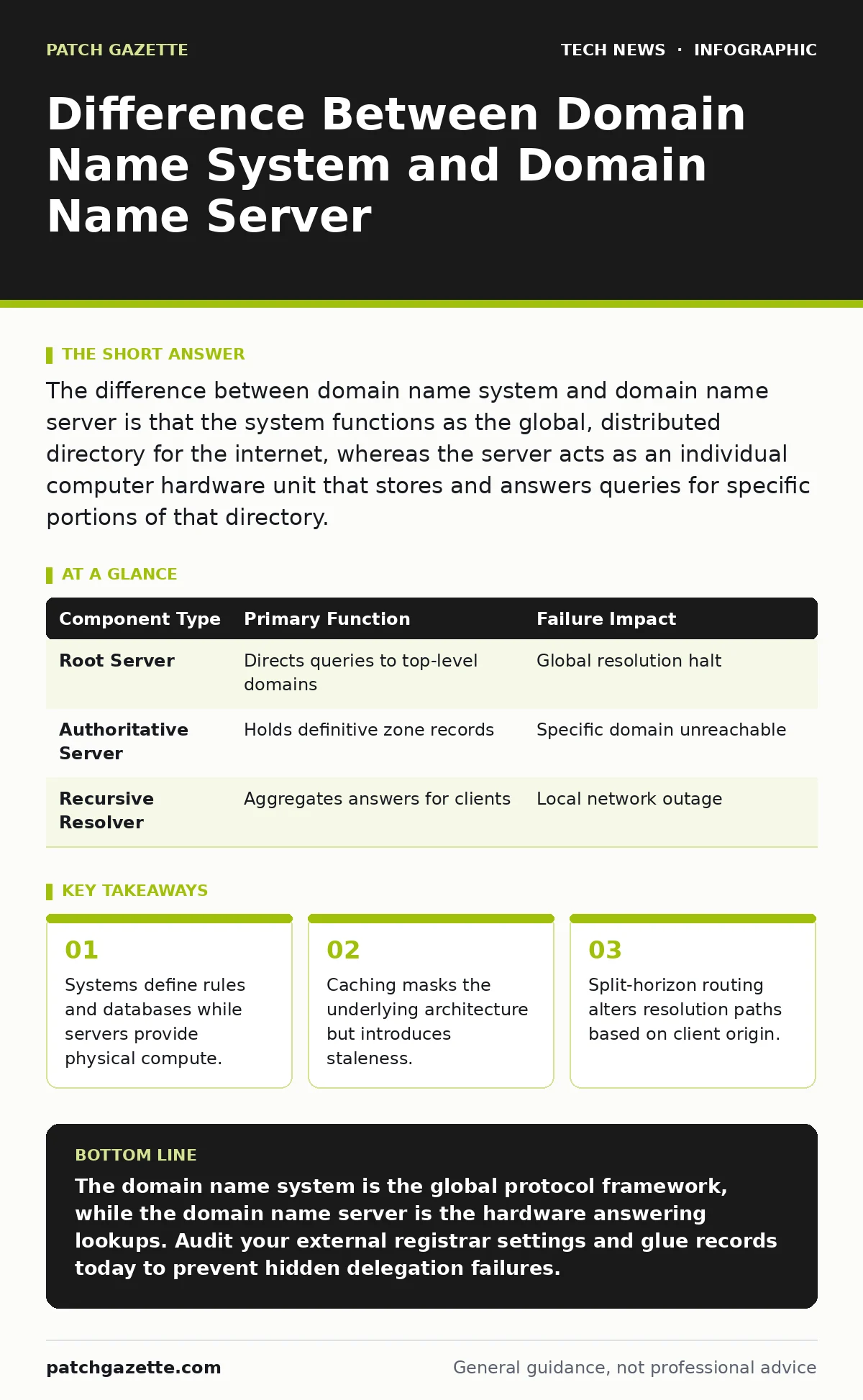
The difference between domain name system and domain name server is that the system functions as the global, distributed directory for the internet, whereas the server acts as an individual computer hardware unit that stores and answers queries for specific portions of that directory.
What is the difference between domain name system and domain name server?
The difference between domain name system and domain name server separates a global conceptual architecture from individual hardware components. You query the system whenever you load a web address, but your request actually hits a specific server. Systems provide the naming hierarchy and lookup rules. Servers execute those rules by holding zones of records and answering network packets.
Conflating these two concepts leads to flawed troubleshooting mental models during network outages. Treating a software protocol framework like a piece of rack-mounted hardware blinds you to routing logic failures. Imagine troubleshooting a global shipping network by inspecting only a single local post office box. You must distinguish between the abstract namespace and the concrete endpoints serving it.
How does the global namespace function without a single central database?
Global namespace operation relies on hierarchical delegation rather than central storage. Root servers point to top-level domain operators, who point to authoritative zones. This distributed tree structure prevents any single lookup point from becoming a massive bottleneck.
Decentralization brings hidden costs in the form of propagation delays when records change. Updating a record requires waiting for time-to-live expiration across millions of independent caches worldwide. You cannot instantly push a global address change without accounting for stale cached records lingering on third-party networks. This architectural reality impacts how you coordinate migrations with load balancers without dropping active user connections.
| Component Type | Primary Function | Failure Impact |
|---|---|---|
| Root Server | Directs queries to top-level domains | Global resolution halt |
| Authoritative Server | Holds definitive zone records | Specific domain unreachable |
| Recursive Resolver | Aggregates answers for clients | Local network outage |
Why do recursive resolvers create unexpected security boundaries?
Recursive resolvers act as middlemen that fetch records on behalf of client applications. These machines do not author records, but they cache answers to speed up subsequent requests for the same names. Public resolvers managed by third parties see every domain name your infrastructure queries, creating pervasive privacy leakage.
Privacy loss is just the beginning of the risks introduced by recursive intermediary caching. Attackers target resolvers to inject false records that redirect traffic toward malicious endpoints. Cache poisoning attacks exploit weak transaction IDs to spoof responses before legitimate authoritative servers reply. Securing these pathways requires deploying cryptographic validation standards like DNSSEC across your infrastructure.
What happens when split-horizon configurations alter name resolution?
Split-horizon configurations serve different answers to internal networks than to the public internet. Internal clients receive private IP addresses for corporate resources, while external users receive public routes. This mechanism keeps internal traffic routing local and improves performance for internal services.
Maintenance overhead multiplies rapidly once you introduce split-horizon views into your architecture. Debugging connectivity issues becomes frustrating because tests run from your administrative workstation might succeed while external clients fail. Engineers often forget that their local lookup path differs entirely from the path traversed by customers.
How does caching break administrative expectations during migrations?
Caching forces intermediary nodes to remember old zone data until specified time limits expire. Setting short time limits before a migration helps, but many third-party resolvers ignore low values entirely. You must plan for a transition window where old and new infrastructure simultaneously receive production traffic.
Failing to account for stubborn caches results in intermittent connection errors during cutovers. Users on one ISP reach the new server while users on another hit the decommissioned hardware. Teams handling DevOps security must coordinate record TTL reductions days in advance to minimize this synchronization gap.
See also: Should I enable DNSSEC on my domain for cryptographic validation? · Quantum cryptography example and how mathematical traps protect data
What causes glue records to break domain delegation chains?
Glue records are specialized address entries provided at parent zones to resolve circular dependencies. They prevent infinite loops that would otherwise occur when a domain's authoritative server relies on the domain itself for its name. Missing or outdated glue records instantly sever the delegation chain, rendering entire zones invisible to the internet.
Maintaining glue records requires manual updates at your registrar whenever name server IP addresses change. Automated internal deployment tools cannot fix broken glue records because parent zone operators must approve the changes. Forgetting this dependency leads to mysterious outages that standard internal diagnostic tools fail to identify.
Key takeaways
- Systems define rules and databases while servers provide physical compute.
- Caching masks the underlying architecture but introduces staleness.
- Split-horizon routing alters resolution paths based on client origin.
The domain name system is the global protocol framework, while the domain name server is the hardware answering lookups. Audit your external registrar settings and glue records today to prevent hidden delegation failures.
Frequently asked questions
Can a single machine act as both a recursive resolver and an authoritative server?
Combining these roles on one machine creates severe security risks, including amplification attacks and cache poisoning vulnerabilities, and must be strictly avoided in production.
Why do some network paths bypass local resolvers entirely?
Modern operating systems and applications frequently implement alternative lookup mechanisms that query public resolvers directly, bypassing corporate network policies and internal split-horizon views.
How do load balancing systems interact with name resolution?
Load balancers rely on short time-to-live settings and dynamic record rotation to distribute incoming client traffic across multiple physical data centers.
What prevents malicious actors from spoofing responses at the root server level?
Root servers utilize strict access controls, cryptographic signing, and globally distributed anycast routing to ensure their responses remain authentic and resilient against interception.
How this guide was produced: written by the Patch Gazette editorial team with AI assistance, checked against the public references listed below, and reviewed when the facts change. See our editorial policy or report an error.