
Telegram link and domain outages: how to maintain operational continuity
External messaging service outages disrupt internal operations when teams rely on third-party domains for primary coordination.
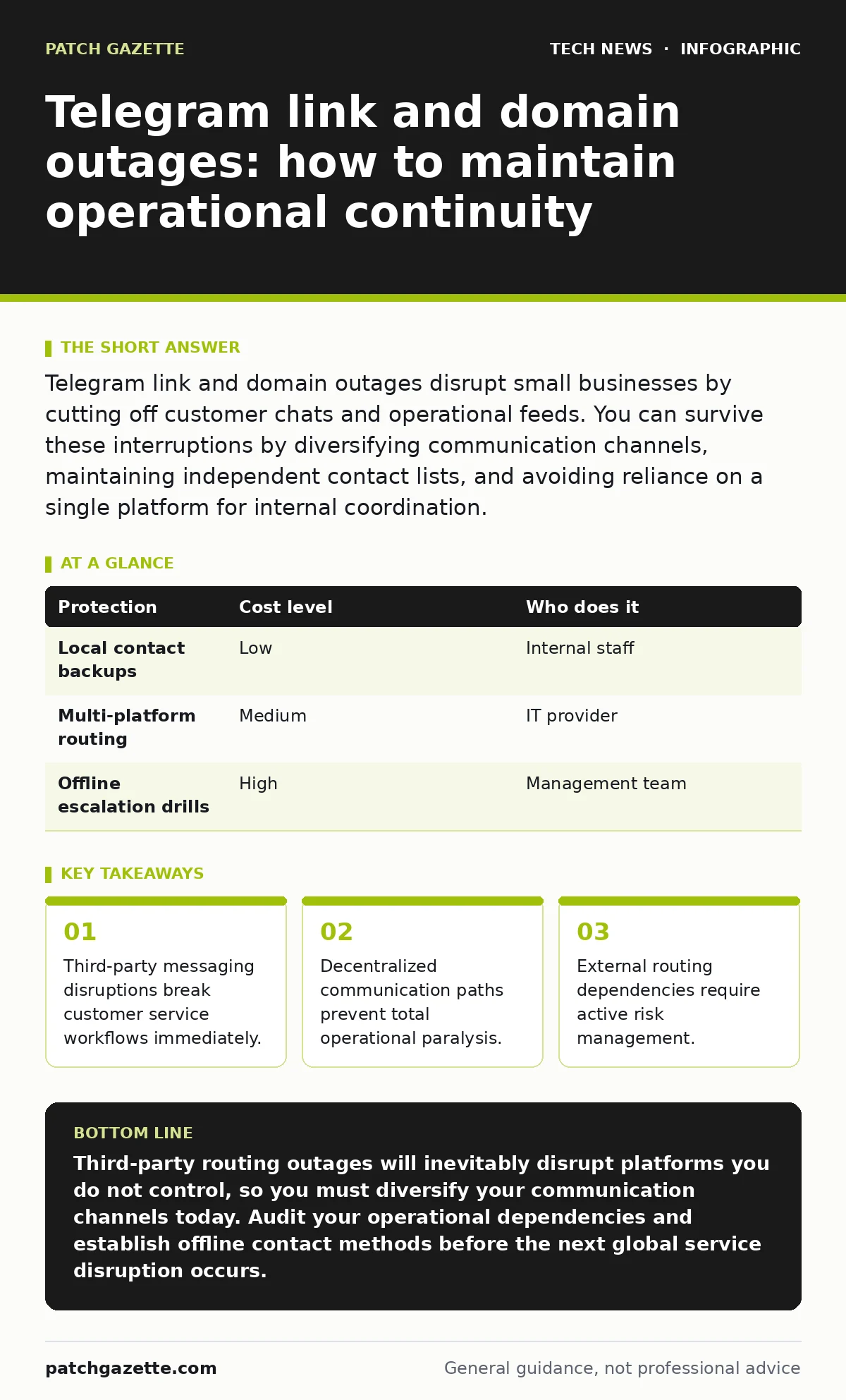
Telegram link and domain outages disrupt small businesses by cutting off customer chats and operational feeds. You can survive these interruptions by diversifying communication channels, maintaining independent contact lists, and avoiding reliance on a single platform for internal coordination.
Why Messaging Outages Impact Small Operations
Small businesses suffer disproportionately during platform outages because they lack redundant communication infrastructure. 3 separate vulnerabilities typically compound the failure: lost customer inquiries, blocked internal coordination, and missing offline contact records. When you tie your primary customer intake channel to a single proprietary service, any interruption at the provider level halts your revenue generation immediately.
Decentralized coordination models reduce this vulnerability by distributing conversations across open protocols and direct phone networks. 2 operational adjustments protect your team: maintaining local contact lists outside proprietary apps and establishing clear escalation procedures for service failures. Without these safeguards, your staff remains idle while waiting for external servers to recover.
How Routing Failures Cut Off Customer Access
Domain routing failures happen when the underlying address translation systems break down, making specific web links unreachable. 3 distinct layers of infrastructure can fail: the central registry, the authoritative name servers, or the local resolver cache managed by your internet service provider. You experience this as broken hyperlinks and spinning load screens when clicking on shared chat invites.
Proper management of the Domain Name System helps you understand how name resolution works, but external service outages bypass your local controls entirely. You cannot fix a broken routing path owned by a third-party provider. 3 mitigation tactics help: publishing static landing pages with alternative contact details, monitoring external status dashboards, and training staff to pivot quickly to email protocols.
What to Ask an IT Provider About Routing Resilience
IT providers must answer specific operational questions regarding third-party service dependencies and contingency planning. 4 precise inquiries reveal their preparedness:
- How do you monitor external dependencies that our daily workflows rely upon?
- What alternative communication paths do you provision for emergency scenarios?
- How frequently do you test offline fallback procedures with our staff?
- What Service Level Agreements cover third-party routing failures?
Vendor accountability begins with explicit contractual definitions regarding external disruptions. 2 distinct metrics matter: the maximum tolerable downtime for internal tools and the recovery time objective for secondary communication channels. Poorly defined provider scopes leave you stranded when proprietary messaging networks experience global routing collapses.
What Trade-Offs Exist in Multi-Platform Strategies
Multi-platform redundancy introduces administrative friction and security maintenance overhead that smaller teams struggle to absorb. 3 hidden costs emerge: increased licensing expenses, fragmented conversation histories, and higher cognitive load for employees juggling multiple interfaces. You trade simplicity for resilience when you force your workforce to monitor 3 different messaging applications simultaneously.
Security surfaces expand whenever you add secondary communication tools to your corporate environment. 2 distinct risks accompany extra platforms: unmonitored shadow IT usage and inconsistent data retention policies. You must balance the operational need for uptime against the administrative burden of securing multiple communication vectors against unauthorized access.
| Protection | Cost level | Who does it |
|---|---|---|
| Local contact backups | Low | Internal staff |
| Multi-platform routing | Medium | IT provider |
| Offline escalation drills | High | Management team |
Where Internet of Things Devices Compound Messaging Risks
Connected hardware adds unforeseen failure points when automated systems rely on cloud messaging platforms for alert notifications. 3 hardware categories frequently break during network splits: security cameras, environmental sensors, and automated point-of-sale terminals. You might lose visibility into physical office security if your monitoring equipment depends on the same routing paths as your staff chat channels.
Reviewing your Internet of Things deployment ensures that physical security devices maintain local alert mechanisms rather than depending entirely on external message brokers. 2 architectural rules prevent total visibility loss: implementing local network alarms and ensuring physical devices retain event logs on local storage media during cloud outages.
See also: What is blockchain security and how cryptographic ledgers fail · Difference between cyber security and devops explained clearly
How to Separate Internal Operations from Public Chats
Internal operations require isolated communication channels that function independently of public social networks and messaging platforms. 3 structural changes isolate your core business: deploying self-hosted chat servers, enforcing direct email policies for management decisions, and maintaining physical phone trees. You protect your daily productivity by treating public messaging apps as optional customer acquisition tools rather than core infrastructure.
Proper open port management ensures that your self-hosted internal communication tools remain accessible to authorized remote workers without exposing unnecessary attack surfaces to the public internet. 2 security baselines protect internal servers: restricting administrative access to vetted virtual private networks and disabling unencrypted service ports.
Key takeaways
- Third-party messaging disruptions break customer service workflows immediately.
- Decentralized communication paths prevent total operational paralysis.
- External routing dependencies require active risk management.
Third-party routing outages will inevitably disrupt platforms you do not control, so you must diversify your communication channels today. Audit your operational dependencies and establish offline contact methods before the next global service disruption occurs.
Frequently asked questions
Can my business prevent Telegram link and domain outages from affecting operations?
You cannot prevent external outages owned by third-party providers, but you can insulate your operations by diversifying communication channels and maintaining independent, offline customer contact lists.
What should employees do immediately when a messaging service goes down?
Employees should immediately switch to pre-established backup communication methods such as corporate email, direct phone calls, or secondary messaging tools. Staff must also notify customers of the alternative contact paths through static web channels.
How do domain routing failures actually break chat links?
Domain routing failures break chat links by preventing the translation of human-readable web addresses into machine-readable server numbers, causing browsers and apps to time out when attempting to load the destination.
Why do small businesses suffer more than large enterprises during platform outages?
Small businesses suffer more because they typically rely on single, centralized applications for all internal and external communication without maintaining redundant infrastructure or secondary staff coordination protocols.
How this guide was produced: written by the Patch Gazette editorial team with AI assistance, checked against the public references listed below, and reviewed when the facts change. See our editorial policy or report an error.