
How Gift Card Scams Work: The Step-by-Step Attack Chain
Attackers exploit corporate payment workflows and human psychology to convert digital codes into untraceable cash, bypassing traditional transaction monitoring.
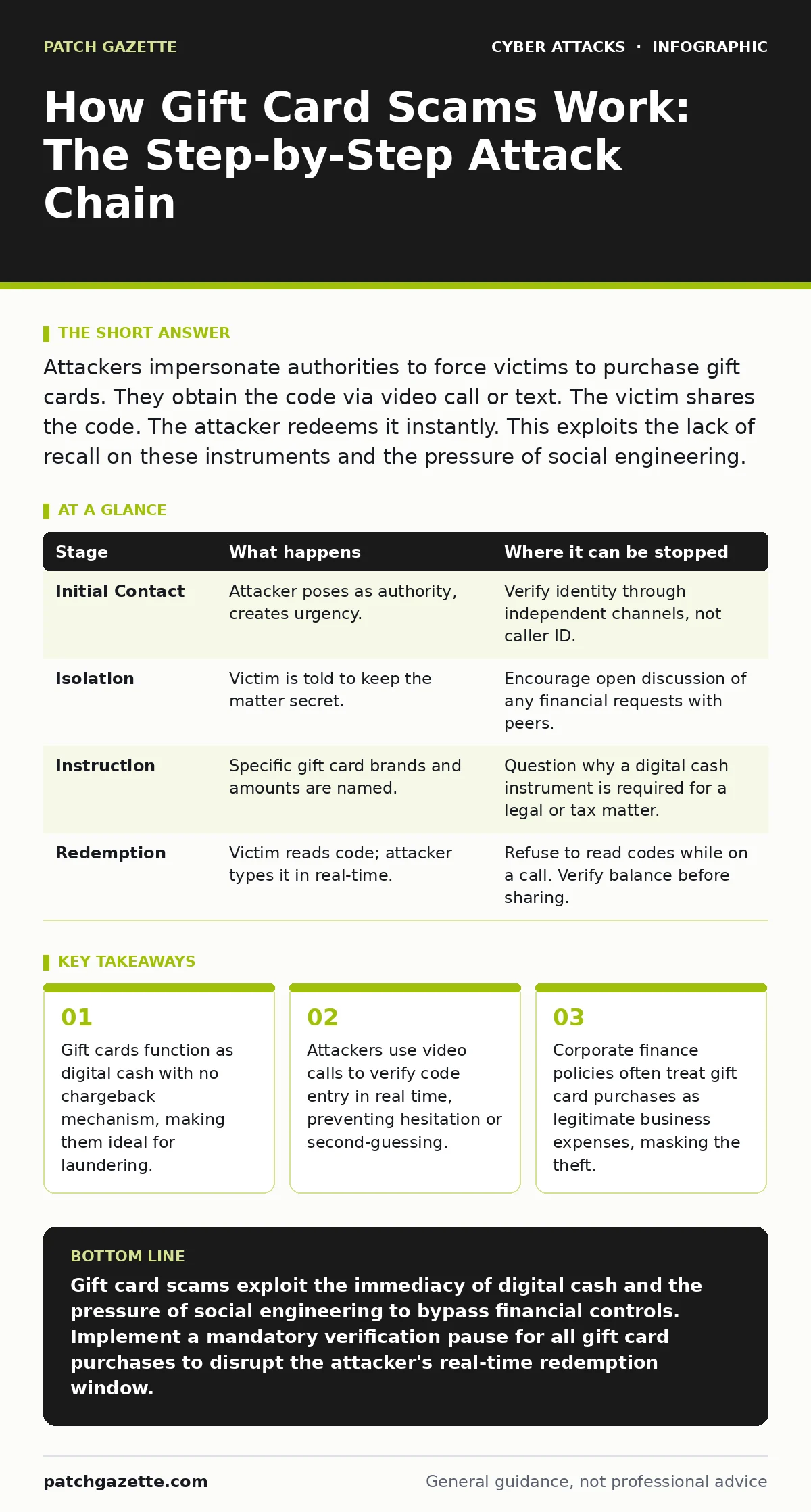
Attackers impersonate authorities to force victims to purchase gift cards. They obtain the code via video call or text. The victim shares the code. The attacker redeems it instantly. This exploits the lack of recall on these instruments and the pressure of social engineering.
The Psychology of Immediate Compliance
The attack begins long before the victim sees a gift card. The adversary selects a target who holds authority to make payments or who has access to corporate funds. They craft a scenario that demands immediate action to avoid severe consequences. This might involve impersonating the Internal Revenue Service, a law enforcement agency, or a senior executive.
The core mechanism here is urgency. By creating a time-sensitive crisis, the attacker short-circuits the victim’s critical thinking. The victim is not asked to think; they are instructed to act. This mirrors the pressure tactics seen in phishing campaigns, but with higher stakes and direct human interaction. The goal is to induce a state of hyper-arousal where the victim seeks to relieve anxiety by complying with the perceived authority.
Isolating the Victim
Once contact is established, the attacker works to isolate the target from their support network. They instruct the victim to keep the matter confidential, often citing legal privilege or internal investigations. This isolation is critical. If the victim speaks to an IT manager or a colleague, the illusion may break.
The attacker may ask the victim to join a secure video call or move to a private line. This serves two purposes. First, it prevents others from overhearing the instructions. Second, it allows the attacker to read the victim’s facial expressions and adjust their tone. If the victim hesitates, the attacker increases the pressure, citing warrants or imminent arrest. This social engineering layer is where the attack lives or dies.
The Pivot to Digital Currency
With the victim compliant and isolated, the attacker introduces the payment method. They do not ask for a bank transfer or a check. Those methods leave trails and can be reversed. Instead, they request gift cards. The choice of cards matters. The attacker prefers retailers with broad appeal and high liquidity.
The instruction is specific. The victim is told to go to a specific store or website. They are told to buy a specific amount. This specificity reduces the cognitive load on the victim. They are not choosing; they are executing. The attacker relies on the victim’s assumption that if the authority figure asked for this method, it must be the correct procedure for the specific crisis at hand.
Stage 1: Acquisition and Verification
The victim purchases the card. At this point, the card is a dormant piece of plastic or a digital string of characters. It has value, but that value is locked behind a PIN or a scratch-off layer. The attacker knows this. They do not want the card yet. They want the code.
The victim is instructed to stay on the line or keep the video call active. The attacker may ask the victim to read the code aloud. Alternatively, they may ask for a photo of the back of the card. This stage is where the theft technically occurs. The moment the code is revealed, the attacker can redeem it. The victim still holds the card, but it is now worthless.
| Stage | What happens | Where it can be stopped |
|---|---|---|
| Initial Contact | Attacker poses as authority, creates urgency. | Verify identity through independent channels, not caller ID. |
| Isolation | Victim is told to keep the matter secret. | Encourage open discussion of any financial requests with peers. |
| Instruction | Specific gift card brands and amounts are named. | Question why a digital cash instrument is required for a legal or tax matter. |
| Redemption | Victim reads code; attacker types it in real-time. | Refuse to read codes while on a call. Verify balance before sharing. |
The Real-Time Redemption
This is the most dangerous aspect of modern gift card scams. The attacker does not wait for the victim to hang up. They have the retailer’s website open on their own screen. As the victim reads the code, the attacker types it in.
If the victim pauses, the attacker may type the first part of the code. If the victim reads the PIN, the attacker enters it. The transaction completes in seconds. The attacker confirms the redemption by checking their own account balance. Only then do they instruct the victim to hang up or tear up the card. The victim believes they have completed a difficult task. The attacker now holds the value.
Exploiting Corporate Finance Controls
In a corporate setting, the attack often targets the procurement or finance team. The attacker may send a spoofed email from the CEO requesting urgent gift cards for "client gifts" or "bonuses." This is a form of Business Email Compromise.
Finance departments often have pre-approved limits for such purchases. If the request falls within those limits, it may be processed automatically. The use of gift cards allows the attacker to bypass conditional access policies that might block unusual bank transfers. A gift card purchase looks like a standard retail transaction. It does not trigger the same alerts as a wire transfer to a foreign account. This camouflage is a significant vulnerability in many organizations.
See also: Detect API Abuse: Log Patterns, Blind Spots, and Detection Tactics · Dumpster Diving Response: Secure Physical Data and Stop Identity Theft
The Aftermath and Laundering
Once redeemed, the gift card value is converted to cash or other goods. The attacker may use the balance to buy high-value electronics, which are then resold. Or they may use the card to purchase cryptocurrency, further obscuring the trail.
Gift cards are difficult to trace once redeemed. Retailers do not typically flag individual redemptions unless a pattern emerges. By the time the victim realizes the fraud, the attacker has moved the value through multiple layers. The lack of a chargeback mechanism means the victim cannot reverse the transaction. The loss is final.
Interrupting the Chain
You can stop this attack at multiple points. The most effective intervention is at the stage of isolation. If your organization has a policy that no financial request is ever confidential, the attacker loses their leverage.
Training should focus on the mechanism of the scam, not just the warning. Employees need to understand that legitimate authorities do not demand payment in gift cards. They need to know that video calls are used to verify codes in real time. This specific knowledge changes the behavior. Instead of just being "careful," the employee actively refuses to read codes while on a call.
Consider how this intersects with other threats. Just as QR code phishing uses visual cues to bypass suspicion, gift card scams use the visual authority of a corporate logo or a government seal. The medium changes, but the psychological exploit remains the same.
Building Structural Defenses
Technical controls can also help. Monitor for large purchases of gift cards, especially from accounts that do not typically make such purchases. Set up alerts for transactions that exceed a certain threshold.
Implement a verification step for any gift card purchase over a minimal amount. Require a second sign-off from a manager who is not the requestor. This adds friction to the process. Friction is your friend in security. It gives the victim time to think and consult.
Remember that this is not just a social engineering problem. It is a workflow problem. If your payment processes allow for quick, unchallenged purchases of digital cash, you are vulnerable. Review your procurement policies. Ensure they account for this specific vector. The goal is not to stop all gift card purchases, but to stop the fraudulent ones by introducing verification steps that the attacker cannot bypass.
Key takeaways
- Gift cards function as digital cash with no chargeback mechanism, making them ideal for laundering.
- Attackers use video calls to verify code entry in real time, preventing hesitation or second-guessing.
- Corporate finance policies often treat gift card purchases as legitimate business expenses, masking the theft.
Gift card scams exploit the immediacy of digital cash and the pressure of social engineering to bypass financial controls. Implement a mandatory verification pause for all gift card purchases to disrupt the attacker's real-time redemption window.
Frequently asked questions
Can I track a gift card after the code is shared?
No. Once the code is redeemed by the attacker, the transaction is complete. Retailers treat it as a legitimate purchase and cannot reverse it or trace the subsequent use of the funds.
Why do attackers prefer gift cards over bank transfers?
Gift cards are irreversible and untraceable once redeemed. Bank transfers can often be frozen or reversed, and they leave a clear digital trail that law enforcement can follow. Gift cards act as anonymous cash.
Does using a corporate credit card protect me?
Not entirely. While you can dispute a fraudulent charge on a credit card, the process is slow and often unsuccessful if the merchant validates the code. The attacker redeems the card instantly, so the dispute happens after the value is gone.
How do I verify if a call from my CEO is legitimate?
Hang up and call the CEO using a number you already have in your address book, not one provided by the caller. Do not use the "Call Back" feature on your phone, as this may return you to the attacker.
How this guide was produced: written by the Patch Gazette editorial team with AI assistance, checked against the public references listed below, and reviewed when the facts change. See our editorial policy or report an error.