Detect API Abuse: Log Patterns, Blind Spots, and Detection Tactics
API abuse hides in plain sight within normal traffic patterns, requiring behavioral analysis rather than signature matching to uncover slow-drip data theft.
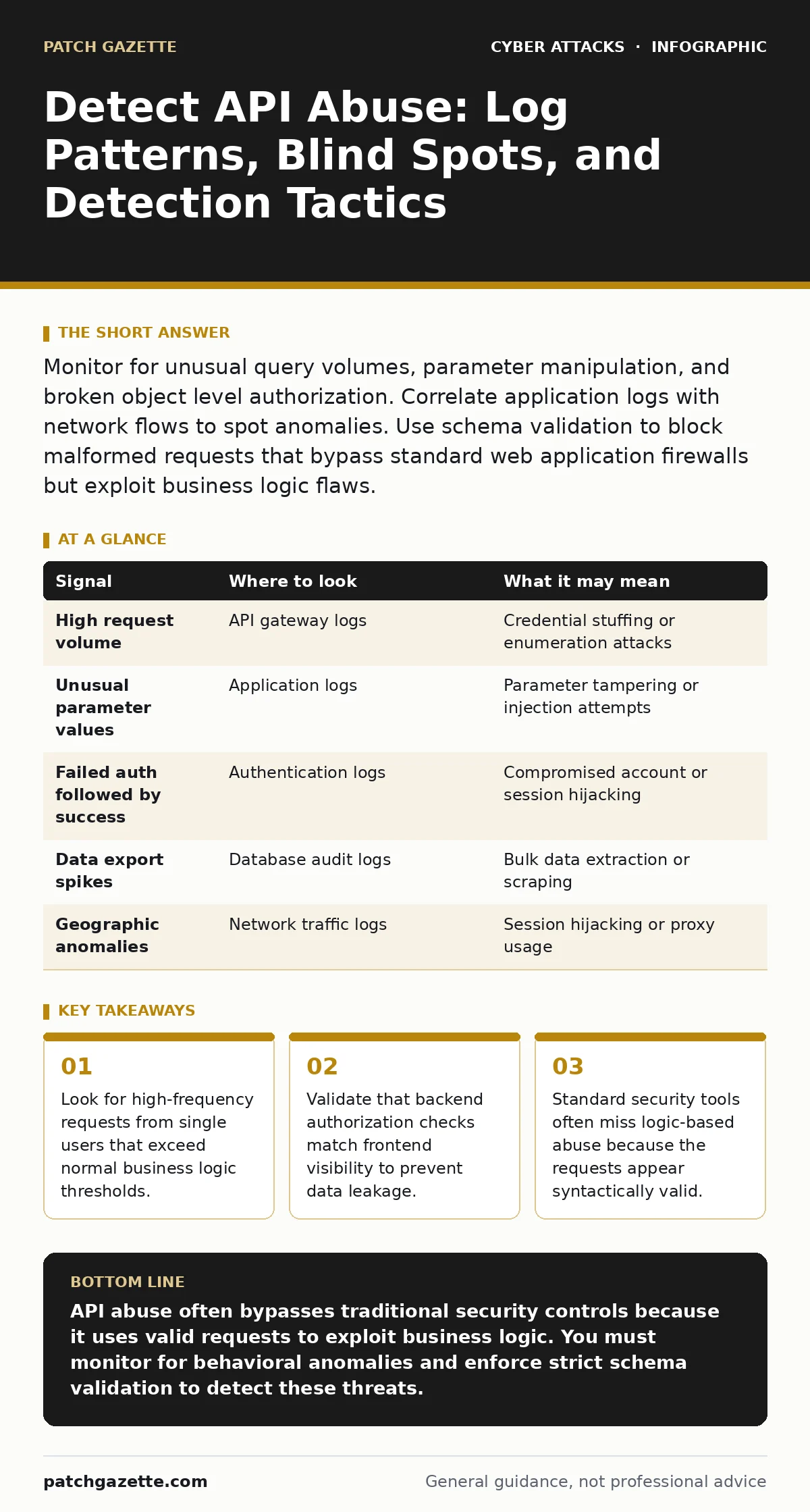
Monitor for unusual query volumes, parameter manipulation, and broken object level authorization. Correlate application logs with network flows to spot anomalies. Use schema validation to block malformed requests that bypass standard web application firewalls but exploit business logic flaws.
The Illusion of Valid Traffic
Application programming interfaces (APIs) function as the digital plumbing between services. They allow different software components to exchange data without human intervention. Attackers exploit this by sending requests that are technically valid but logically abusive. A standard web application firewall (WAF) inspects the structure of a request. It checks for known attack patterns like SQL injection. It does not always check if the request makes sense in the context of the user's permissions.
Imagine a user requesting their own bank statement. The API returns the data. Now imagine that same user changing one number in the request to retrieve another user's statement. The API accepts the request because the format is correct. This is broken object level authorization, or BOLA. Detecting this requires looking at behavior, not just syntax.
Signal Correlation Table
| Signal | Where to look | What it may mean |
|---|---|---|
| High request volume | API gateway logs | Credential stuffing or enumeration attacks |
| Unusual parameter values | Application logs | Parameter tampering or injection attempts |
| Failed auth followed by success | Authentication logs | Compromised account or session hijacking |
| Data export spikes | Database audit logs | Bulk data extraction or scraping |
| Geographic anomalies | Network traffic logs | Session hijacking or proxy usage |
Behavioral Anomalies in Logs
You must establish a baseline for normal API usage. Most users follow predictable patterns. They access specific endpoints at regular intervals. Deviations from this baseline often indicate abuse. Look for users who access endpoints they never touched before. Check for requests that occur at odd hours or in rapid succession.
Rate limiting is a common defense. Attackers know this and may slow their requests to stay under the threshold. This is called low-and-slow abuse. You must detect this by analyzing trends over time, not just instantaneous spikes. If a user suddenly downloads five times more data than usual, even if they stay under the rate limit, it is a red flag.
Schema and Payload Inspection
APIs often accept structured data formats like JSON or XML. Attackers may send payloads that are technically valid but contain unexpected fields. For example, an API might expect a user ID. An attacker might add a field that requests additional data. If the backend processes this extra field without validation, it can leak sensitive information.
You should validate every request against a strict schema. This schema defines exactly what fields are allowed and what data types they must contain. Reject any request that contains unknown fields. This prevents attackers from injecting malicious parameters that your application might inadvertently process.
The Blind Spot of Logic Flows
Many security tools focus on perimeter defense. They inspect incoming traffic for known threats. They do not understand the business logic of your application. This creates a blind spot. An attacker can send a perfectly formatted request that your firewall allows. However, the request might trigger a business rule that causes unintended consequences.
For example, an API might allow users to update their profile. An attacker might change a field that influences pricing. The request is valid. The firewall allows it. The business logic executes it. The result is financial loss. You must test your APIs for logic flaws, not just syntax errors. This requires manual review and automated testing that understands your business rules.
See also: How Gift Card Scams Work: The Step-by-Step Attack Chain · Phishing Explained: How Attackers Steal Trust and Data
Tooling and Automation
You need tools that can analyze API traffic in real-time. Traditional intrusion detection systems are not enough. You need API-specific monitoring solutions. These tools can track endpoint usage, monitor for anomalies, and enforce rate limiting. They can also correlate logs from different sources.
Integrate your API monitoring with your security information and event management (SIEM) system. This allows you to create alerts based on complex behaviors. For example, you can alert if a user accesses a sensitive endpoint and then immediately exports data. This correlation helps you spot abuse that no single tool would catch.
Common Detection Pitfalls
One common pitfall is ignoring internal APIs. Attackers often pivot to internal services after gaining initial access. These internal APIs may have weaker security controls. They may not be monitored as closely. You must apply the same detection strategies to internal APIs as you do to external ones.
Another pitfall is over-reliance on authentication. You might assume that if a user is authenticated, they are safe. This is not true. An authenticated user can still abuse the API. They can scrape data, overload services, or manipulate business logic. You must enforce authorization checks on every request, regardless of authentication status.
Continuous Improvement
API abuse techniques evolve. Attackers adapt to your defenses. You must continuously update your detection rules. Review your logs regularly. Look for new patterns of abuse. Update your schemas and validation rules. Test your APIs for new vulnerabilities.
Collaborate with your development team. Security is not just the responsibility of the security team. Developers must build security into their APIs from the start. They must understand the risks of API abuse. They must implement proper validation and authorization checks. This shared responsibility model reduces the attack surface.
Integration with Access Controls
Your API detection strategy must work with your access control policies. If a user tries to access a resource they are not authorized to see, the API should reject the request. It should also log the attempt. This log entry is critical for detection.
You should use conditional access policies to enforce strict rules. For example, you might require additional verification for sensitive API calls. This adds a layer of security that makes abuse more difficult. It also provides more data for your detection systems.
Key takeaways
- Look for high-frequency requests from single users that exceed normal business logic thresholds.
- Validate that backend authorization checks match frontend visibility to prevent data leakage.
- Standard security tools often miss logic-based abuse because the requests appear syntactically valid.
API abuse often bypasses traditional security controls because it uses valid requests to exploit business logic. You must monitor for behavioral anomalies and enforce strict schema validation to detect these threats.
Frequently asked questions
How do I distinguish between a power user and an attacker?
Power users follow consistent patterns within business logic. Attackers often exhibit erratic behavior, such as accessing unrelated endpoints in rapid succession or manipulating parameters to gain unauthorized access. Analyze the intent behind the requests, not just the volume.
What is the most common type of API abuse?
Broken object level authorization is one of the most common types. Attackers manipulate object IDs in API requests to access resources they should not see. This is often due to insufficient server-side validation of user permissions.
Can API gateways prevent all abuse?
No, API gateways can help by enforcing rate limiting and basic authentication. However, they cannot understand complex business logic. Attackers can still exploit logic flaws or abuse valid requests within the allowed limits. You need additional monitoring and validation.
How often should I review my API logs?
You should review your API logs regularly, ideally in real-time or near real-time. Automated monitoring tools can alert you to suspicious activity immediately. Regular manual reviews help you refine your detection rules and identify new patterns of abuse.
How this guide was produced: written by the Patch Gazette editorial team with AI assistance, checked against the public references listed below, and reviewed when the facts change. See our editorial policy or report an error.